
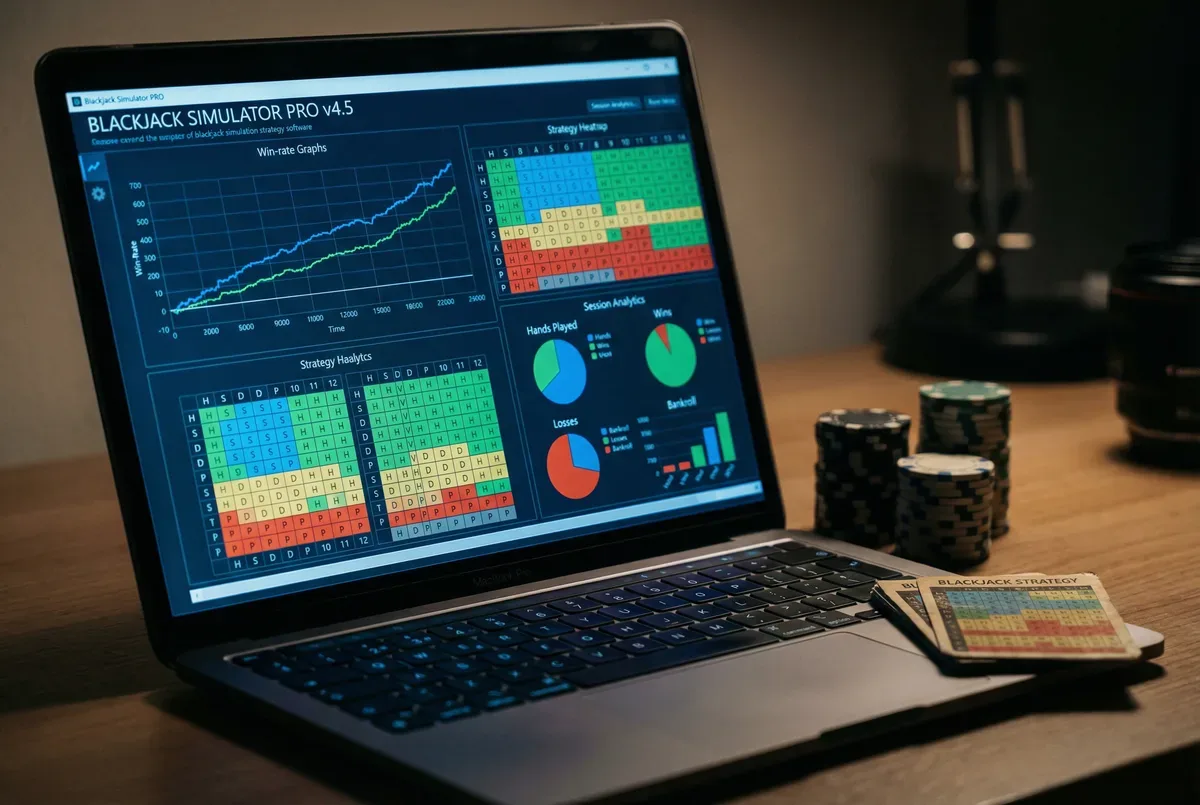
How Professional Players Use Simulation Tools to Stay Sharp
- Professional Players Use Simulation Tools the Way Athletes Use Film Study
- Why Does the Five Simulation Use Case Every Serious Player Should Run Regularly?
- How Does Bankroll Simulation The Use Case Most Players Underestimate?
- How Do You Interpret Simulation Results and Adjusting Your Strategy?
- The Simulation Environment That Bridges Practice and Live Play
A professional blackjack player does not maintain their edge by playing more live hands. Live sessions are high-cost practice environments: every hand deals real variance, real financial exposure, and real casino scrutiny. Simulation tools serve the preparation function that live play cannot they allow unlimited practice repetitions, scenario-specific drilling, and variance modeling without any of the associated financial or strategic cost. The relationship between simulation tools and live play for a professional is similar to the relationship between film study and game performance for an athlete. You do not improve your technique during the competition you improve it in controlled practice, then deploy it under pressure. Simulation is the controlled practice layer of professional blackjack.
Professional Players Use Simulation Tools the Way Athletes Use Film Study
Timeline
Strategy accuracy drill
Targeted sessions on error-prone hand categories to maintain sub-2% error rate
Count accuracy session
Maintain running count through rapid shoe simulation, checking accuracy under speed
Deviation practice
Drill known counting deviations (Illustrious 18) in high/low count scenarios
Bankroll scenario modeling
Run 1,000-session simulations to verify bankroll adequacy for planned bet levels
Pre-trip rule analysis
Model expected value under specific casino rule sets before traveling
Why Does the Five Simulation Use Case Every Serious Player Should Run Regularly?
The first use case is strategy maintenance. Basic strategy accuracy degrades without practice particularly on edge cases, soft total decisions, and multi-card split situations. A monthly session of 300 targeted hands across all hand categories keeps accuracy at the professional standard. Error logs from these maintenance sessions often reveal that certain hands have drifted back toward incorrect defaults, especially if the player has recently been playing under a different rule set.
Top professionals use a blackjack simulator to stress-test every edge-case decision before sitting down at a real table.
The second use case is counting accuracy calibration. Card counters must maintain their running count through realistic shoe conditions not just deal-yourself-slowly practice. Simulation tools that deal at casino speed with distracting visual elements stress-test the counting habit. Accuracy at slow practice speed versus accuracy at casino dealing speed are two different numbers for most counters, and the gap between them requires specific simulation drills that deliberately match real-deal velocity.
The third use case is deviation drilling. The Illustrious 18 the 18 most valuable blackjack basic strategy deviations based on count represent the highest-priority memorization for any serious counter. Simulation tools that present hands in count context and require the correct deviation (not the blackjack basic strategy default) verify that the deviation knowledge is automatic, not effortful. An effortful deviation burns cognitive bandwidth that should be available for maintaining the count.
Illustrious 18 deviations
high-value
EV gain from I18
%% player edge
Count accuracy target
per shoe
How Does Bankroll Simulation The Use Case Most Players Underestimate?
Multi-session bankroll simulation is the most analytically powerful use of simulation tools and the one most players skip entirely. Running 1,000 simulated sessions under specified conditions rule set, bet spread, player edge, session length generates an outcome distribution that tells you the realistic range of financial outcomes from your planned play strategy. The 10th percentile outcome is your downside scenario: how bad can it get while still being within statistical expectation? The 90th percentile is your upside scenario. The median is your most likely result. This distribution is the only rational basis for setting a bankroll figure and bet sizing.
Every professional I know who has sustained long-term advantage play has run bankroll simulations before each significant betting level increase. The players who blow up who hit a bad variance stretch and can't absorb it are almost always the ones who sized their bankroll by intuition instead of simulation data. A simulation run takes 10 minutes. A blown bankroll takes months to rebuild.
How Do You Interpret Simulation Results and Adjusting Your Strategy?
Consistent practice with simulation tools compounds over time. The player who runs 1,000 sessions in simulation before sitting at a real table arrives with calibrated expectations, a tested bankroll plan, and the pattern recognition that only repetition can build. Preparation is the edge that shows up when it counts.
The Simulation Environment That Bridges Practice and Live Play
Our apply this at a live professional table immediately environment serves the final simulation tier: realistic dealing pace and interface under zero financial risk. This is where counting and strategy practice converges before real-money sessions. But recognize the boundary clearly live simulations with no stakes do not replicate the cognitive pressure of real money play. When you move to live sessions with real financial exposure, variance becomes weight that no simulation fully prepares you for. Start at the minimum bet level and scale only after verifying consistent performance over a meaningful sample.
Frequently Asked Questions
Monthly maintenance sessions are the minimum for active players typically 300 targeted hands on weak categories and one full counting calibration session. Players returning from an extended break should run a complete strategy and count verification before any live sessions.
It shows the statistical distribution of outcomes across hundreds or thousands of simulated sessions under your specified conditions. The output tells you the probability of ruin at various bankroll levels, the expected win rate, and the realistic downside range essential data for bet sizing decisions.
High-quality simulation tools can replicate dealing speed, distracting visual elements, and count verification challenges. What they cannot replicate is the social and sensory casino environment, pit scrutiny, and the emotional weight of real stakes all of which affect counting performance in live conditions.
Simulation Precision Does Not Guarantee Live Performance
Even a perfectly calibrated simulation practice routine produces players who perform differently under live-money conditions. Variance, psychology, and casino environment all affect real performance. Never overcommit financially based on simulation results alone.
Blackjack Academy provides educational content only. Professional blackjack involves real financial risk and variance that cannot be fully modeled. Always play within your verified risk tolerance.

Written by
Mark AnurakProfessional card counter since 2009 · 500,000+ hands logged · Former Macau advantage player. Studied under Thorp, Griffin & Wong methodology. Full bio →
Learn More
Continue your education with these related lessons.

How Advantage Players Track Their Results
Results tracking for advantage players: session log structure, separating skill from variance, the 95% confidence interval calculation, and how many…

Master the Art of Table Selection for Maximum Advantage Play Edge
Table selection as a professional skill: S17 vs H17 value, deck penetration scouting, how to leave a table without drama,…
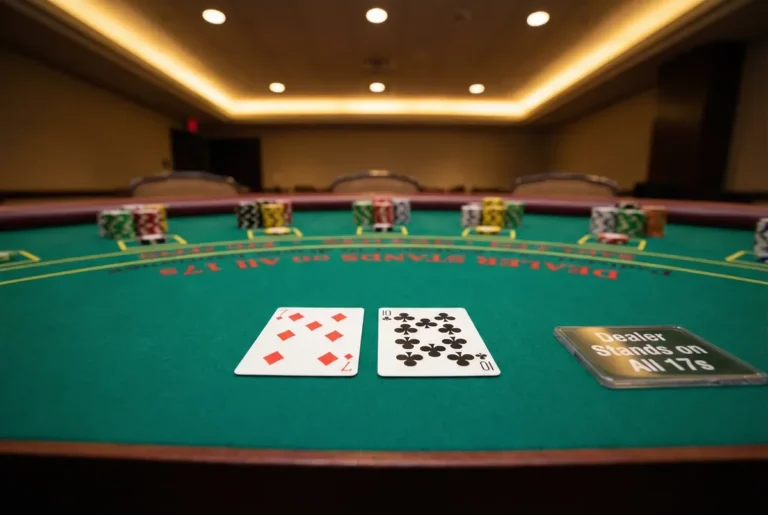
How Stand on 17 Decreases the Casino House Edge
The difference between a dealer standing on all 17s versus hitting soft 17 is worth 0.22% to the house. That…