
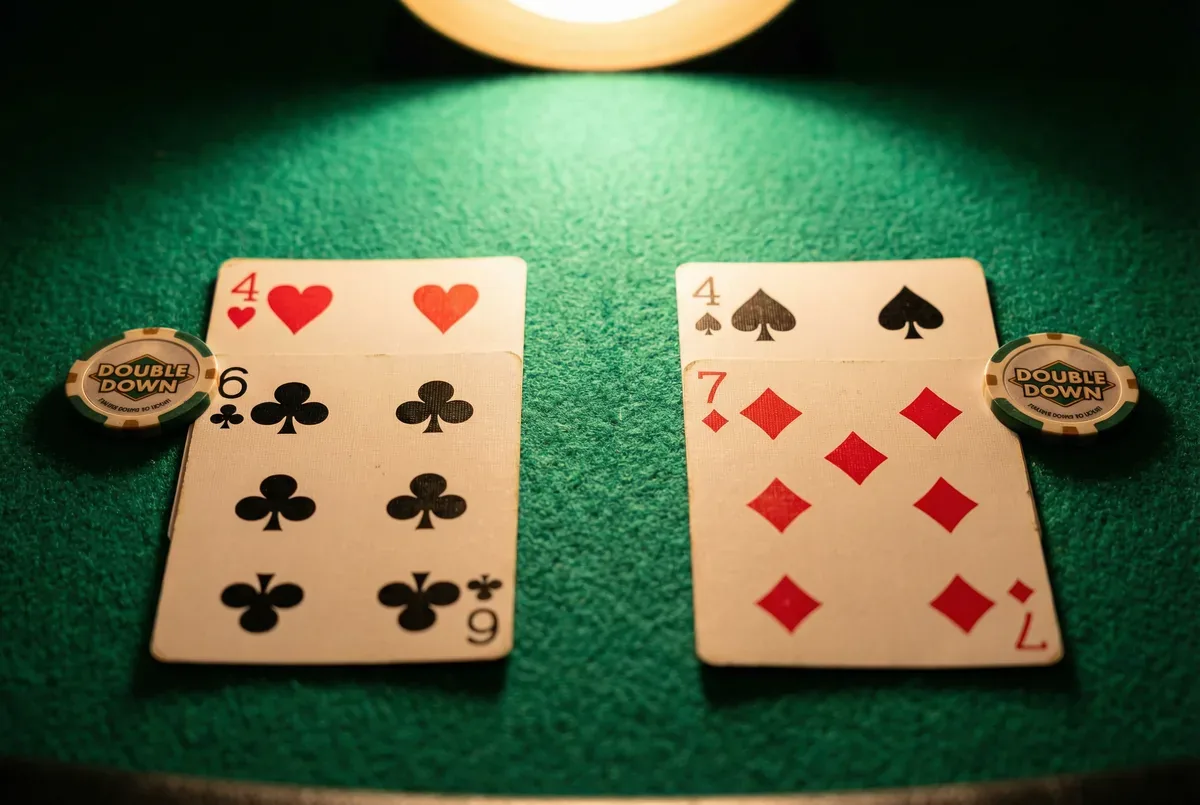
When Double After Split Makes Splitting 4s Profitable
A pair of 4s totals 8 a reasonable starting hand that hits comfortably toward a strong total. Splitting that 8 into two separate 4s seems aggressive because each new hand starts weak, requiring multiple draws. But when the dealer shows a 5 or 6 the two most bust-prone up-cards in the deck and the table offers double after split, splitting 4s becomes mathematically correct. The reason is that each 4 can hit a drawing card of 5, 6, or 7 to create a 9, 10, or 11, and those totals become double-down opportunities against the dealer’s fragile position. Without DAS, you can’t capitalize on that potential, and splitting 4s is always wrong. With DAS, the option to double the new hands is what tips the math.
Splitting 4s Is Only Correct When DAS Is Allowed and the Dealer Shows 5 or 6
Dealer Shows
Your Hand
DAS is NOT available at this table. You hold 4-4 vs dealer 6. What is the correct play?
With DAS available: split 4-4 vs 6. Without DAS: hit. The DAS rule is the only variable that changes this decision. Understanding this boundary is the entire lesson of this post.
Why the Dealer 5 and 6 Are the Only Valid Split Targets?
The logic of splitting 4s with DAS depends entirely on two conditions being simultaneously true: the dealer has a 5 or 6 up-card, and you have the ability to double any single card you draw to each split hand. Against dealer 5, the dealer busts approximately 42% of the time. Against dealer 6, the bust rate climbs to roughly 44%. These bust frequencies create enough space for the player to extract value from aggressive action including splitting a mediocre starting hand and doubling any strong draws.
Against any other dealer up-card 2, 3, 4, 7, 8, 9, 10, or Ace splitting 4s with DAS remains incorrect. The dealer is not bust-prone enough against those cards for the splitting strategy to produce positive EV. Against a dealer 7 or higher, splitting creates two weak starting hands against a strong dealer position. The DAS option adds value only when you expect both to double frequently AND the dealer is likely to bust. Both conditions converge only at dealer 5 and dealer 6.
The practical implication is that DAS games require a modified blackjack basic blackjack strategy chart. Players using a standard no-DAS chart in a DAS game will miss this split opportunity against dealer 5 and 6. The missed splits are not catastrophically expensive per hand, but they add up across many hours of play and represent a category of EV that’s straightforward to capture once you know it exists.
| Dealer Up-Card | Hit 8 EV | Split 4s EV |
|---|---|---|
| Dealer 2 | ||
| +0.06 | ||
| +0.02 | ||
| Dealer 3 | ||
| +0.08 | ||
| +0.04 | ||
| Dealer 4 | ||
| +0.12 | ||
| +0.10 | ||
| Dealer 5 | ||
| +0.14 | ||
| +0.18 | ||
| Dealer 6 | ||
| +0.16 | ||
| +0.20 | ||
| Dealer 7 | ||
| +0.03 | ||
| -0.08 |
How DAS Changes the Broader Splitting Strategy?
Splitting 4s with DAS is the most dramatic example of how the double-after-split rule reshapes an entire blackjack strategy chart. The same logic applies, with varying magnitude, and to pairs of 2s and 3s. In no-DAS games, 2s and 3s are split only against dealer 4 through 7. In DAS games, 2s split against 2 through 7 and 3s split against 2 through 7. The expansion happens because DAS creates potential doubling outcomes on the resulting hands that don’t exist without the rule. Each pair becomes a more aggressive split because the payoff from drawing a strong card is larger.
Always know whether DAS is available before sitting down. It changes strategy on at least three pair types 2s, 3s, and 4s. If you're using a printed strategy card, make sure it's labeled for your specific rule set. Using the wrong chart costs you real money.
What Are the Practical Bet Sizing When DAS Applies to 4s?
Skilled players build systematic routines around this principle. Each decision becomes automatic through deliberate practice, and the sessions where discipline holds produce consistent results over hundreds of hands. The professional edge is not just knowing the rule it is executing it without hesitation under casino conditions.
Drilling DAS Strategy Before Playing With Real Money
The pair-splitting adjustments for DAS games represent some of the higher-value blackjack basic strategy deviations available to players who don’t count. They’re not obscure they’re in every serious blackjack basic strategy resource but they require separate drilling because the instinct to hit 8 is strong and the split is counterintuitive until you’ve internalized the reasoning. If you want to face these decisions under real conditions, execute this split at a live table tonight brings you live dealer games where DAS availability is real and every hand you split costs or earns actual money confirm the rule set before you sit and make sure DAS is the version of blackjack basic strategy you’ve practiced.
Frequently Asked Questions
DAS stands for Double After Split. It means you are allowed to double down on the first two cards of any split hand. This rule is not offered at all tables some casinos restrict doubling to the original hand only (No DAS or NDAS).
Yes, in standard multi-deck DAS games. The expected value of splitting 4s vs dealer 5 with DAS is higher than hitting the 8. This is a firm basic strategy rule in DAS games not a close call or a situational judgment.
In single-deck games with DAS, some strategy tables also recommend splitting 4s vs dealer 4, in addition to 5 and 6. Composition effects are stronger in single-deck play and shift the EV slightly at dealer 4 as well.
Before you test these plays at a real table, run them through our free blackjack simulator practice unlimited hands at zero cost until every move becomes automatic.
DAS Adds Value Only If You Execute Correctly
Playing DAS strategy deviations incorrectly splitting where you shouldn't or missing correct splits costs you EV. Study the correct chart for your game's rule set before any real-money session.
Blackjack Academy is an educational resource. All gambling carries financial risk. Set a session budget and stick to it.

Written by
Mark AnurakProfessional card counter since 2009 · 500,000+ hands logged · Former Macau advantage player. Studied under Thorp, Griffin & Wong methodology. Full bio →
Learn More
Continue your education with these related lessons.
The Deadliest Casino Blackjack Myths That Keep Costing Players Real Money
The most expensive blackjack myths and their actual EV cost: dealer wins ties, third base controls outcomes, hot and cold…

The Real Legal Risks of Blackjack Team Communication in Casinos
Blackjack team play occupies a legally complex space. Card counting alone is not a crime, but team communication inside a…
The Rarest Blackjack Advantage Hitting Split Aces for a Massive Edge
Most casinos allow only one draw card per split Ace. The rare tables that allow full hitting rules on split…