
How a Crowded Table Affects Your Mathematical Strategy
- Table Occupancy Directly Changes Your Expected Loss Per Hour
- Why Does the Mathematics of Hand Per Hour and Why It Dominates Risk?
- What Other Players' Decisions Actually Do to Your Hand?
- How Do You Use Table Occupancy as a Deliberate Session Management Tool?
- Model These Scenarios Before Choosing Your Next Table
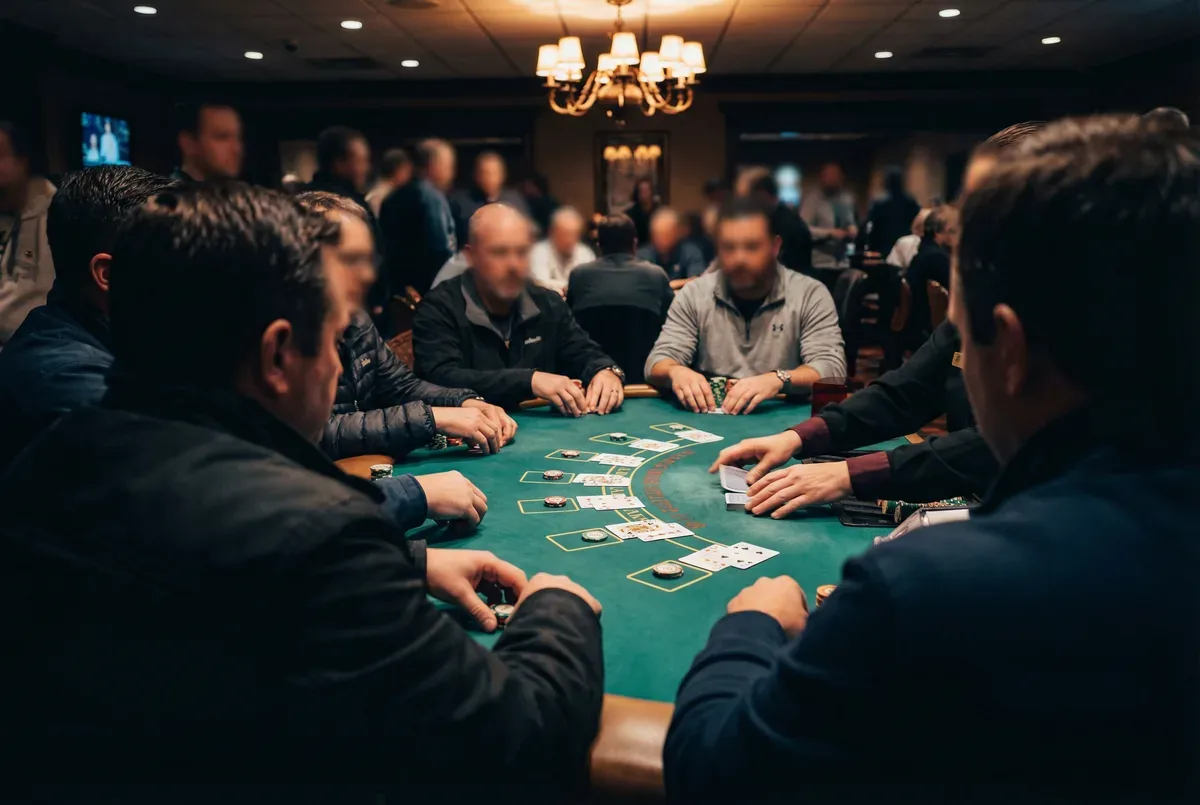
A blackjack table with one player deals approximately 200 hands per hour. Add six players to fill the table and that number drops to roughly 60 hands per hour. Expected loss is a function of hands played times average bet times blackjack house edge. At $25 per hand with a 0.40% blackjack house edge, a heads-up player expects to lose $20 per hour. The same player at a full table, same bet, same rules, expects to lose approximately $6 per hour. Crowding does not change your probability of winning any individual hand, your optimal strategy, or the blackjack house edge on each hand but it dramatically reduces your exposure to the blackjack house edge per unit of time. Understanding this relationship gives you a concrete tool for managing your real financial risk at any table you choose.
Table Occupancy Directly Changes Your Expected Loss Per Hour
Hands/Hour (1 player)
hands
Hands/Hour (7 players)
hands
Expected Loss Reduction
%%
Why Does the Mathematics of Hand Per Hour and Why It Dominates Risk?
The blackjack house edge is a per-hand figure. The casino does not measure your profitability in hours it measures it in resolved bets. When you play 200 hands per hour, you are giving the casino 200 opportunities to extract 0.40% of your bet. When you play 60 hands per hour, you give them 60 opportunities. This is why professional players who want to minimize exposure choose crowded tables. Not because they are superstitious about other players’ cards, but because crowding is a legitimate time-based variance management tool that works through pure arithmetic.
The flip side exists for card counters. Counting requires seeing as many cards as possible per hour to accumulate count information and act on high-count opportunities. A crowded table sees more cards per round each player’s hand adds cards to the count but delivers fewer rounds per hour. The net effect on count efficiency depends on the ratio of cards seen to rounds dealt. For most counters, a moderately filled table (3–4 players) balances count accuracy with hand frequency better than either extreme.
Recreational players typically prefer heads-up play because it is faster and more interactive. From a pure financial exposure standpoint, this preference costs them: the entertainment benefit of faster play comes at the price of 3x the expected dollar loss per hour. That tradeoff is perfectly legitimate if the faster pace is worth it to you but it should be a conscious choice, not an accidental one.
| Players at Table | Hands/Hour | Expected Loss/Hour |
|---|---|---|
| 1 (heads up) | ||
| 200 | ||
| $20.00 | ||
| 3 players | ||
| 120 | ||
| $12.00 | ||
| 5 players | ||
| 80 | ||
| $8.00 | ||
| 7 players (full) | ||
| 60 | ||
| $6.00 |
What Other Players’ Decisions Actually Do to Your Hand?
A persistent myth holds that poor decisions by third-base players hurt the rest of the table. If the third baseman hits a 13 against a dealer 4 and pulls a 5 the card you would have used to improve your 16 the table complains you were robbed. The mathematics refutes this entirely. You had no claim on that card. The distribution of good and bad cards is equal across all possible scenarios of what the third-base player does. Over sufficient hands, poor decisions by other players neither help nor harm your individual expected value. Your EV is determined solely by your own decisions against the dealer’s upcard.
Common Myth
“Bad players at third base hurt your blackjack results”
When a player hits incorrectly and 'takes your card,' it feels like a direct transfer of luck. The next dealer bust or player win reinforces the false attribution.
The Reality
Other players' decisions have zero effect on your expected value over any statistically meaningful sample. Card distribution is random and symmetric across all third-base scenarios.
Statistical simulations of millions of hands show no EV difference between playing with optimal vs suboptimal third-base players. The myth persists entirely due to confirmation bias.
How Do You Use Table Occupancy as a Deliberate Session Management Tool?
A practical application: if you arrive at a casino with a $500 budget and want to maximize session length, choose the fullest table with accepblackjack table rules. The crowded table at 60 hands per hour with a 0.40% edge at $25 means you expect to play approximately 83 rounds before your budget is consumed by expected loss in a worst-case scenario. The same budget at a heads-up table plays out in roughly 25 rounds under the same EV calculation. Variance means neither scenario is guaranteed you might win at either table but the crowded table gives your bankroll significantly more resilience against bad variance by reducing the frequency of hands dealt against you.
Model These Scenarios Before Choosing Your Next Table
The numbers in this article are models your actual session will vary based on variance, rule adjustments, and pace. Our test the math against real stakes environment lets you experience different table speeds before you encounter them with real money at stake. Be clear with yourself before any real-money session: blackjack involves real financial risk regardless of table occupancy, and variance can produce significant losses even at favorable tables. Play what you can genuinely afford to lose.
Frequently Asked Questions
No. Your probability of winning each hand remains identical regardless of table occupancy. What changes is the number of hands dealt per hour, which reduces your expected dollar loss per unit of time not your per-hand house edge.
Generally a moderate number of players (3–4) is optimal for counters. More players means more cards visible per round for a more accurate count, but fewer rounds per hour for fewer opportunities to act on a positive count.
Mathematically no. Over a sufficient sample, the random distribution of good and bad cards is equal across all possible actions other players take. Short-term streaks that feel like causation are the result of variance and confirmation bias.
Before you test these plays at a real table, run them through our free blackjack simulator practice unlimited hands at zero cost until every move becomes automatic.
Fewer Hands Per Hour Still Means Real Money at Risk
A crowded table reduces your hourly exposure it does not eliminate the house edge. Every hand you play carries a mathematical cost, and variance can produce large losses over any session regardless of table occupancy.
Blackjack Academy provides educational content only. Blackjack involves real financial risk. Always play within limits you can afford.

Written by
Mark AnurakProfessional card counter since 2009 · 500,000+ hands logged · Former Macau advantage player. Studied under Thorp, Griffin & Wong methodology. Full bio →
Learn More
Continue your education with these related lessons.

Turning Free Casino Offers into Guaranteed Cash Profits
No-deposit bonuses, free spins, and matched deposit offers can be turned into mathematically guaranteed profits when you understand bonus conversion,…
Arnold Snyder’s Proven Math Method for Advanced Shuffle Tracking
Arnold Snyder developed the analytical framework for shuffle tracking a technique that goes beyond card counting to track clumps of…
How Restricted Doubling Drains Your Total Return
Games that restrict doubling to totals of 9, 10, and 11 only cost players up to 0.25% in expected return.…