
The Real History of Casino Surveillance Against Professional Counters
- The Casino Surveillance vs. Advantage Player Arms Race Has Been Running for Six Decades
- What Early Surveillance Looked For And Why It Missed Team Play?
- What Is the Digital Escalation From RFID to Facial Recognition?
- How Modern Advantage Players Adapt?
- Understanding the Environment Before Playing Seriously
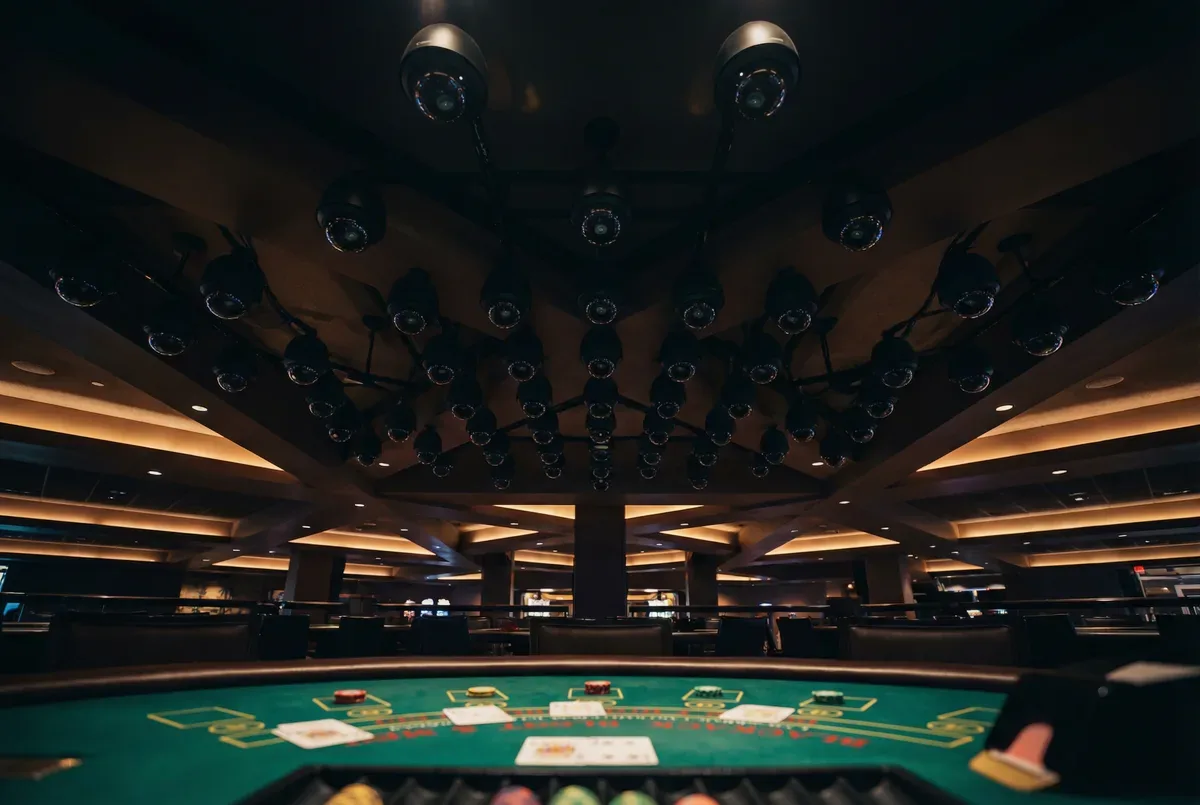
Casino surveillance and professional advantage play have coevolved since the early 1960s each advance by one side prompting a countermove from the other. When Ed Thorp published Beat the Dealer in 1962 and proved blackjack could be beaten with blackjack card counting, casinos responded by adding decks to the shoe, shuffling more frequently, and training pit bosses to watch betting patterns. When those countermeasures became familiar, professional players developed camouflage techniques, team systems, and back-counting to circumvent them. Every escalation has been answered. Understanding the full arc of this history reveals what modern casino surveillance actually looks for and what it can and cannot detect.
The Casino Surveillance vs. Advantage Player Arms Race Has Been Running for Six Decades
Timeline
1962
Beat the Dealer published casinos first learn card counting is real
1964
Casinos respond with 4-deck shoes and rule restrictions to reduce counter advantage
1970s
Big Player team systems use spotters to camouflage large bets new detection challenge
1977
Ken Uston publishes team tactics publicly casinos hire player consultants to learn counter behaviors
1982
NJ Supreme Court rules casinos cannot bar counters Atlantic City briefly becomes counter-friendly
1990s
Biometric surveillance and shared player databases emerge among major casino operators
2000s
NORA (Non-Obvious Relationship Awareness) software identifies players across aliases
2010s
Facial recognition AI deployed in major Las Vegas properties
Today
Machine learning correlates betting patterns, playing decisions, and physical profiles in real time
What Early Surveillance Looked For And Why It Missed Team Play?
The first generation of casino surveillance targeted individual behaviors: bet spreading correlated with the count, hesitations at decisions that suggested calculation rather than intuition, and card-by-card attention inconsistent with recreational gambling. Pit bosses were trained to watch bet sizing patterns a player who consistently made minimum bets in negative counts and large bets in positive counts was a counter, full stop. The response was to shuffle whenever a known counter increased bets, effectively denying them the positive-count hands.
Team play initially defeated these detection methods because the Big Player did not count their bet sizing had no correlation to deck composition that could be observed at their table. The spotter counted at a different table and signaled when conditions were favorable. From the pit boss’s perspective, the Big Player was simply a high roller choosing to bet large at a random table. The Big Player’s play looked like luck, not system. Early surveillance had no tools to connect players across different tables or to analyze the statistical pattern of when Big Players arrived relative to shoe composition.
The casino response was institutional: hire former card counters as consultants, create shared player profiles across casino networks, and train surveillance staff to recognize team signals gestures, positioning, verbal codes. By the late 1970s and early 1980s, major Las Vegas casinos maintained Griffin Investigations files physical dossiers on known or suspected advantage players, shared across the industry. A player identified at one casino could be flagged at another before ever sitting down.
- 1960sManual pit boss observation, basic bet-spread detection
- 1970sClosed-circuit TV, shared player photo files across properties
- 1980sComputerized player databases, professional counter identification services
- 1990sDigital surveillance, cross-casino biometric matching begins
- 2000sRFID chips tracking bet amounts, NORA relationship analysis software
- TodayFacial recognition, AI behavioral pattern analysis, real-time alert systems
What Is the Digital Escalation From RFID to Facial Recognition?
The introduction of RFID (radio frequency identification) chips in casino betting chips represented a significant escalation in surveillance capability. RFID chips allow casinos to track the exact value of bets placed by every player at every moment creating a digital record of bet sizing across entire sessions. The correlation between a player’s bet size and the running count can be computed automatically. A system that flags players whose bet-to-count correlation exceeds a threshold across a session can identify counters with no human observation required.
Facial recognition technology added another layer. Modern major casino properties in Las Vegas and Macau deploy facial recognition systems that can match a player’s face to a database of known advantage players within seconds of entering the casino before they reach a table. The Griffin Investigations physical dossiers of the 1970s have been replaced by digitized profiles shared across global casino networks. A player barred from a property in Las Vegas may find that their face precedes them to Macau or Singapore.
Common Myth
“A skilled counter using perfect camouflage cannot be detected”
Professional players describe elaborate disguise techniques as foolproof
The Reality
Modern AI behavioral analysis can detect statistical anomalies in bet patterns that no disguise changes
RFID and pattern analysis detect bet-count correlation regardless of physical appearance changes
How Modern Advantage Players Adapt?
Modern professional advantage players have adapted to surveillance in several ways. Team operations use more members, faster rotations, and fewer hands per player per property to limit the statistical sample available for analysis. Bet spreads are more conservative to avoid triggering algorithmic thresholds. New players front for teams rather than using known profiles. Emerging markets with less sophisticated surveillance infrastructure attract professional attention. Online blackjack, where behavioral surveillance is less developed than in physical casinos, has become a focus for some professional operations.
The arms race continues. Casino technology investment in surveillance has never been higher. Player camouflage techniques have never been more sophisticated. The fundamental mathematical edge remains accessible to those who develop the necessary skills but the operating environment is more constrained than it was in the 1970s or 1980s. Professional players today operate with a level of awareness of casino detection systems that would have seemed paranoid to earlier generations of counters.
Understanding the Environment Before Playing Seriously
Anyone pursuing advantage play seriously needs to understand the surveillance environment they are operating in. The mathematics of counting are not the limiting factor the longevity of being able to apply them at real-money tables is. The stress-test your cover at a live table tonight environment provides a consequence-free setting to develop the foundational skills that all advantage techniques require, with no surveillance implications and no real money at risk during the learning process.
Frequently Asked Questions
Modern casinos use a combination of RFID chip tracking to correlate bet size with count, facial recognition to identify known advantage players, behavioral pattern analysis software, and trained pit staff. The most sophisticated systems can flag statistical anomalies in betting patterns automatically.
Yes, in the right environments. Less-surveilled casinos, lower stakes games, cautious bet spreads, and regular property rotation allow careful counters to operate. The expected value is lower when bet spreads must be constrained, but the fundamental advantage remains exploitable.
Griffin Investigations was a casino security firm operating from the 1960s through 2005 that maintained a shared database of known or suspected advantage players, including photos, aliases, and behavioral profiles. The database was shared across subscribing casinos as a counter-detection tool.
Before you test these plays at a real table, run them through our free blackjack simulator practice unlimited hands at zero cost until every move becomes automatic.
Know the Environment Before You Play
Casino surveillance is more sophisticated than most players realize. Understand what it looks for and how advantage play operates within those constraints.
Blackjack involves real financial risk. Card counting is legal but casinos retain the right to refuse service to any player in most jurisdictions.

Written by
Mark AnurakProfessional card counter since 2009 · 500,000+ hands logged · Former Macau advantage player. Studied under Thorp, Griffin & Wong methodology. Full bio →
Learn More
Continue your education with these related lessons.

How to Look and Act Like a Casual Tourist at the Table
Camouflage the art of appearing to be a recreational player while executing professional-level advantage play is a learnable skill that…

How to Stay Calm and Keep Your Money After a Back Off
Getting backed off is a defining moment for any advantage player. How you respond in the next sixty seconds determines…

Master the Art of Table Selection for Maximum Advantage Play Edge
Table selection as a professional skill: S17 vs H17 value, deck penetration scouting, how to leave a table without drama,…