
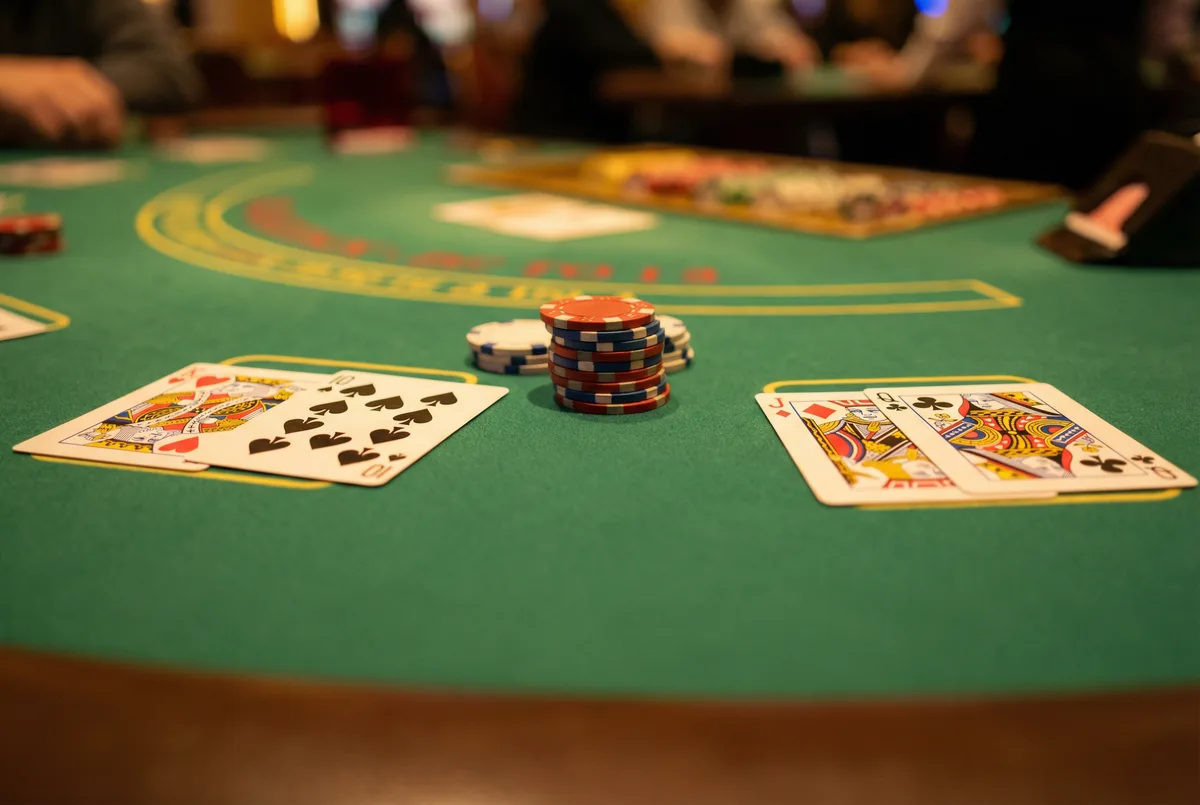
What Actually Happens During a Push or Tie in Casino Blackjack
[bja_toc]
A push happens when you and the dealer finish with the same hand total — your bet is returned and the hand is erased from your results. No win, no loss, no chips gained, no chips lost. That sounds simple, but the push rule has real implications for your bankroll variance, your expected value on certain decisions, and the way dangerous game variants quietly take money from uninformed players. Pushes occur on approximately 8.48% of all hands in a standard six-deck game, meaning roughly one in every twelve hands produces no result at all. Understanding exactly when pushes happen, why they protect you, and where casino variants weaponise the rule against you is foundational knowledge every blackjack player needs.
What a Push Means in Blackjack
A push is a standoff between your hand and the dealer’s hand. Both reach the same total without busting, and the outcome is neutral. Your original wager comes back to you exactly as placed. The casino takes nothing. You gain nothing. The round simply did not happen in financial terms.
In a live casino, the dealer signals a push by knocking the felt twice behind your bet or verbally saying “push” or “tie.” Your chips remain in the betting circle. You can leave them for the next hand, add to them, or pull them back — the choice is yours. Online blackjack displays the word “Push” on screen and your account balance is unchanged. There is no partial loss, no rake, and no commission taken on a push under standard rules.
- Push frequency8.48% of all hands
- Most common push total20
- Double natural push~0.5% of hands
- Pushes per 100 handsapproximately 8–9
- Financial impact of each pushzero
The most common push total is 20. Both the player and dealer frequently reach strong hands that neither wants to hit — the dealer must stand on 20, and no competent player hits 20. Pushes at 19 and 18 are the next most common. Pushes at 17 occur when both finish on exactly 17, which happens less frequently than higher totals but is still a regular event. Pushes at 21 require both hands to reach blackjack or 21 simultaneously — the rarest push scenario, but one that eliminates what would otherwise be the player’s 3:2 payout on a natural.
What you will almost never see is a push at a total below 17. The dealer is required to hit anything below 17, so the dealer virtually never stands on 15 or 16. And under basic strategy, neither do you. Pushes at low totals are a signal that someone at the table is playing incorrectly.
How Often Does a Push Happen, and Which Totals Cause It?
Push frequency varies by hand total because it depends on how often both the player and the dealer independently reach the same number. Totals of 18, 19, and 20 account for the majority of pushes because these are the most common non-bust finishing totals for both sides.
The double-natural push — both the player and the dealer receive a natural blackjack on the same hand — frustrates players more than any other push scenario. You held the strongest possible hand and received nothing. But in a six-deck shoe, the probability of any hand being a natural is approximately 4.75%. The probability of both the player and the dealer being dealt a natural simultaneously is around 0.5%. Over a full session of 200 hands, this happens roughly once. It is a genuinely rare event that costs far less in long-run expected value than the alternatives players reach for to avoid it — specifically, taking even money or insurance, both of which have negative expected value for the player.
Common Myth
“Taking even money avoids a losing push when you have a natural”
Players see insurance/even money as protection against the frustration of a push on their best hand
The Reality
Even money is mathematically equivalent to taking insurance — it has a negative expected value and costs you money over time
Declining even money on a natural yields +EV. Taking even money surrenders the difference between 3:2 and 1:1 — approximately 4 cents per dollar wagered across the double-natural frequency
Over a session of 200 hands at a typical pace, you can expect 16 to 17 pushes. These hands consume real time — you are dealt cards, decisions are made, the hand plays out — but your chip stack does not move. Experienced players account for this when estimating session length. If you plan to play 200 hands and expect 17 pushes, only 183 hands will actually affect your bankroll. The house edge applies only to those 183 hands.
A higher-than-normal push rate during a session can be a subtle indicator of a high-card-rich shoe. When the remaining deck is packed with tens and aces, both the player and the dealer are more likely to reach strong totals — 19, 20, 21 — and those strong totals collide more often. Card counters do not act directly on push frequency as a signal, but a shoe where pushes cluster is consistent with a rising true count.
Why Does a Push Protect Your Bankroll More Than You Realise?
The push rule is player-friendly in a way that is easy to overlook. Without it, the casino would need to invent a tiebreaker for every matched total — and any tiebreaker the casino devises will favour the house. The push rule instead returns your money completely. Every push is a hand where the casino’s mathematical edge did not apply.
The practical bankroll effect is that pushes slow the rate at which the house edge grinds your stack. In a six-deck game with a 0.5% house edge (you can model your specific rules with our blackjack calculator), the expected loss over 200 hands at a $25 table is $25. But 17 of those hands are pushes, which means only 183 hands are decisive. Your actual expected loss is closer to $23. The difference seems small per session, but across hundreds of sessions it represents a measurable reduction in total exposure to the house edge.
Over 1,000 sessions of 200 hands at $25 per hand, a player experiences roughly 17,000 pushes. Those 17,000 neutral hands represent $425,000 in bets that the house edge never touched. Pushes are not frustrating dead hands — they are hands where the casino made nothing off you.
Variance is also affected. Every push is one fewer hand in which your result swings up or down. A session with more pushes than average will have slightly less variance — a flatter equity curve in both directions. This is why players who are ahead by a meaningful amount sometimes welcome a run of pushes near the end of a session: the neutral results preserve the lead without adding risk. The hand outcome was already decided the moment the dealer’s second card was dealt. Pushing at 20 when the dealer also has 20 is not bad luck — it is a neutral result in a situation where you had no better outcome available.
Which Game Variants Change the Push Rule Against You?
Standard blackjack returns your bet on every push. Several game variants modify this rule, and every modification you will ever encounter in a casino favours the house. Knowing which changes to avoid is as important as knowing basic strategy.
The most dangerous variant is Dealer Wins Ties — sometimes called Ties Win for the Dealer. Under this rule, any matched total results in a loss for the player. This single change adds approximately 9% to the house edge, transforming a beatable game into one of the worst bets on the casino floor. If you see this rule displayed on a table placard, walk away without sitting down. There is no basic strategy adjustment, no bet-spread, and no counting system that overcomes a 9% added edge.
Standard Rule
Variant Rule
- Bet returned to player
- Player loses tied hands
Push on 22 appears in Free Bet Blackjack and some progressive variants. When the dealer busts with exactly 22, all remaining player hands push rather than winning. This rule costs the player approximately 6% in expected value on those specific bust hands, which translates to roughly 1% off the overall expected return. The game compensates by offering free doubles and free splits, but the push-on-22 rule is the mechanism that pays for those freebies. Players who do not understand this trade-off systematically overestimate how good the free doubles feel.
In Spanish 21, one category of pushes is eliminated entirely in the player’s favour: a player 21 always beats a dealer 21, including dealer blackjack against player 21 composed of five or more cards. This removes the double-natural push and gives the player a guaranteed win on 21-versus-21 collisions. It is a genuine advantage — but Spanish 21 removes all 10-spot cards from the eight-deck shoe, which costs more in expected value than the favourable push modification returns. Every rule change in a variant is connected to something else. The game always balances.
Playing Your Next Push Correctly at a Live Table
The push rule does not change any basic strategy decision. You never adjust your play to try to avoid or engineer a push. Basic strategy is optimised across all possible outcomes including pushes — the correct action for every hand already accounts for the probability that the dealer reaches the same total. Standing on 17 because you fear the dealer has 17 is not a strategic thought. It is the correct play because the math of all outcomes combined points to standing, not because you are managing push risk.
Where push awareness directly helps you is in two specific situations. First, when the dealer shows an ace and you hold a natural blackjack, the casino offers even money — a guaranteed 1:1 payout instead of risking a push if the dealer also has a natural. Decline it every time. The expected value of playing out your natural blackjack, including the rare double-natural push, is approximately 4% higher than accepting even money. Second, when you are evaluating which tables to sit at, check the push rule on the placard before buying in. A single line of text — “Dealer wins ties” or “Push on 22” — tells you everything about whether the game is worth playing.
The next time the dealer taps the felt and your chips come back, treat the push as exactly what it is: a free hand. Your money survived. The casino’s edge did not apply. Reset your bet according to your bankroll plan and play the next hand. If you want to track how pushes affect your actual session results in real time, the free blackjack simulator logs push frequency alongside your win rate so you can see how neutral hands interact with your long-run outcomes. For real-money practice where the stakes and decisions feel genuine, a live dealer table at your staking level will make the push rule second nature within an hour of play — just make certain the table rules return your bet on every tie before you sit down with real money.
Frequently Asked Questions
Your bet is returned to you in full. A push means you and the dealer tied with the same hand total. Neither side wins, neither loses, and your chips stay exactly where they were placed.
Approximately 8.48% of all hands end in a push under standard six-deck rules with the dealer standing on soft 17. That is roughly one push every twelve hands, or 16 to 17 pushes per 200-hand session.
No. Declining even money and accepting the occasional double-natural push produces a higher expected value over time. Taking even money is mathematically identical to taking insurance — it has a negative expected value and costs you money across a long run of hands.
Understand Every Outcome Before You Bet
Push, win, or loss — each outcome has a precise expected value. The blackjack simulator shows you exactly how push frequency interacts with your win rate across thousands of hands.
Blackjack Academy is an educational resource. All strategy recommendations are based on mathematical expectation. Always gamble responsibly and within your means.

Written by
Mark AnurakProfessional card counter since 2009 · 500,000+ hands logged · Former Macau advantage player. Studied under Thorp, Griffin & Wong methodology. Full bio →
Learn More
Continue your education with these related lessons.
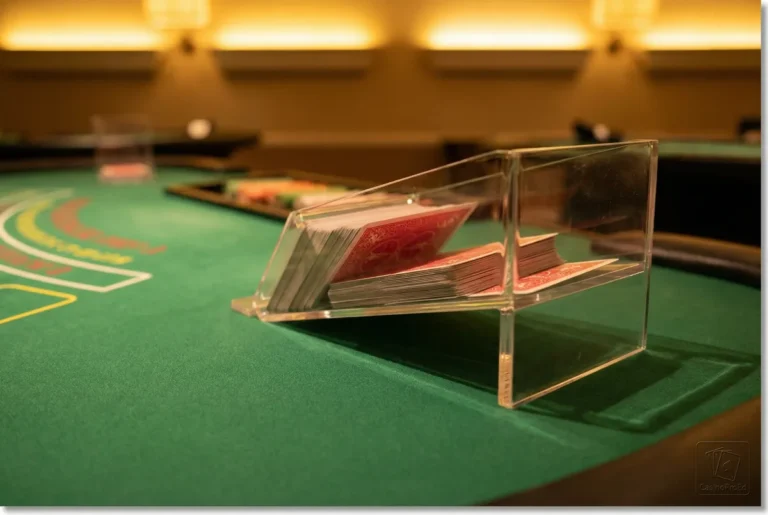
Why the Discard Tray is Important for Serious Blackjack Players
The discard tray sits at the right side of every blackjack table, quietly holding the used cards. Most players never…
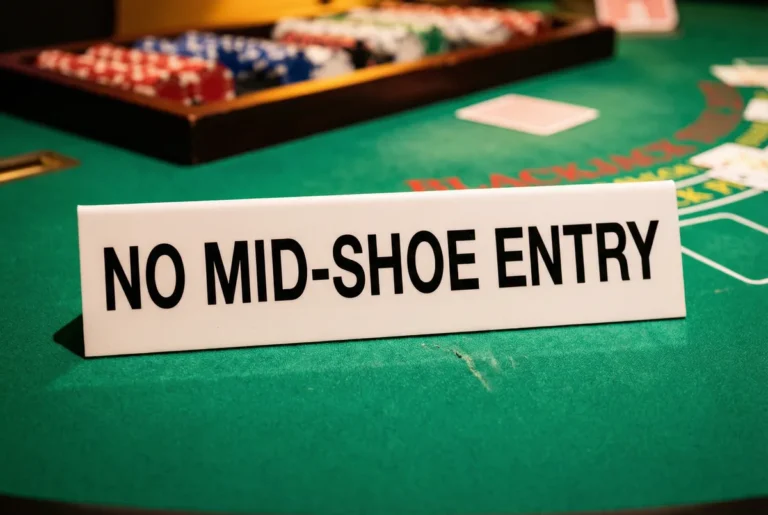
Why Some Casinos Have a No Mid Shoe Entry Rule
No mid-shoe entry rules seem random until you understand exactly what casinos are protecting against. Here is the full story.
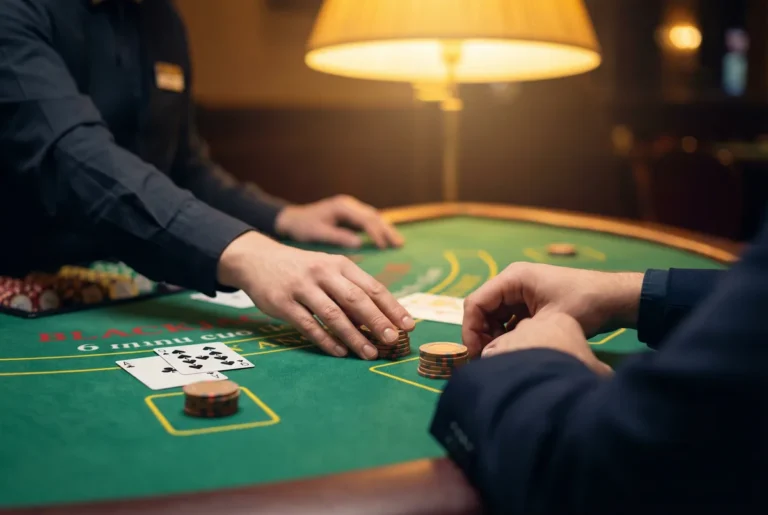
How the Dealer Settles and Pays Out Every Blackjack Wager
The dealer follows a fixed settlement sequence after every hand: players who beat the dealer are paid, pushes are returned,…