
The Critical Difference Between Hard and Soft Hands in Blackjack
I used to stand on every 17. Hard 17, soft 17, did not matter. I thought 17 was 17. It cost me for months before I understood the difference. A hard 17 and a soft 17 have the same numeric total but completely opposite correct plays. Stand on the hard 17. Hit or double the soft 17. 40 or more blackjack basic strategy decisions change depending on whether your hand is hard or soft. That is not a minor detail. It is the single most important classification in blackjack. Over 400 hands at a $25 table, misplaying soft hands costs you roughly $80 to $120 in expected value.
What Makes a Hand Hard or Soft
A soft hand contains an Ace that is currently counted as 11. A hard hand is everything else: any hand without an Ace, or a hand where the Ace must count as 1 to avoid busting. The word “soft” refers to flexibility. A soft hand can absorb a high card without busting because the Ace drops from 11 to 1 if needed. A hard hand has no such cushion. Every card you draw adds to your total with no room to adjust.
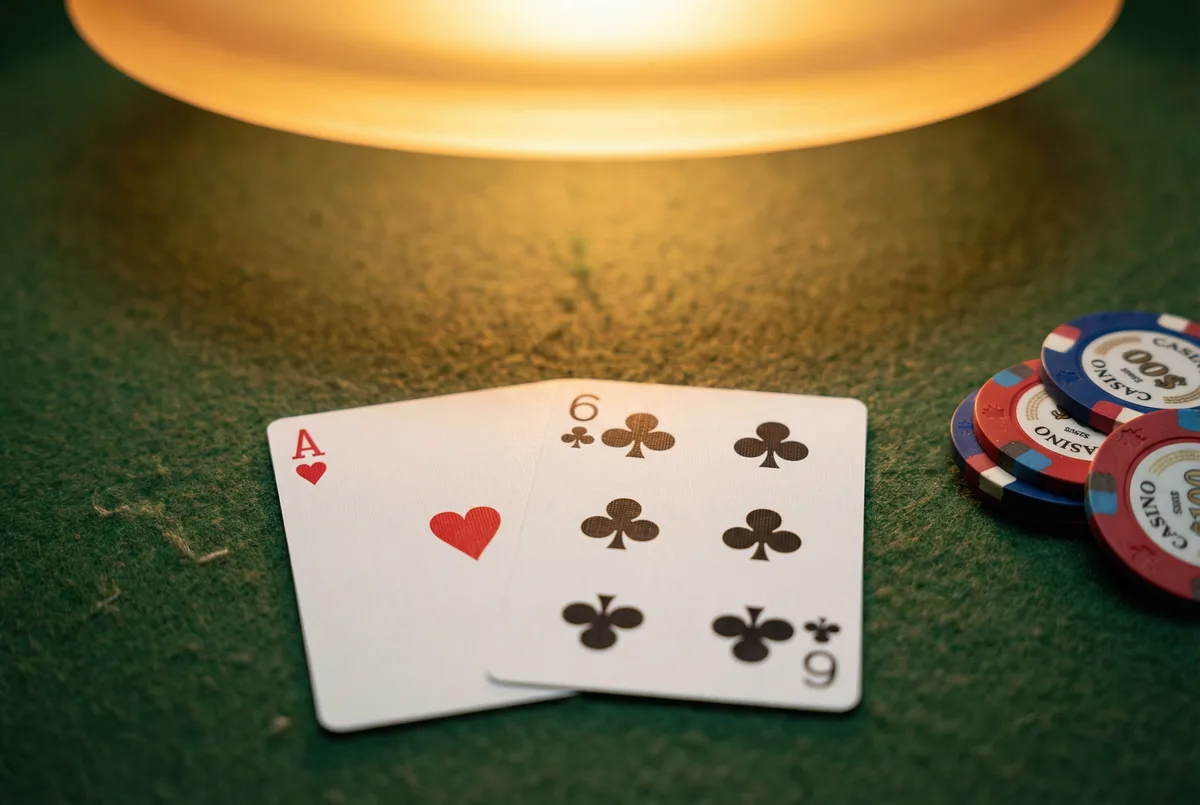
Ace-6 is soft 17. The Ace counts as 11, giving you a total of 17. If you draw a 9, the Ace drops to 1 and your new total is 16 (1 + 6 + 9). You did not bust. You lost the soft advantage, but you are still in the hand. Compare that to hard 17 (say, 10-7). Draw a 9 and you have 26. Bust. Game over. Same starting total, completely different risk profiles.
Hard Hand
Soft Hand
- Counts as 1 (or no Ace)
- Yes, can bust
- 10 + 7 = Hard 17
- Conservative (stand more)
- None
- Counts as 11
- No, Ace drops to 1
- A + 6 = Soft 17
- Aggressive (hit or double more)
- High
A hand can transition from soft to hard during play. If you hold Ace-5 (soft 16) and draw a 10, the Ace drops to 1 and you now have 1 + 5 + 10 = hard 16. The hand started soft and became hard. Once a hand becomes hard, it stays hard. The transition only goes one direction. This matters because the moment your hand flips to hard, you switch to hard hand strategy rules for all subsequent decisions.
Why Soft Hands Are More Valuable Than Hard Hands of the Same Total?
Soft hands are more valuable than hard hands of the same total because they give you a free shot at improving without any risk of busting on the next card. When you hold soft 15 (Ace-4) and draw a card, the worst case scenario is ending up with a hard total between 12 and 16. You lose the soft flexibility, but you do not lose the hand. That is a fundamentally different situation from holding hard 15, where any card 7 or higher ends the hand immediately.
- 1Ace-7: Soft 18 (Ace counts as 11, total is 18)
- 210-8: Hard 18 (no Ace, total is fixed at 18)
- 3Ace-5-7: Hard 13 (Ace must count as 1 because 11+5+7=23 busts)
- 4Ace-3: Soft 14 (Ace counts as 11, total is 14)
- 59-7: Hard 16 (no Ace, total is fixed at 16)
- 6Ace-4-2: Soft 17 (Ace counts as 11, total is 17)
This bust protection creates opportunities that hard hands never offer. Doubling down on soft totals against weak dealer upcards is one of the highest expected value plays in the entire game. When you double soft 17 against a dealer 6, you are putting twice the money on the table knowing that you cannot bust on the next card and the dealer has a high probability of busting. The risk is asymmetric in your favor.
Professional players treat soft hands as offensive weapons. Recreational players treat them like any other total. The gap between those two approaches shows up directly in win rate. A player who stands on every soft 17 and soft 18 is leaving real money on the table that a strategy-aware player captures.
How Does Hard Hand Strategy Rules Every Player Must Know?
Hard hands are straightforward because every card drawn adds directly to your total with no flexibility: hard 17 through 21 always stand, hard 13 through 16 strategy depends entirely on the dealer’s upcard. Hard 17 through 21: always stand. You cannot improve without significant bust risk. Hard 13 through 16 against a dealer 2 through 6: stand and let the dealer bust. Hard 13 through 16 against a dealer 7 through Ace: hit because your total is too weak to win by standing.
Hard 12 is the first interesting decision point. Against a dealer 4, 5, or 6, you stand because the dealer busts frequently with those upcards. Against a dealer 2 or 3, you hit hard 12 because the dealer does not bust often enough to justify standing on such a weak total. And against a dealer 7 through Ace, you always hit hard 12.
Dealer Shows
Your Hand
You hold Ace-6 (soft 17) against a dealer 5. What is the correct play?
Double down on soft 17 against a dealer 5. You cannot bust, and the dealer has a roughly 42% chance of busting. Putting double the money on the table in this situation has a positive expected value.
Hard 11 and below require no difficult decisions. You always hit (or double when the situation calls for it) because there is zero chance of busting on a single card. Hard 11 is the single best doubling opportunity in the game against dealer upcards 2 through 10. You are one card away from 21 and the Ace is the only card that gives you a total under 13.
The most expensive mistakes in hard hand play are standing on hard 12 through 16 against dealer 7 or higher (the “never bust” fallacy) and hitting hard 17 or above (unnecessary risk). Both are common among recreational players and both are mathematically wrong in every scenario.
One number puts this in perspective: the dealer busts about 42% of the time when showing a 5 or 6. That means standing on your stiff hand against those upcards wins almost half the time without you doing anything. But against a dealer 10, the dealer busts only about 21% of the time. Standing on hard 14 against a 10 means you lose roughly 4 out of 5 hands. Hitting at least gives you a shot at reaching 17 through 21.
What Are the Soft Hand Strategy Rules?
Soft 19 and soft 20 are stand-always hands because these totals are strong enough to compete against any dealer upcard and trying to improve them rarely produces a better outcome. These totals are strong enough to compete against any dealer upcard and trying to improve them rarely produces a better outcome. Soft 20 (Ace-9) is one of the strongest non-natural hands in the game. Never hit it. Never double it. Stand.
Soft 13 through soft 17 are hands where you should always take action. Never stand on these totals. They are too weak to win against any dealer upcard without improvement. Against a dealer 5 or 6, doubling is the correct play for most of these hands. Against other dealer upcards, hitting is correct. The key insight is that you have nothing to lose by taking a card because the Ace prevents busting.
Soft 18 (Ace-7) is the most commonly misplayed hand in blackjack. Against dealer 9 or 10, standing on 18 feels safe but hitting soft 18 vs dealer 9 has measurably higher EV than standing. The Ace absorbs any overdraw. Against dealer 3-6, doubling soft 18 is correct. Against dealer 2, 7, or 8, stand. Against 9, 10, or Ace, hit. This one hand has four different correct actions depending on the dealer upcard.
Soft 18 (Ace-7) is the most frequently misplayed hand in blackjack. Most players stand on 18 automatically because it looks like a winning hand. But against a dealer 9, you win only about 40% of the time by standing. Hitting gives you a chance to reach 19, 20, or 21 while the Ace protects you from busting. The expected value of hitting soft 18 against a dealer 9 is measurably higher than standing.
Against a dealer 3 through 6, you double soft 18 because the dealer is in a weak position and you want maximum money on the table. Against a dealer 2, 7, or 8, you stand because your 18 is competitive enough. These nuances are what separate a strategy player from a guessing player.
Doubling soft hands is where the real profit hides. Over 500 hands, a player who correctly doubles soft 13 through 18 against weak dealer upcards earns roughly $50 to $80 more at a $25 table compared to a player who just hits those same hands. That gap adds up over multiple sessions. It is money that exists in the rules for anyone willing to learn the correct play.
Identifying Your Hand Type at the Table
The first thing you do when you look at your cards is classify the hand. If there is an Ace and it can count as 11 without busting, the hand is soft. If there is no Ace or the Ace must count as 1, the hand is hard. This classification comes before any decision about hitting, standing, doubling, or splitting. Get it wrong and every subsequent decision is based on the wrong strategy table.
Practice this classification until it becomes automatic. Ace-3 is soft 14, not hard 14. Ace-5-6 is hard 12 (the Ace must count as 1 because 11 + 5 + 6 = 22, a bust). Ace-2-4 is soft 17 (11 + 2 + 4 = 17, no bust). The classification depends on whether the Ace can safely count as 11 given all the other cards in your hand.
You now know that a soft hand gives you a free swing and a hard hand locks you in. I classify every hand before I do anything else, and it is the one habit I am most glad I built. Bring this knowledge to a real game and spend 20 hands doing one thing: before you act, say the classification out loud. “Soft 16.” “Hard 14.” If your hand has an Ace, ask yourself whether it is counting as 11 or 1. By hand 15 you will stop thinking about it and start seeing it automatically. That is the goal. Decide your session budget before the cards move.
Frequently Asked Questions
A soft hand contains an Ace counted as 11. A hard hand has no Ace, or the Ace must count as 1 to avoid busting. Soft hands can absorb a hit without busting because the Ace drops from 11 to 1 if needed.
Soft 17 is too weak to beat any dealer upcard consistently. Because the Ace gives you bust protection, hitting costs you nothing. The worst outcome is converting to a hard total between 12 and 16, which is no worse than standing on a losing 17.
Yes. If you hold Ace-5 (soft 16) and draw a 10, the Ace must drop to 1 to avoid busting, giving you hard 16 (1 + 5 + 10). Once a hand becomes hard it stays hard. You then switch to hard hand strategy rules.
Before you test these plays at a real table, run them through our free blackjack simulator practice unlimited hands at zero cost until every move becomes automatic.
Know Your Edge Before You Bet
The calculator shows your exact expected value for every hand combination.
Blackjack Academy is an educational resource. All strategy is based on mathematical expectation. Always play within your means.

Written by
Mark AnurakProfessional card counter since 2009 · 500,000+ hands logged · Former Macau advantage player. Studied under Thorp, Griffin & Wong methodology. Full bio →
Learn More
Continue your education with these related lessons.
Key Differences Between British Pontoon and American Blackjack
British Pontoon and American blackjack share a common ancestor but diverged into distinct games with different rules, terminology, and strategy.…

Why Play Moves Clockwise from the Dealer’s Left Side
Blackjack action always starts at first base the seat to the dealer's left and moves clockwise to third base. This…
Why You Must Demand a 3 to 2 Natural Blackjack Payout
The difference between a 3:2 and a 6:5 natural payout is not a small rule variation. It is a 1.39%…