
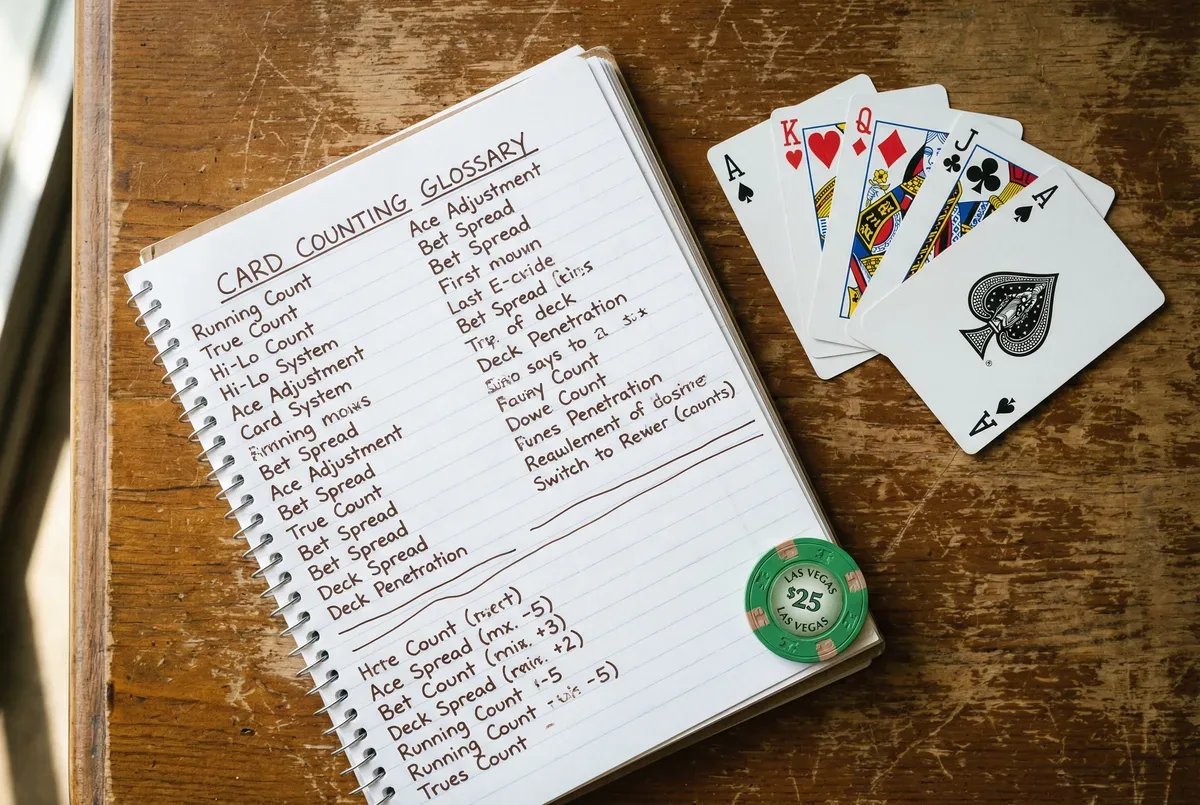
The Advanced Counting Player’s Complete Glossary
Running count, true count, bet spread, penetration, EV, variance, RoR, Kelly criterion, Wonging, and index play are the ten terms that appear in virtually every blackjack card counting discussion and misunderstanding any one of them produces the wrong decisions at the table or the bankroll level.
The 10 Terms Every Counter Must Know Cold
These are not vocabulary for impressing other players. They are the operational language of advantage play: the labels attached to the specific quantities you are calculating, the specific behaviors you are executing, and the specific risks you are managing in every session. A counter who cannot define these terms precisely is a counter who has memorized a technique without understanding the system it operates within.
- Running Count (RC)the cumulative sum of all card count values seen since the last shuffle
- True Count (TC)RC divided by the estimated number of decks remaining the normalized edge signal
- Bet Spreadthe ratio of your maximum bet to your minimum bet (e.g. 1:12 = $25 min to $300 max)
- Penetrationthe percentage of the shoe dealt before the shuffle card triggers a reshuffle
- EV (Expected Value)the average monetary result per hand or per session at a given count and bet level
- Variancethe statistical spread of outcomes around the expected value the source of short-term swings
- RoR (Risk of Ruin)the probability of losing your entire bankroll before reaching your target profit
- Kelly Criterionthe bet sizing formula that maximizes long-run bankroll growth at a given edge and bankroll
- Wongingentering a shoe mid-deal when the count is positive and leaving when it turns negative
- Index Playa basic strategy deviation triggered at a specific true count threshold (e.g., stand 16 vs 10 at TC 0)
How Do You Count Systems and Technical Counting Terms?
Hi-Lo is the most widely used blackjack card counting system: cards 2–6 are counted as +1, cards 7–9 as 0, and cards 10–Ace as -1, producing a balanced count that returns to zero after a full deck is processed.
KO (Knock-Out) is an unbalanced system that counts 7s as +1 in addition to the 2–6 range, producing a starting count below zero that eliminates the need for a true count conversion the running count itself is used for betting decisions. This simplification costs a small amount of edge but significantly reduces the cognitive workload, making KO a common recommendation for beginners.
Omega II is a level-2 balanced system developed by Bryce Carlson. It assigns +1 to 2s, 3s, and 7s; +2 to 4s, 5s, and 6s; -1 to 9s; -2 to 10s through Kings; and 0 to Aces and 8s. The additional granularity produces slightly higher betting correlation but requires more mental overhead per card. Zen and Red Seven are similar level-2 systems that vary primarily in their Ace treatment. The marginal edge gain of level-2 systems over Hi-Lo is small enough that most professional counters opt for Hi-Lo’s simplicity and reliability under casino pressure.
Ace Side Count is a supplementary technique used alongside Hi-Lo or another primary system. Because Aces are counted as -1 in Hi-Lo but have disproportionate impact on blackjack frequency, some counters track Aces separately to adjust their bet sizing and playing decisions more precisely when Ace density is unusually high or low. Side counting Aces adds meaningful edge but requires counting two simultaneous streams a significant cognitive demand that not all players can maintain at casino speed.
Composition-Dependent strategy differs from blackjack basic strategy in that it considers the specific cards comprising a hand total, not just the total itself. Example: a 10-6 versus a 7-9 both equal 16, but their composition-dependent correct plays can differ. In a single-deck game, these distinctions matter measurably. In six-deck games, the impact is negligible, and blackjack basic strategy plus index plays handles all significant decisions.
Timeline
1962 Ed Thorp
Beat the Dealer introduces the ten-count system. Establishes RC and basic counting framework. Terms like 'favorable count' enter the vocabulary.
1966 Julian Braun
Computer simulations refine basic strategy and count values. Betting correlation and playing efficiency as concepts emerge.
1980s Arnold Snyder and Blackjack Forum
Hi-Lo system popularized. 'True count' formalized as RC ÷ remaining decks. Wonging named after Stanford Wong.
1990s Stanford Wong
Professional Blackjack codifies TC conversion, index plays, and bet spread mechanics. Wong adds 'back-counting' and 'Wonging' to the operational lexicon.
1997 Don Schlesinger
Blackjack Attack introduces SCORE, N0, Illustrious 18, and Fab 4. Risk of Ruin and Kelly sizing integrated into advantage play framework.
2000s–Present
CVCX software makes SCORE and N0 calculations accessible to all counters. Modern glossary includes heat, backoff, flat-bet restriction, and trespass as operational terms.
What Are Bankroll, Risk, and Game Evaluation Terms?
N0 is the number of hands required for a counter’s results to converge toward their theoretical expected value with statistical confidence the point where edge is more likely than variance to explain cumulative outcomes.
SCORE (Standardized Comparison of Risk and Expectation) is Don Schlesinger’s metric for evaluating overall game quality for a card counter, collapsing expected value, variance, and bet spread into a single number that allows fair comparison between games with different rule sets, deck counts, and penetration levels. Higher SCORE is better.
Kelly Criterion is the formula for optimal bet sizing that maximizes long-run bankroll growth: bet size = (edge / variance) × bankroll. Full Kelly bets maximize growth but produce significant short-term swings. Half-Kelly betting at 50% of the Kelly-optimal amount is the standard professional practice: it sacrifices roughly 25% of theoretical growth rate in exchange for substantially reduced variance and a much lower probability of severe drawdown. Most serious counters operate between quarter-Kelly and half-Kelly depending on their risk tolerance.
Risk of Ruin is the probability that a counter’s bankroll will be exhausted before reaching a target profit, given their edge, variance, bet sizing, and total bankroll. A professional counter typically targets RoR below 5%. At 5% RoR, a counter can expect roughly a 1-in-20 chance of going broke before doubling their bankroll an acceptable level for a dedicated player. Higher bet spreads at smaller bankrolls dramatically increase RoR even at positive EV, which is why bankroll sizing and bet sizing must be calibrated together.
What Are Casino Operations, Heat, and Team Play Vocabulary?
Heat is the term for increased casino scrutiny directed at a suspected advantage player manifesting as closer observation from the floor, mid-shoe shuffles, or direct questioning. Recognizing heat early and responding appropriately (cover plays, bet modulation, voluntary departure) is a core operational skill for any counter who plays the same property more than once.
Backoff is a casino’s formal or informal request that a player stop playing blackjack. It differs from a trespass in that the player is not barred from the property, only from the specific game. Flat-bet restriction is the milder preceding response: the casino requests the player keep their bet size constant, eliminating the bet spread that makes counting profitable. Trespass is the formal legal exclusion from the property, which makes re-entry criminal trespass in most jurisdictions.
Cover play is a deliberately suboptimal decision made to disguise skilled play from floor observation taking insurance once with a large bet to appear as a normal player, doubling on a hand that index play does not call for because a recreational player might, or tipping conspicuously. Cover plays cost EV and should be used sparingly and strategically, not reflexively.
In team play, the spotter is a player who counts at a table but flat-bets at the minimum, never altering their bet size regardless of count. When the count reaches a pre-agreed positive threshold, the spotter signals a big player, who enters the game with a large bet and plays only the favorable count rounds. The controller is a variant role who both counts and communicates with multiple spotters, coordinating several tables simultaneously. These team structures allow aggressive bet spreads to be deployed without the individual correlated-bet signature that triggers detection.
Putting the Glossary to Work at the Real-Money Table
Vocabulary without execution is trivia the test of whether these terms are genuinely understood is whether they govern actual decisions under casino pressure without conscious retrieval.
When you are mid-shoe and the RC is +8 with 2.5 decks remaining, the correct behavior is automatic: TC is approximately +3, bet sizing increases to Kelly-optimal for TC +3, and any insurance offer is accepted without deliberation. If any of those steps require looking up the definition, the vocabulary is memorized but not operational. Drill until the terms activate behavior directly.
Live-money play sharpens the distinction faster than any practice deck. The genuine financial pressure of each hand at see this edge in live counted play in your next session exposes whether your glossary is internalized or merely studied and every session carries real monetary risk that no amount of definitional accuracy protects against. Play only with funds you can afford to lose completely.
The single most misused term in counting is 'edge.' A 1% edge does not mean you win 51 hands in 100. It means that over 100,000 hands, your cumulative profit divided by total wagered approaches 1%. In a single session of 200 hands, a 1% edge is invisible under the variance.
Frequently Asked Questions
The running count is the cumulative sum of card count values since the last shuffle. The true count is the running count divided by the number of decks remaining to be dealt. True count normalizes the count for comparison across different points in a shoe a RC of +8 with 4 decks left is a TC of +2, representing much less edge than RC +8 with 1 deck left (TC +8). True count is what drives all betting and index play decisions in multi-deck games.
Wonging named after Stanford Wong is the practice of observing a blackjack table without playing (back-counting) and entering the game only when the true count reaches a positive threshold. The counter exits when the count turns negative. This technique produces higher EV per hand played but is highly visible to floor managers, who recognize the behavior as a strong counter indicator.
Half-Kelly is betting at 50% of the Kelly-optimal amount. Full Kelly maximizes long-run bankroll growth but produces severe short-term swings. Half-Kelly reduces variance significantly with roughly 75% of the growth rate of full Kelly and lowers the risk of a severe drawdown that could force a player to stop before reaching statistical convergence. Most professional counters operate between quarter-Kelly and half-Kelly as a result.
Before you test these plays at a real table, run them through our free blackjack simulator practice unlimited hands at zero cost until every move becomes automatic.
Mathematical Risk Warning
Understanding terminology is the foundation of skilled play, not a substitute for it. Real-money blackjack carries significant financial risk. Only play with funds you can afford to lose entirely.
Blackjack Academy is an educational resource. All strategy is based on mathematical expectation. Always play within your means.

Written by
Mark AnurakProfessional card counter since 2009 · 500,000+ hands logged · Former Macau advantage player. Studied under Thorp, Griffin & Wong methodology. Full bio →
Learn More
Continue your education with these related lessons.

How Ed Thorp Invented Card Counting and Wrote Beat the Dealer
Ed Thorp proved in 1962 that blackjack was mathematically beatable. His book Beat the Dealer changed the game forever and…

5 Advanced Camouflage Techniques Every Card Counter Must Master
Camouflage keeps card counters in games longer. Learn advanced techniques: acting like a tourist, intentional strategy mistakes, cover bets, and…

Why Continuous Shuffling Machines Completely Destroy the Counter’s Edge
Continuous shuffling machines eliminate card counting advantage entirely. Learn exactly how CSMs work, why the running count resets constantly, and…