
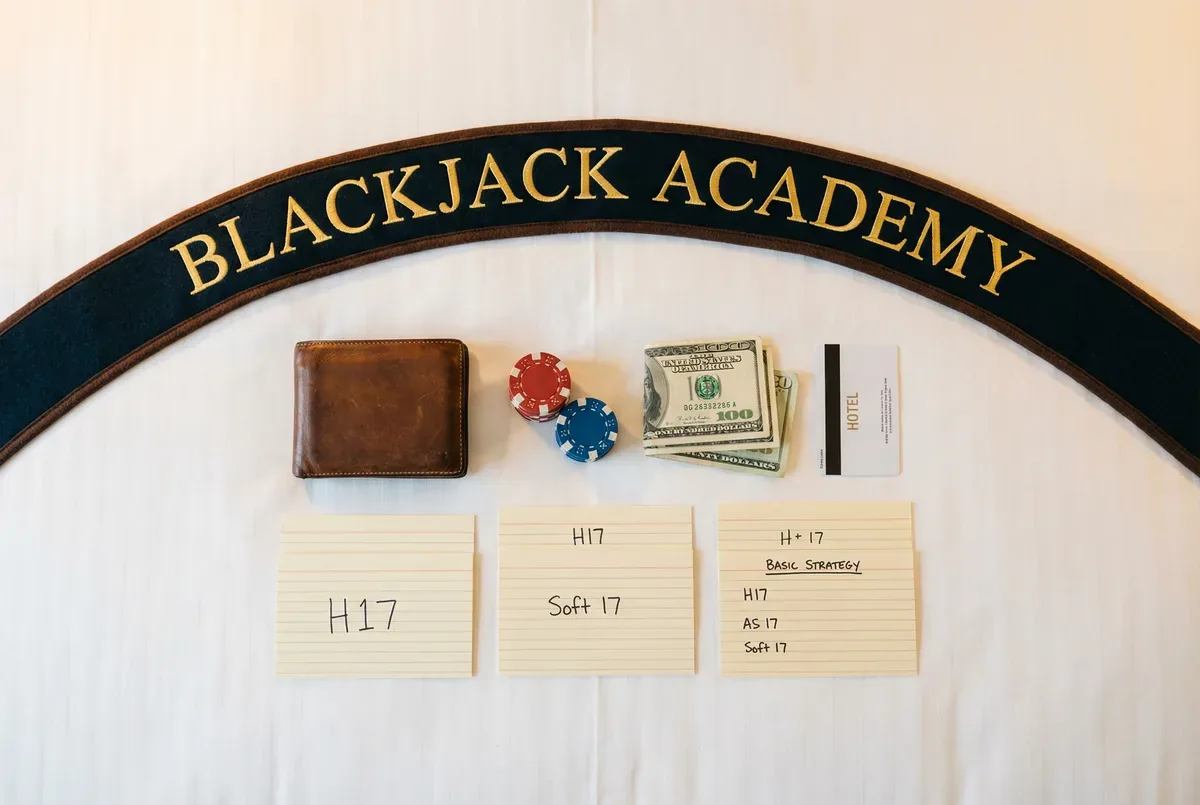
The Complete Card Counter’s Pre-Trip Checklist
A pre-trip checklist is the single most important ritual a card counter can establish, separating the players who grind out an edge consistently from those who show up unprepared and donate money to conditions they could have avoided.

Why Serious Counters Run a Checklist Before Every Trip
Most counters lose money not because their technique fails in the casino they lose because they went before they were ready. They drove three hours to a property whose penetration dropped to 50% last month. They sat at a table with a $50 minimum when their bankroll required a $15 minimum to play without ruin risk. They hadn’t drilled in two weeks and their true count conversion lagged by half a second. Each failure is preventable. A rigorous checklist is how professionals prevent it.
This checklist is organized in the sequence you should run it: game research first, drill verification second, bankroll confirmation third, physical readiness fourth, and logistics last. Every item is a gate. If any gate fails, the trip does not happen.
- 1. Penetration reporttarget casino deals 75%+ into shoe
- 2. Rules confirmedS17, DAS, RSA, no CSMs at target tables
- 3. Table minimum fits bankroll (min bet = 1/200 of total trip bankroll)
- 4. Speed test passed200 cards counted in under 90 seconds without error
- 5. Accuracy test passed3 full shoes dealt with zero running count errors
- 6. True count conversion drilledmental TC from any RC within 0.5 seconds
- 7. Bankroll in cash, separate from personal funds, physically present
- 8. Session stop-loss set20 max-bet units per session
- 9. Physical check8+ hours sleep, zero alcohol, no illness, no major stress
- 10. Trip length plannedmax 2 sessions per day, departure time fixed in advance
What Is Game Research?
Penetration is the single most important variable in determining whether a casino trip is worth making a game with 65% penetration is roughly three times less profitable than the same game dealt to 80%, and no counting system overcomes shallow cut cards.
Penetration reports come from multiple sources: counting forums like CVCX community boards, trip reports on advantage play networks, direct scouting trips, or trusted contacts at the property. Reports go stale within two to four weeks casinos shift cut card placement seasonally, during management changes, or in response to recent counter activity. A penetration report that is six weeks old is close to useless. Confirm within the last 14 days or scout in person before committing to the session.
Beyond penetration, verify the full rule set: dealer stands or hits soft 17 (S17 vs H17 is worth roughly 0.2% in expected value), whether doubling after split is permitted, whether re-splitting aces is allowed, surrender availability, and whether continuous shuffle machines have replaced hand-dealt games at your target table tier. Some properties run CSMs at low-limit tables and pitch or shoe games at higher limits know before you park the car.
Target penetration
% minimum into shoe
Speed benchmark
in under 90 seconds
Accuracy floor
zero RC errors
What Is Drill Requirements?
Drilling requirements before a trip exist because the casino environment degrades performance noise, alcohol fumes, distraction from other players, and social pressure from dealers all slow your count and introduce errors that flip your edge into a deficit.
The speed test is non-negotiable: flip through a full deck of 52 cards and call the final running count aloud. You must complete this in under 25 seconds with zero errors. Then run two more decks without pausing. This simulates the sustained pace of a six-deck shoe dealt at 70–80 hands per hour. If you cannot maintain accuracy at speed in a quiet room, you will certainly drop errors in a noisy pit.
The accuracy test requires dealing out three complete six-deck shoes and verifying the running count at each shuffle it must return to zero every time. Any non-zero result means a counting error crept in somewhere in that shoe. Three clean shoes back-to-back is the floor standard. One error in three shoes is a reason to drill for another 48 hours before traveling.
True count conversion must be reflexive, not calculated. Given any running count between -12 and +12 and any remaining deck estimate between 1 and 5, you need the correct TC within half a second. Hesitation at the table during betting decisions is one of the most reliable heat signals floor managers are trained to notice. If your TC conversion requires conscious arithmetic, you are not ready.
What Are Bankroll Verification and Session Planning?
Bankroll verification means physically confirming, in cash, that the funds you plan to play with exist and are separate from personal money not a number in a bank account balance that also covers rent.
The minimum unit formula for blackjack card counting is 200 times your minimum bet. If the target table runs a $25 minimum, you need $5,000 in dedicated playing bankroll before that table is appropriate for your risk of ruin calculations. This is not the money you bring to the casino it is the total edge-play bankroll from which the trip stake is drawn. Bringing your entire edge-play bankroll to one trip is a separate risk management failure.
Session stop-loss rules must be set before you leave the house, not while you are losing at the table. A standard stop-loss for a single session is 20 max-bet units. If your max bet is $100, you stop playing that session after losing $2,000. This rule exists because variance can produce losing streaks that look indistinguishable from skill failure in the moment. The stop-loss protects your bankroll until the next session; it does not protect you from emotion.
Trip length planning should cap at two sessions per day and include a fixed departure time set before arrival. Open-ended casino trips are where counters make the worst decisions. If you are scheduled to leave at 6 PM, you do not extend because you are stuck. The edge is the same in every session; chasing losses in session three of a day is not edge play, it is compulsive gambling with a counting overlay.
The 24-hour rule: if your count is not clean today, you do not go tomorrow. Variance in the casino is permanent. Your skills are not. One extra day of drilling costs you nothing. One trip taken before you were ready can cost you a month of bankroll and a backoff at the only beatable property in your region. Train until three clean shoes in a row feels boring. Then go.
Physical Readiness, What to Bring, and Putting It All Together
Physical readiness is as technical as counting accuracy fatigue degrades true count conversion by the same mechanism it degrades driving reaction time, and a tired counter at hour six of a session is a counter who is making index play errors that quietly eliminate the edge.
Eight hours of sleep the night before is the floor, not the target. No alcohol for at least 24 hours before play not because casinos offer free drinks (you will decline), but because residual dehydration from the previous evening slows cognition measurably. No illness, even mild: a head cold drops focus by 15–20% and extends TC conversion time enough to produce index errors on borderline decisions. Major personal stress a significant argument, financial anxiety outside the bankroll, a medical appointment looming is sufficient grounds to postpone. The casino will be there next week. Your edge requires your full cognitive capacity.
What to bring: playing bankroll in cash, a valid ID, a phone with a quiet timer app for session tracking, comfortable clothing that does not mark you as a regular. What to leave home: loyalty cards tied to your real identity, any behavior journal that could be discovered, and the attitude that this trip needs to be profitable to justify the work. Every trip is a sample. Samples are evaluated in aggregate, not individually. Professionals who want to try their skills at a real-money table can visit put this count to work with real stakes tonight but understand that real money is at risk in every session, and no checklist eliminates the variance inherent to any casino game. Bring only what you can afford to lose on this trip specifically.
Frequently Asked Questions
Penetration reports older than 14 days are unreliable. Casinos shift cut card placement frequently, especially after counter activity or management changes. Confirm from a fresh source or scout the property personally within two weeks of your planned trip.
You need at least $5,000 in dedicated edge-play bankroll before a $25 table is appropriate that is 200 times the minimum bet. This is the total bankroll from which trip stakes are drawn, not the cash you bring in a single session.
No. Both tests must pass independently. Speed without accuracy is dangerous, but accuracy without speed means you will drop count at table pace. The casino deals at 70–80 hands per hour under social pressure. Your benchmarks must be met in a quiet room before you face those conditions.
Before you test these plays at a real table, run them through our free blackjack simulator practice unlimited hands at zero cost until every move becomes automatic.
Mathematical Risk Warning
Card counting requires significant skill, bankroll, and preparation. All casino games involve real financial risk. Never play with money you cannot afford to lose.
Blackjack Academy is an educational resource. All strategy is based on mathematical expectation. Always play within your means.

Written by
Mark AnurakProfessional card counter since 2009 · 500,000+ hands logged · Former Macau advantage player. Studied under Thorp, Griffin & Wong methodology. Full bio →
Learn More
Continue your education with these related lessons.

Don Schlesinger’s Blackjack Attack and Its Most Powerful Counting Lessons
An in-depth look at Don Schlesinger's Blackjack Attack: its contributions to card counting through the Illustrious 18, SCORE methodology, and…
How to Handle the Insurance Side Bet as a Card Counter
Insurance looks like a safety net but it's a losing side bet unless you're counting cards. Learn the TC+3 threshold…

The Complete Guide to Back-Counting (Wonging)
Wonging back-counting a shoe and entering only at positive counts is theoretically the most efficient use of counting skill. Here…