
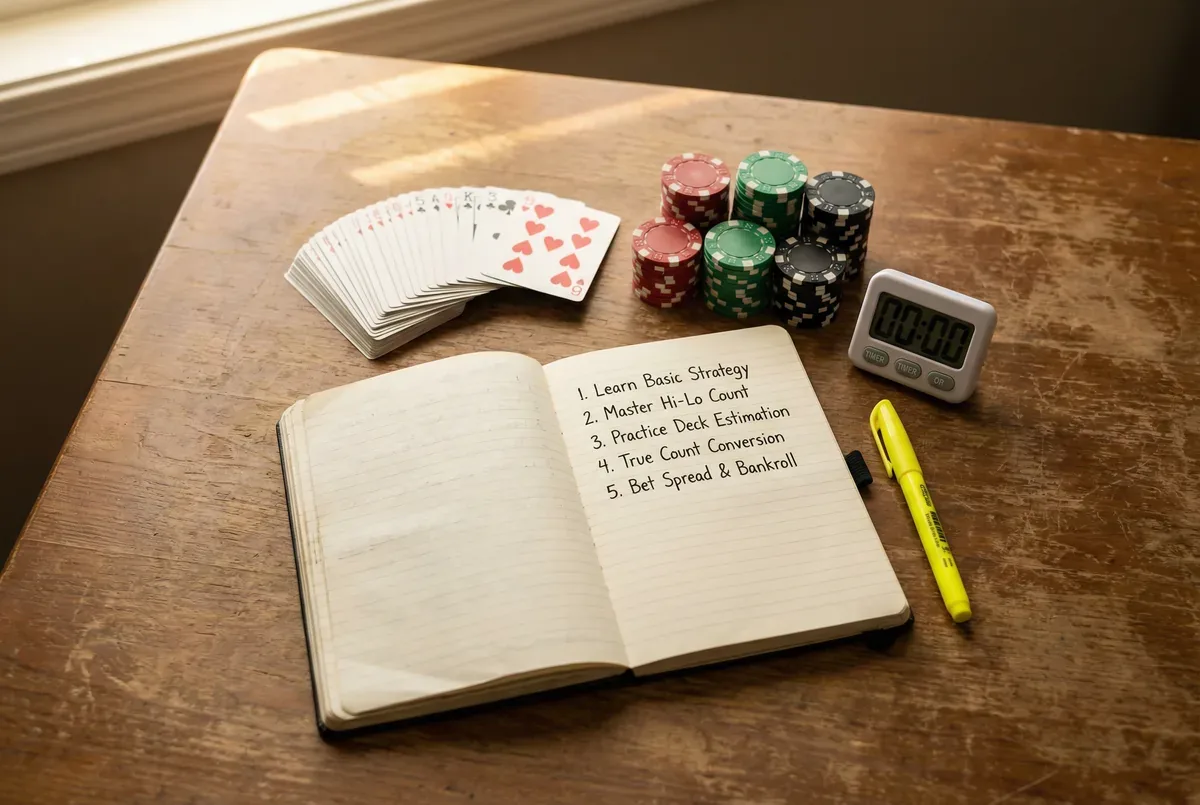
Your Complete Card Counting Action Plan
Most blackjack card counting journeys fail not because the skill is too difficult but because learners lack a structured progression with clear exit criteria at each stage they practice randomly, move to the next concept too early, and arrive at a live casino with gaps they did not know they had. A six-stage action plan with measurable benchmarks eliminates that failure mode by telling you exactly what casino-ready means and exactly how to verify you have reached it.

Why Most Counting Journeys Stall and How a Roadmap Fixes That
The six stages are: perfect blackjack basic strategy, single-card Hi-Lo recognition, full-deck running count drills, true count conversion, live dealer online practice, and first live casino session. Each stage has an exit criterion a specific, measurable performance threshold that you must clear before advancing. Not a rough sense that you are ready, but a verifiable benchmark. This structure matters because counting errors compound: a player who advances to true count conversion with shaky running count accuracy will build false confidence on a cracked foundation.
Total cumulative time from Stage 1 entry to Stage 6 readiness is approximately 150 to 350 hours for most adult learners, depending on prior card game experience and daily practice volume. This range is wide because individual variation is real some learners reach card recognition speed in two weeks; others need six. What matters is not speed of advancement but completeness of each stage before moving forward.
Timeline
Stage 1
Perfect Basic Strategy: Exit criterion: zero errors on 500 consecutive hands against all dealer upcards. Estimated hours: 20–40. No counting until this is automatic.|Stage 2: Single-Card Hi-Lo Recognition|Exit criterion: classify every card as +1, −1, or 0 in under 1 second per card without hesitation. Estimated hours: 10–20.|Stage 3: Full-Deck Running Count Drills|Exit criterion: count an entire 52-card deck in under 25 seconds with zero errors, three consecutive attempts. Estimated hours: 20–40.|Stage 4: True Count Conversion|Exit criterion: convert running count to true count within 2 seconds of a decks-remaining estimate, accurate to ±0.5 at any point in the shoe. Estimated hours: 15–30.|Stage 5: Online Live Dealer Practice|Exit criterion: 50+ tracked sessions with documented positive EV trend, consistent bet-spread execution under full conversation distraction. Estimated hours: 60–150.|Stage 6: First Live Casino Session|Exit criteria met: all Stage 1–5 benchmarks cleared, session checklist reviewed, bankroll set at 300+ units, target venue researched, back-off protocol memorized.
What Is Stages 1 and 2?
Basic strategy must be automatic before counting begins not mostly memorized, not accurate under optimal conditions, but reflexively correct under distraction, fatigue, and social pressure. The exit criterion for Stage 1 is zero errors on 500 consecutive hands dealt against every dealer upcard combination. This benchmark exists because at a live casino, you will be managing the running count, the true count conversion, bet sizing, social interaction, and blackjack basic strategy simultaneously. Any strategy decision that requires conscious deliberation consumes cognitive bandwidth that belongs to the count.
Use a blackjack basic strategy trainer app with a hard-stop on incorrect responses. Do not guess and continue guessing and continuing trains the wrong pattern. Every incorrect response should trigger a review of that exact hand configuration. Track your error rate across sessions and look for the specific decision types where errors cluster: hard 12 vs dealer 2 and 3, soft 18 vs dealer 9 and 10, pair of 9s against dealer 7. These are the statistically common failure points. Drill them until they feel as automatic as your own name.
Stage 2 is single-card Hi-Lo classification. Every card in the deck must trigger an immediate, unconditional count response: 2 through 6 is +1, 7 through 9 is 0, 10 through Ace is −1. The exit criterion is under one second per card without hesitation across an entire deck. Use a physical deck of cards, not a phone app the physical manipulation builds a kinesthetic association that transfers better to the speed of live dealing. Time yourself with a stopwatch. The one-second threshold sounds easy until you try it cold for the first time.
- Stage 1 CLEARED500 consecutive hands, zero errors, basic strategy fully automatic
- Stage 2 CLEAREDfull deck classified in under 52 seconds (sub-1s per card), zero hesitations
- Stage 3 CLEAREDfull deck running count in under 25s, three consecutive perfect attempts
- Stage 4 CLEAREDtrue count conversion within 2 seconds, accurate to ±0.5, any shoe depth
- Stage 5 CLEARED50+ live dealer sessions logged, positive EV trend documented, distraction test passed
How Do You Runn Count and True Count Precision?
Stage 3, full-deck running count, and is where most self-taught counters discover that their Stage 2 speed was not actually sufficient. Counting a single card in under a second is different from maintaining a continuous running count through a deck dealt at realistic speed. The full-deck drill bridges that gap. Your goal is to deal yourself a standard 52-card deck face-up, two cards at a time as a dealer would pitch them, and arrive at a final count of zero because a full deck has equal numbers of high and low cards in under 25 seconds with zero arithmetic errors. Three consecutive successful attempts clear the stage.
Common errors at Stage 3: counting only one card of a two-card delivery, losing the count when a face card appears after a long run of neutral cards, and arithmetic drift during rapid dealing. The solution to all three is deliberate repetition with error logging. When you miss, note the exact card sequence that triggered the error. Pattern-specific drilling is faster than generic repetition.
Stage 4, true count conversion, and requires dividing your running count by the estimated number of remaining decks at any point in a multi-deck shoe. The exit criterion is conversion within two seconds, accurate to within ±0.5 true count, at any shoe depth from one deck remaining to five. Practice with a partner who calls out a running count and a cards-remaining estimate at random while you provide the true count verbally. The two-second window is strict because at a live table, you convert while the dealer is settling the previous hand there is no pause for arithmetic.
What Happens at Stage 5?
Stage 5 online live dealer practice is the most important stage for building real-world readiness, because it introduces the one variable that no home drill can replicate: maintaining an accurate count while interacting with other humans at real dealing speed. Live dealer blackjack uses real cards dealt by a real dealer on a real table, streamed in real time. The counting conditions are genuine. The social pressure is real. The temptation to let your count slip when conversation happens at the table is real.
The exit criterion for Stage 5 is fifty or more tracked sessions with a documented positive EV trend, and consistent bet-spread execution measured against your count record. Track every session: shoe penetration, your starting count at each hand, your bet size, and the outcome. This record serves two functions. First, it creates verifiable evidence of positive EV trend which tells you whether your true count accuracy is translating to advantage. Second, it trains the habit of session discipline and record-keeping that defines professional advantage play.
The distraction test is embedded in Stage 5: if you cannot hold your count while the chat interface is active, while other players are making decisions, while the dealer is speaking you are not ready for Stage 6. The ability to maintain full count accuracy under ambient distraction is the single sharpest predictor of live casino performance. Players who skip Stage 5 and move directly to live casino play consistently report losing the count in the first twenty minutes of their first session.
Here is the final test before Stage 6: sit down with a running deck drill and turn on a podcast at full volume. Count the full deck in under 30 seconds five seconds slower than your silent standard while the podcast is playing. If you cannot do that, you are not ready for Stage 6. A live casino is louder than a podcast, more distracting than a podcast, and it involves real money on every hand. The counter who passes this test knows their count is genuinely automatic. The counter who fails it learns something valuable before it costs them anything.
Stage 6: Your First Live Casino Session Checklist
Stage 6 readiness means every prior exit criterion has been cleared and documented not approximately, not mostly, but specifically verified and you have completed a pre-session checklist that covers bankroll, game selection, session management, and back-off protocol. The checklist is not bureaucratic overhead. It is the operational procedure that separates a prepared advantage player from an enthusiastic amateur walking into a live game with unresolved gaps in their preparation.
Bankroll: minimum 300 units at your intended bet size before your first session. At $10 units, that is $3,000 dedicated to blackjack bankroll not money you need for other purposes. This reserve exists to absorb variance. Even with a genuine edge, you will have losing sessions. A 300-unit bankroll keeps you solvent through the losing runs that are mathematically inevitable. Game selection: research your target venue in advance. Confirm the rules, H17 vs S17, DAS, RSA, and and the estimated penetration. Do not sit down at a game you have not vetted.
Session management: set a hard time limit before you sit down. Ninety minutes at a single table is a reasonable first-session ceiling. Know your back-off protocol before you need it: if a supervisor approaches and asks about your play, you are not obligated to answer, and you are free to leave. Staying calm during a back-off is a skill you should have rehearsed mentally before it happens in person. When you are ready to put all of this into action in a lower-stakes environment first, execute your counting action plan at a live real-money table offers a live-format table where you can run through your session checklist in real conditions just be clear with yourself that any step toward real-money play carries genuine financial risk, and only your fully prepared, fully bankrolled self should make that move.
Frequently Asked Questions
Most adult learners reach Stage 6 readiness in 150 to 350 cumulative hours of deliberate practice across all six stages. The range reflects individual variation in prior card game experience, daily practice volume, and how strictly each exit criterion is enforced before advancing.
Count a full 52-card deck in under 25 seconds with zero running-count errors, achieved on three consecutive attempts. Two cards are dealt at a time to match live dealing pace, and the final count must resolve to zero confirming no arithmetic drift.
Stage 5 is the only home-accessible environment that replicates the core challenge of live counting: maintaining accuracy while interacting with other humans at real dealing speed. Players who skip Stage 5 consistently lose their count in the first twenty minutes of their first live casino session.
Before you test these plays at a real table, run them through our free blackjack simulator practice unlimited hands at zero cost until every move becomes automatic.
Mathematical Risk Warning
Completing this roadmap prepares you technically. It does not eliminate financial risk. Live blackjack involves real money and real variance only step into a live game with a dedicated bankroll you can afford to lose entirely.
Blackjack Academy is an educational resource. All strategy is based on mathematical expectation. Always play within your means.

Written by
Mark AnurakProfessional card counter since 2009 · 500,000+ hands logged · Former Macau advantage player. Studied under Thorp, Griffin & Wong methodology. Full bio →
Learn More
Continue your education with these related lessons.

How to Maximize Value From Every Casino Visit as a Counter
Every casino visit has a structure that either maximizes or wastes your counting edge. Learn pre-visit planning, the rotation strategy…

How to Use Shuffle Tracking as an Advanced Counting Extension
Shuffle tracking extends card counting by predicting where clumps of high or low cards land after the shuffle. Learn zone…

What Card Counting Actually Is and Why Most Players Get It Wrong
Card counting is not memorization, not cheating, and not magic. It is a legal, mathematically grounded technique that shifts the…