

Is Card Counting Worth It? The Honest ROI Analysis with Real Numbers
Card counting ROI is calculated by dividing net expected value by total time invested not just hands played, but every hour spent learning, drilling, traveling, and managing sessions which produces a true hourly rate that most introductory guides never compute honestly. When you run that calculation at realistic bet levels, the result is illuminating, sometimes humbling, and always worth knowing before you invest months of practice into a skill.
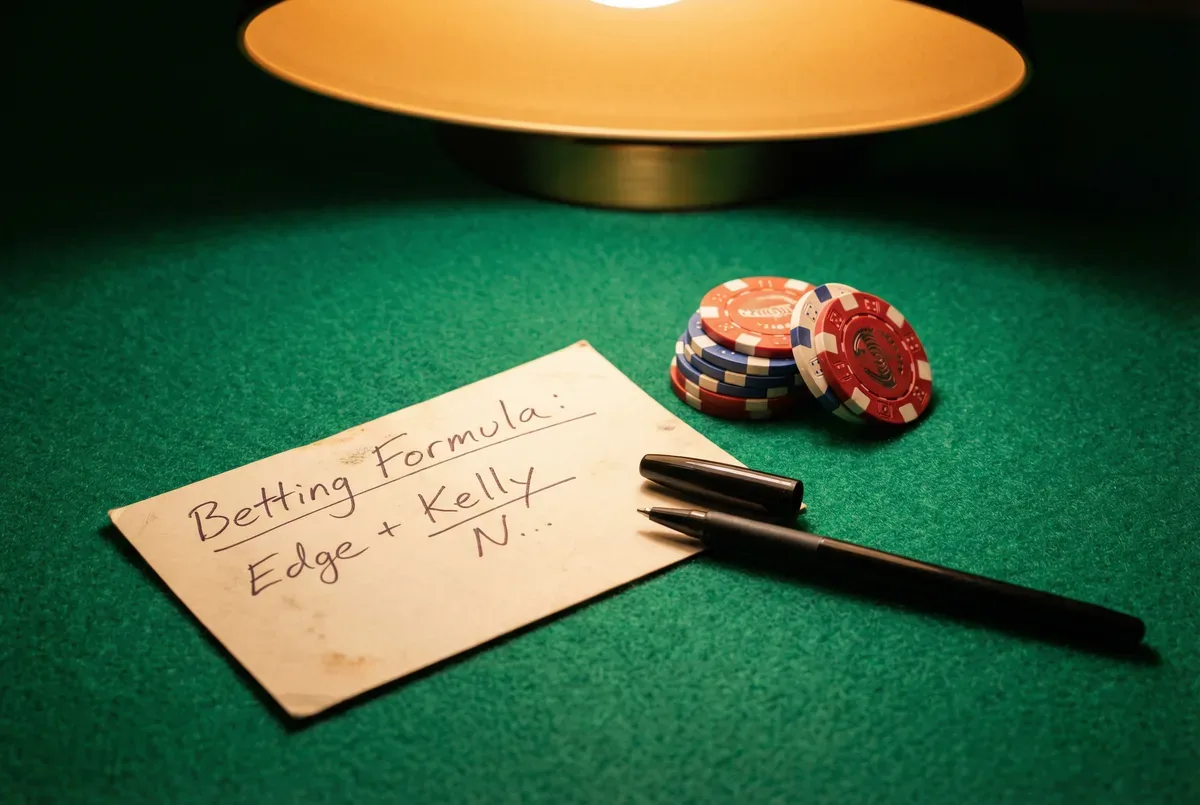
The Real ROI Formula for Card Counting
The edge itself is real and documented. A competent Hi-Lo counter playing a favorable six-deck game with 75% penetration, proper blackjack basic strategy, and a 1-to-12 bet spread generates approximately 0.5% to 1.0% player advantage over expected value. At 80 hands per hour a reasonable pace at a live table the EV per hand is a function of your unit size multiplied by that advantage. At $25 units, 80 hands per hour, and a 0.7% edge, your expected win rate is roughly $14 per hour of play.
The critical word is play. Time at the table is not the same as total time invested. Add setup: travel to a casino with favorable conditions, parking, walking the floor, finding a good table. Add learning: most players require 200 to 400 hours to reach casino-ready proficiency. Amortize that learning cost across a realistic session volume, and the effective hourly rate drops sharply in the early years of play.
Hours to learn Hi-Lo to casino standard
hrs
Expected EV at $10 unit (80 hands/hr, 0.7% edge)
per hour played
Expected EV at $25 unit (same conditions)
per hour played
What Are Realistic Stake Levels and What They Actually Return?
Realistic income projections for blackjack card counting depend almost entirely on stake level, game conditions, and session frequency three variables that interact in ways that create very different experiences for different types of players. Running the numbers at three common unit levels reveals why counting is a compelling proposition at one end of the spectrum and a marginal time allocation at the other.
At a $10 minimum unit, the EV ceiling is approximately $5 to $7 per hour played in good conditions. After accounting for two hours of travel and setup overhead per session, a two-hour session yields roughly $10 to $14 in net expected profit less than minimum wage in most US cities. This does not mean $10-unit counting is wrong. It means the primary return is not financial: it is skill development, confidence building, and low-stakes practice that prepares you for higher units.
At $100 units, expected hourly EV reaches $50 to $70 in favorable conditions. A dedicated player running 10 sessions per month of three hours each generates $1,500 to $2,100 in expected monthly profit from play alone. The volatility at this level is significant a three-session losing streak is routine even with a positive edge but the expected return justifies serious investment in game conditions, travel, and session discipline. This is where blackjack card counting begins to function as a genuine part-time income stream.
The gap between $10 and $100 units is not just arithmetic. It is the difference between a hobby that pays for itself and a skill that generates meaningful income. The decision about which level suits you is ultimately about bankroll, risk tolerance, and how much the non-monetary components of counting the intellectual engagement, the discipline matter to you independent of financial return.
Advantages
- Documented mathematical edge not gambler's fallacy, actual positive EV
- Skill transferable across all live blackjack jurisdictions globally
- Intellectual challenge and pattern recognition rewarding independent of income
- At $100+ units, competitive hourly EV vs many conventional part-time work
- Disciplines entire approach to gambling and money management
Disadvantages
- Learning curve of 200–400 hours before casino-ready accuracy
- Low unit-size EV often fails to beat opportunity cost of time
- Casino back-offs compress operational lifespan at any single property
- High variance requires substantial bankroll (300+ units) for ruin protection
- Travel and setup overhead reduce effective hourly rate significantly
What Is Opportunity Cost?
Opportunity cost what you could earn or achieve with the same time invested in an alternative skill is the variable that most blackjack card counting guides deliberately omit, because including it complicates the sales pitch. A realistic ROI analysis cannot omit it. The 300 hours required to develop casino-ready counting proficiency is 300 hours that could be allocated to a professional certification, a freelance skill, a business system, or any other compounding return activity.
For a player earning $20 per hour in their professional life, 300 learning hours represent $6,000 in foregone income or output. Recovering that through counting at $25 units, generating $14 per hour of play, requires approximately 430 hours of play more than a year of dedicated sessions for most people. The break-even horizon extends further when you account for session overhead and the inevitable losing variance in early career play.
This does not make counting a bad investment. It makes it a contextual one. A player who genuinely enjoys the intellectual process who finds counting inherently engaging, not merely instrumentally valuable is not bearing the full opportunity cost in the same way, because some portion of those 300 hours delivers value beyond financial return. Intellectual satisfaction, discipline development, and the unique experience of playing with an edge in a live casino all have real worth that does not appear in the EV calculation.
Who Card Counting Is Actually Worth It For?
Card counting is worth it for three specific player profiles: high-stakes players with access to favorable game conditions, players who value the intellectual challenge independent of income, and players building toward professional advantage play who understand the long learning curve. For everyone else, the honest answer is that the financial return at typical bet levels does not justify the time investment when compared to the available alternatives.
Casual players at low stakes in markets with poor game conditions high blackjack house edges, continuous shuffling machines, unfavorable rules should not count on counting to change their financial relationship with blackjack. The edge requires good conditions to materialize. In a 6:5 game with 50% penetration, even a perfect count is worth nearly nothing. The mathematical reality is that game selection matters as much as counting skill, and in many markets, good games simply are not available.
For players who meet the criteria favorable games, adequate bankroll, genuine engagement with the skill the verdict is clearly positive. Card counting is one of the few casino activities where the player holds a documented mathematical advantage, and that advantage is both real and repeatable. The honest ROI just requires seeing it clearly, not through the lens of folklore about MIT teams, but as a specific mathematical proposition with specific input requirements.
Net ROI = (Expected EV per hand × hands played) − (learning hours × opportunity cost rate) − session overhead costs. This formula is honest. Run it at your stake level before you invest 300 hours in learning.
The ROI Formula
The Honest Final Verdict and Where to Start
The honest verdict on blackjack card counting is this: it is one of the most intellectually legitimate approaches to a casino game that exists, and it is worth it precisely for the players who go into it with accurate expectations. The MIT team mythology and the Hollywood dramatization have done real damage by setting expectations that no realistic counting career can match. Strip away the mythology and what remains is a genuine, mathematically verified edge that requires real work, real bankroll, and real patience to access.
Run your own numbers honestly. Identify your intended bet level, your realistic session volume, and your actual opportunity cost rate. If the ROI equation works for your situation, blackjack card counting is a remarkable skill. If it does not work at your current bet level, the answer may not be to abandon the skill it may be to develop it now at low stakes while building toward the unit level where the economics genuinely favor you. Before risking real money on a live table, stress-test this count at a live dealer table this week is worth visiting to stress-test your count accuracy in a live-dealing environment and always approach real-money play with clear eyes about the fact that variance is real and no mathematical edge protects you from losing sessions.
Frequently Asked Questions
In good conditions six-deck shoe, 75% penetration, favorable rules a competent counter at $25 units can expect approximately $12 to $16 per hour of active play. Session overhead (travel, setup time) reduces the effective rate when calculated against total time invested.
At $25 units, recovering a 300-hour learning cost at roughly $14 EV per play hour requires approximately 430 hours of live play. That break-even horizon is longer than most guides acknowledge, though the learning process has value independent of financial recovery.
For casual players at low stakes in average game conditions, the honest answer is usually no the financial return does not exceed the opportunity cost of the learning time. The activity has real value for players who find it intrinsically engaging or who are targeting higher stake levels.
Before you test these plays at a real table, run them through our free blackjack simulator practice unlimited hands at zero cost until every move becomes automatic.
Mathematical Risk Warning
Card counting gives you a mathematical edge, not a guarantee. Variance is real, losing streaks are routine, and no edge eliminates financial risk. Only play with money you can genuinely afford to lose.
Blackjack Academy is an educational resource. All strategy is based on mathematical expectation. Always play within your means.

Written by
Mark AnurakProfessional card counter since 2009 · 500,000+ hands logged · Former Macau advantage player. Studied under Thorp, Griffin & Wong methodology. Full bio →
Learn More
Continue your education with these related lessons.

The Zen Count Is a Powerful Balanced Multi-Level System for Experts
The Zen Count is Arnold Snyder's balanced multi-level system that assigns finer card values than Hi-Lo to extract more edge…

The True Cost of Index Play Errors in Card Counting
Index play errors are not neutral each wrong deviation costs real EV and can turn a positive-expectation edge into a…

How to Count Cards in a Crowded Casino Without Being Obvious
The real detection risk for card counters is not your behavior at the table it is the pattern of your…