
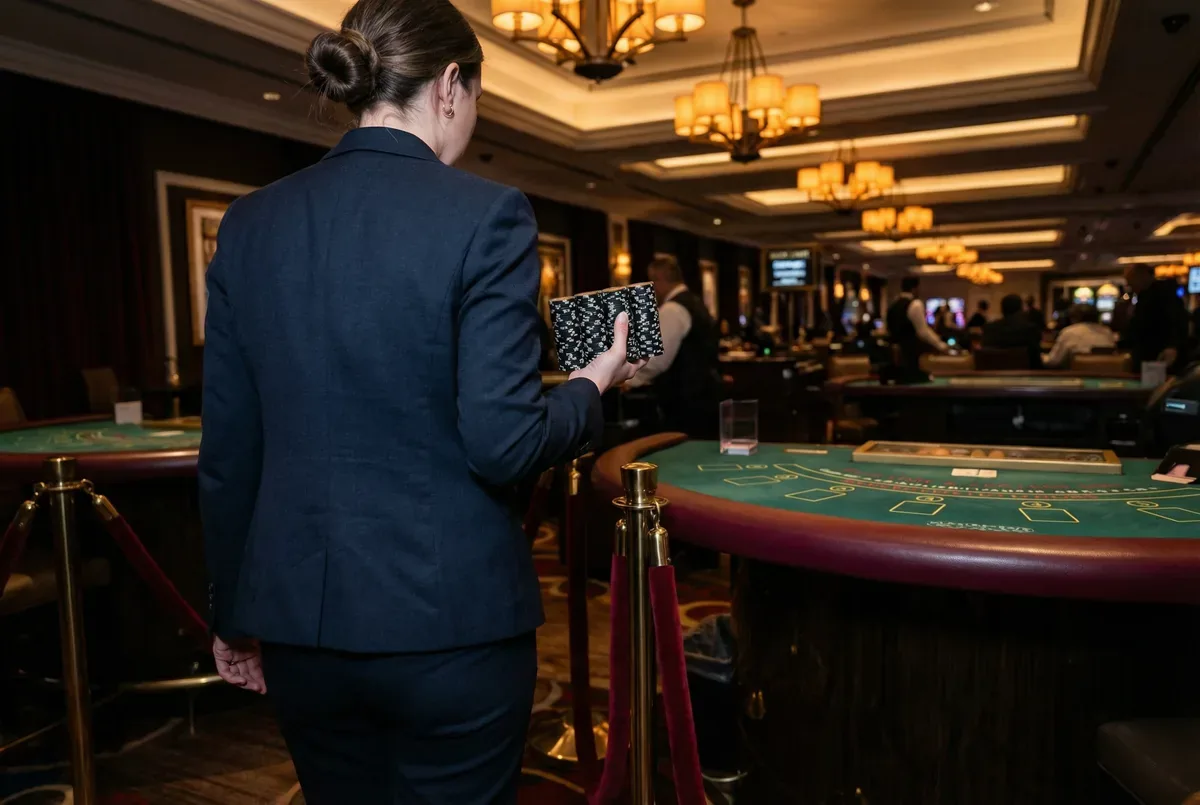
The Powerful Big Player Technique for Spreading Bets Without Heat
The Big Player technique is an advantage-play method where a counter enters a table only when the true count is already positive, bets large immediately, and departs before the count neutralizes eliminating the bet ramp that surveillance software is designed to detect.
What the Big Player Technique Actually Is
In its classic team form, a spotter sits at the table betting minimum, maintains the count silently, and signals the Big Player to walk in. The BP arrives with no betting history at that table, drops a large wager, extracts value across a few positive-count shoes, then departs casually. Surveillance sees a high roller jumping tables a common enough behavior that it rarely triggers concern on its own.
Solo BP play differs in execution but preserves the same logic. The solo counter scouts tables personally, notes the count during a bathroom break or walk-by, then returns to bet big. The bet ramp the pattern of small-to-large wagers that flags a counter never appears in the data, because the player has no prior betting history at that shoe.
Standard Counter
Big Player
- Gradual ramp up/down
- Ramp visible in records
- Extended session (1–3 hrs)
- All count range
- Accumulates over session
- 20–25x max bet
- Single dealer, uncrowded
- Large bet on entry only
- No historical ramp at table
- Short burst (20–40 min)
- Positive counts only
- Minimal no ramp pattern
- 35–50x max bet (selective play)
- Busy floor, multiple tables
Why the BP Sidesteps the Bet-Ramp Problem?
Surveillance systems flag card counters primarily by detecting bet correlation with the count specifically the pattern of bets rising as the shoe depletes high cards for the dealer and lowers them for the player.
A standard counter who sits through an entire shoe produces a data trail: minimum bets in neutral or negative counts, escalating bets as the true count climbs. Modern casino software does not need a human to spot this it runs correlation analysis automatically across every player’s session. A bet ramp that correlates with estimated true count above a threshold score triggers a review flag.
The BP enters with a large bet and no prior data at that shoe. The system has nothing to correlate against. If the BP bets $500 flat for six hands and leaves, that looks like a high roller taking a quick shot not a counter working a count. The absence of a ramp is the entire defense.
Advantages
- No bet ramp in player history
- Highest-EV hands only no grinding through negative counts
- Cover story (high roller behavior) is natural and common
- Works in team or solo format
- Reduces total hands played, cutting variance exposure
Disadvantages
- Requires significantly larger bankroll than standard counting
- Solo scouting is time-intensive and physically demanding
- Missing the signal (in team play) means wasted bankroll exposure
- Casinos have adapted: BP pattern itself now flagged at some properties
- Requires excellent count accuracy no time to recount mid-session
What Are Signals, Self-Scouting, and the Solo BP System?
Classic team BP play depends on reliable signals: a spotter communicates both the table’s availability and the current true count to the BP without either party appearing connected.
Common signal methods include casual physical gestures (touching a drink, adjusting chips), position changes at the table, or proximity cues. The BP walks past, reads the signal, and either approaches or moves on. The goal is zero observable interaction between the two players. A BP who glances at the spotter before every approach is creating exactly the pattern casinos train their floor staff to notice.
Solo BP play eliminates the signal problem at the cost of efficiency. The solo counter scoutes mid-shoe opportunities personally watching a shoe from across the pit during a stroll, estimating the count from visible cards dealt, then deciding whether to sit. A rough count gleaned from 15 to 20 visible cards is less accurate than a running count from shoe start, but it can confirm whether a shoe is in a highly positive state worth entering. Solo BP counters often accept a looser entry threshold TC +3 or higher to compensate for count uncertainty on entry.
How Does Bankroll, Cover, and How Casinos Have Adapted?
The BP technique demands a disproportionately large bankroll relative to the edge captured, because selective play introduces variance spikes that a full-session counter does not face.
A standard counter playing through every count has a smoothed expected-value curve over hundreds of hours. A BP who enters only at TC +3 or above bets maximum on almost every hand meaning short runs of bad luck hit at full bet size with no cushion from prior minimum-bet hands. Practitioners typically require 35 to 50 times their maximum bet as a working bankroll to survive the variance inherent in selective high-bet play.
Cover for table departure matters as much as cover for entry. A BP who bets $500, wins three hands, and immediately walks sends an obvious signal. The correct behavior is to color up chips deliberately, exchange a word or two with the dealer, and leave at a natural pace as if heading to dinner rather than executing a calculated exit. Rushing the departure is one of the most frequent mistakes even experienced BPs make.
Casinos have adapted. Modern surveillance systems specifically flag table-hopping behavior combined with large first bets, particularly when the player shows no prior history at the property. Some properties now track first-bet size as a standalone metric. The BP technique still works but the effective entry threshold at well-surveilled properties has shifted. Solo BPs at Strip properties often need TC +4 or higher before the risk-adjusted EV justifies entry.
Table departure is your biggest cover risk, not entry. Always color up slowly, stack chips deliberately, and give the dealer a moment before you leave. A rushed exit after a winning burst is a louder tell than any bet ramp. Budget 90 seconds for every departure it costs nothing and buys you the next session.
Putting the BP Technique Into Practice
The Big Player technique is not a beginner’s tool. It requires a solid Hi-Lo count, accurate true-count conversion under real casino conditions, and enough bankroll discipline to walk away from a table mid-session without hesitation when the count drops.
For players ready to apply it, see this edge in live counted play under pressure offers live-dealer sessions where you can rehearse table-entry decisions and count-based bet sizing against a real shoe but understand that real money is at stake in every live session, and no advantage play system eliminates the risk of loss on any individual run of hands.
Frequently Asked Questions
Yes. Solo BP play involves scouting tables personally, estimating the count from mid-shoe observations, and entering only when the count is clearly positive. The solo approach is less efficient than team play but avoids the coordination risks of working with partners.
Most practitioners recommend 35 to 50 times your maximum bet. Because a BP bets large on nearly every hand (entering only at positive counts), a short losing run hits at full size with no prior minimum-bet cushion to offset it.
Yes. Modern surveillance flags table-hopping combined with large first bets and no player history. Well-surveilled properties, particularly on the Las Vegas Strip, now require a higher true count threshold (TC +4 or above) before the risk-adjusted edge justifies entry.
Before you test these plays at a real table, run them through our free blackjack simulator practice unlimited hands at zero cost until every move becomes automatic.
Mathematical Risk Warning
Card counting and advantage play involve real financial risk. Even with a long-run edge, individual sessions can produce significant losses. Never play with money you cannot afford to lose.
Blackjack Academy is an educational resource. All strategy is based on mathematical expectation. Always play within your means.

Written by
Mark AnurakProfessional card counter since 2009 · 500,000+ hands logged · Former Macau advantage player. Studied under Thorp, Griffin & Wong methodology. Full bio →
Learn More
Continue your education with these related lessons.
How the Red Seven Count Compares to Hi-Lo for Beginners
Arnold Snyder's Red Seven count eliminates true count conversion by using an unbalanced design. Here is how it compares to…

How to Count Cards Without Getting Caught Using Proven Cover Plays
Cover plays are deliberate actions that disguise card counting from casino surveillance. Learn what they cost, when to use them,…
The Advanced Counting Player’s Complete Glossary
A comprehensive glossary of 30+ card counting and advantage play terms, from running count and true count to SCORE, N0,…