
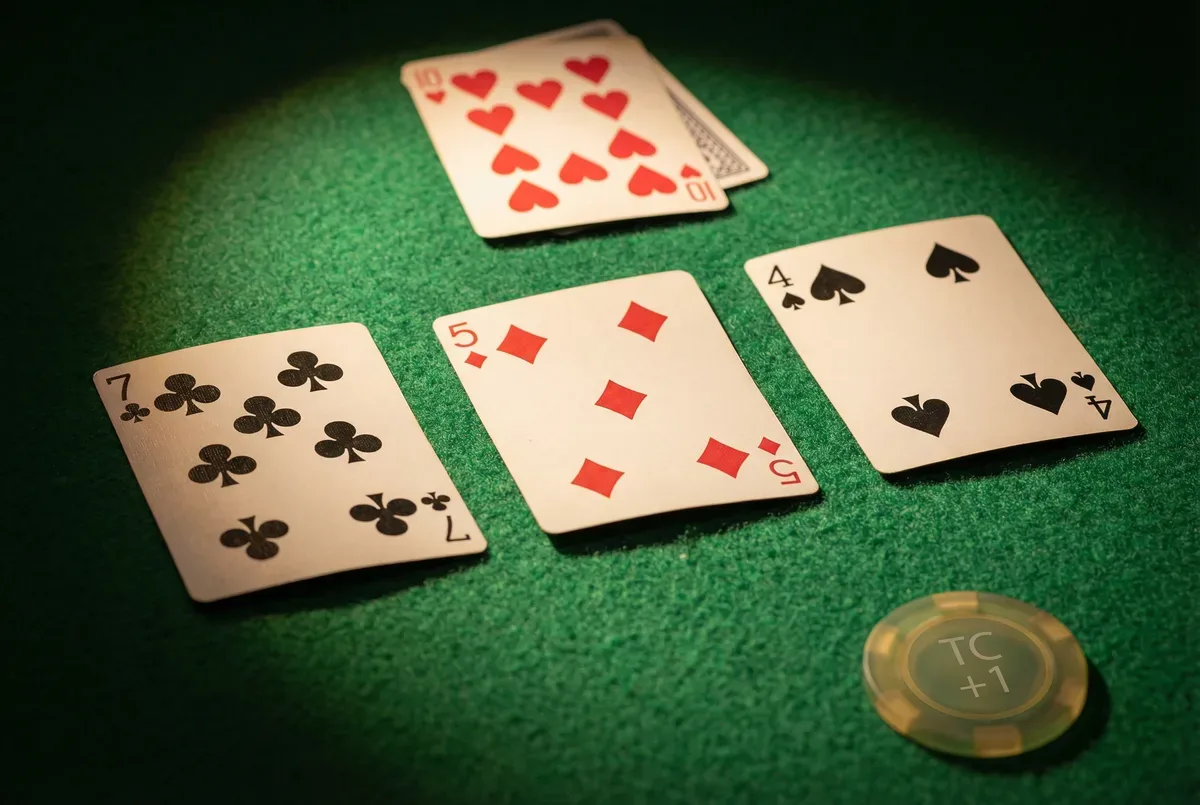
How Composition-Dependent Strategy Gives Card Counters a Real Edge
Composition-dependent strategy is a decision framework that accounts for the specific cards making up your hand, not just the numerical total they sum to. Standard blackjack basic strategy is total-dependent it tells you how to play a hard 12 the same way regardless of whether that 12 is 10+2, 9+3, 7+5, or 4+4+4. Composition-dependent strategy recognizes that these hands are not identical: the cards already in your hand have been removed from the deck, and that removal changes the probability distribution of cards you might draw next.
What Composition-Dependent Strategy Actually Means
The clearest example is 12 versus a dealer 4. Basic strategy says stand. But a 12 made of 10+2 means two 10-value cards have already been accounted for the remaining deck has slightly fewer cards that could give you 22. A 12 made of 7+5 removes no 10-values from the pool. The correct play differs by composition: hit the 10+2 version, stand on the 7+5 version. The difference in expected value is small fractions of a percent but it’s real, calculable, and exploitable in the right conditions.
Total-Dependent (Basic Strategy)
Composition-Dependent
- Hand total only
- Exact cards in hand
Why Does the Hands Where Composition Matter Most?
Not every hand total responds meaningfully to composition adjustments. The decisions where composition creates the largest EV difference are clustered around stiff totals (12–16) against specific dealer upcards, and they tend to involve the question of whether 10-value cards have been disproportionately consumed in forming your hand. The 16-versus-10 decision is the most studied example: a two-card 16 (10+6 or 9+7) and a three-or-more-card 16 (5+4+7, for instance) have different optimal plays because the multi-card version has already stripped small cards from the available draw pool.
The practical rule for 16 versus a dealer 10 is this: if your 16 contains three or more cards, stand. If it’s a two-card 16, hit. The multi-card 16 has consumed low cards to reach 16, leaving a relatively 10-rich remaining deck where hitting is more likely to bust you. The two-card 16 hasn’t had the same effect. This single composition rule is the most valuable one for multi-deck play it applies in six-deck shoes and is worth memorizing even if you ignore every other composition adjustment.
- 12 vs 4Hit if hand is 10+2 (stand otherwise)
- 12 vs 2Hit if hand is 10+2 (stand otherwise)
- 16 vs 10Stand with 3+ card 16 (hit 2-card 16)
- 15 vs 10Stand with 3+ cards including a 5 or 6
- 13 vs 2Hit if hand contains two or more small cards
- 12 vs 3Hit 10+2 composition in single/double-deck
- 16 vs 9Stand with 4+ card 16 in single-deck only
How Counting Overlaps With Composition Decisions?
Card counting and composition-dependent strategy operate on the same underlying principle the makeup of the remaining deck changes the correct play but at different scales. Counting tracks the aggregate imbalance across all remaining cards; composition strategy tracks the specific imbalance caused by the cards already in your hand. In a sense, composition-dependent decisions are micro-level counting applied to a single hand rather than the whole shoe.
For counters, composition adjustments add a layer on top of index plays. The Illustrious 18 index plays already adjust decisions based on True Count these are macro-level composition signals. Composition-dependent strategy goes further, adjusting within a given True Count based on the specific cards dealt to you. The combined effect is a slightly more accurate EV calculation on borderline hands. Peter Griffin’s The Theory of Blackjack provides the mathematical foundation for composition analysis and quantifies the gain at 0.02–0.05% over pure total-dependent blackjack basic strategy in a single-deck game.
What Is the Cognitive Cost vs the EV Gain?
The EV gain from composition-dependent strategy ranges from 0.02% to 0.05% in single-deck, falling to near-zero in six-deck shoes where individual cards have minimal impact on remaining deck composition. To put that in dollar terms: a counter betting $100 per hand at 100 hands per hour gains $2–$5 per hour in theory by applying every composition rule correctly. In practice, the cognitive overhead of tracking compositions alongside a running count and index deviations increases counting errors and may cost more EV than it adds. The math does not favor adding composition decisions at six-deck tables.
The exception is the multi-card 16 versus 10 rule, which is simple enough to apply without material cognitive cost. Glance at how many cards make your 16 if it’s three or more, stand. That single habit delivers the majority of available composition EV in multi-deck games and requires no additional mental load once it’s automatic. All other composition rules are only worth pursuing in single and double-deck games where the per-card impact is large enough for the adjustment to matter at real stakes.
Don't try to memorize the full composition-dependent matrix unless you're playing primarily single and double-deck. For six-deck shoe play, one rule captures most of the available EV: stand on any 3+ card 16 against a dealer 10. That's it. Everything else is noise at the six-deck level.
Apply Composition Strategy Where It Pays Off Most
Composition-dependent strategy belongs in your toolkit for single and double-deck games, applied selectively to the handful of hands where the EV differential is large enough to act on. Building that recognition takes deliberate practice at the pace of a real dealer. apply composition-dependent plays at a live real-money table offers live-dealer single and double-deck formats where you can test composition reads in real conditions understand clearly that these are real-money games with genuine financial downside, and treat them as a controlled practice environment rather than a quick-win opportunity.
Frequently Asked Questions
Total-dependent strategy (standard basic strategy) makes decisions based solely on the numerical total of your hand. Composition-dependent strategy adjusts decisions based on the specific cards comprising that total. For example, a 12 made of 10+2 versus a dealer 4 should be hit, while a 12 made of 7+5 against the same dealer card should be stood even though both hands total 12. The distinction matters because cards already dealt change the remaining deck's composition.
For six-deck games, only one composition rule delivers meaningful value: stand on any three-or-more-card 16 against a dealer 10 (versus hitting a two-card 16). All other composition adjustments produce near-zero EV gains at six decks because individual card removal has minimal impact on the remaining shoe. The full composition matrix is only worth learning for single and double-deck play.
Index plays (like the Illustrious 18) adjust strategy based on True Count a macro-level signal about overall deck composition. Composition-dependent strategy adjusts based on the specific cards in your hand a micro-level signal about localized deck composition. Both operate on the same principle: the remaining cards change the optimal play. Counters who apply both get a slightly more accurate EV estimate on borderline hands, though the added gain is small compared to mastering the count itself.
Before you test these plays at a real table, run them through our free blackjack simulator practice unlimited hands at zero cost until every move becomes automatic.
Mathematical Risk Warning
Advanced strategy techniques like composition-dependent play do not eliminate variance or guarantee profits. Blackjack remains a game with real financial risk at every stakes level. Only play with money you can afford to lose and always prioritize ac
Blackjack Academy is an educational resource. All strategy is based on mathematical expectation. Always play within your means.

Written by
Mark AnurakProfessional card counter since 2009 · 500,000+ hands logged · Former Macau advantage player. Studied under Thorp, Griffin & Wong methodology. Full bio →
Learn More
Continue your education with these related lessons.
The True Cost of Index Play Errors in Card Counting
Index play errors are not neutral each wrong deviation costs real EV and can turn a positive-expectation edge into a…

How to Bet Spread Without Casino Heat
Bet spreading is how counters extract profit but done wrong, it's what gets you backed off. Learn the cover-bet technique,…

How Long It Actually Takes to Learn Card Counting
Most guides promise you can count cards in a weekend. The real timeline is 150 to 250 cumulative hours across…