
How to Handle the Insurance Side Bet as a Card Counter
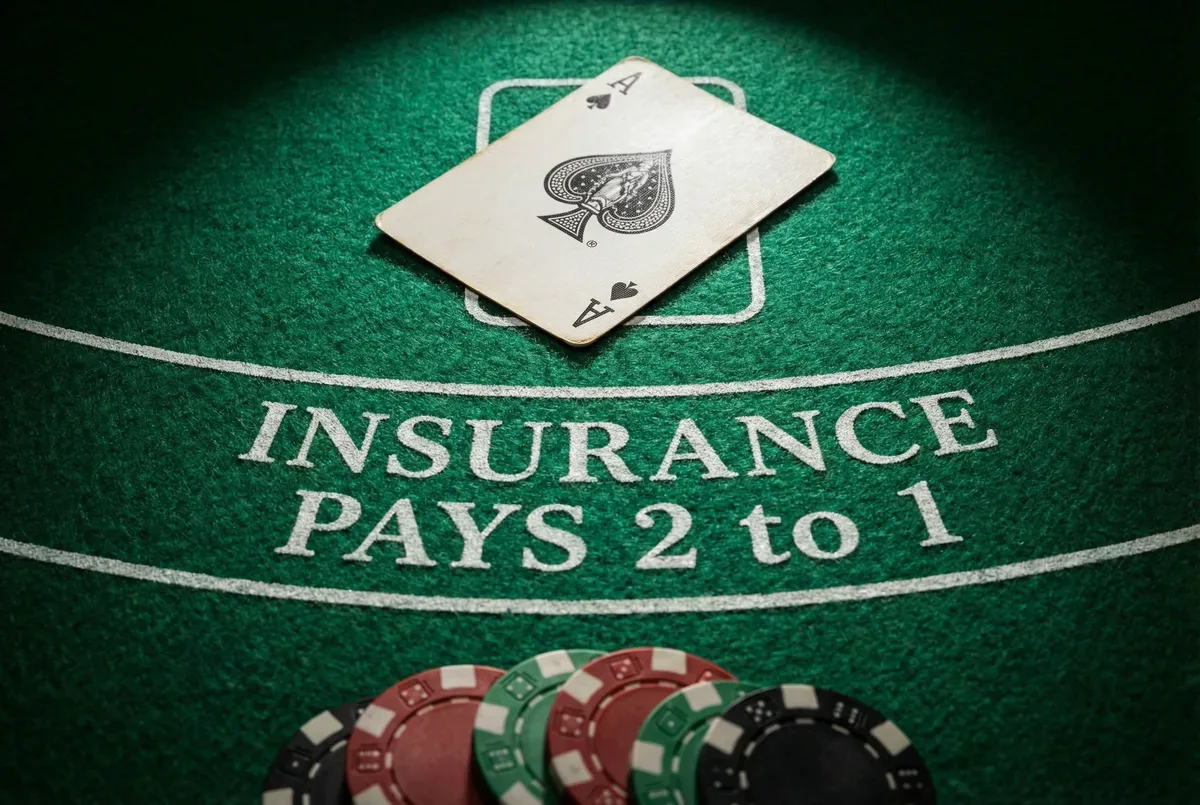
Insurance is a separate side bet paying 2:1 that the dealer holds a 10-value hole card when an Ace shows it has nothing to do with protecting your original hand. Casinos market it as protection, but the math tells a different story: in a neutral shoe, only 30.8% of remaining cards are 10-value, and you need 33.3% (one in three) to break even at 2:1 odds. That 2.5-point gap is the blackjack house edge on insurance, sitting around 7% in most games. For blackjack basic strategy players, the rule is absolute never take insurance.

Insurance Is a Side Bet, Not a Safety Net
Card counters operate under different math. When the running count climbs high enough relative to the remaining decks, the proportion of 10-value cards in the shoe can cross that break-even threshold. At that point, insurance stops being a sucker bet and becomes a positive expectation wager. Knowing exactly when that line is crossed and acting on it without hesitation is one of the cleaner edges counting gives you at the table.
Dealer Shows
Your Hand
The dealer shows an Ace and offers insurance. Your True Count is +4. Do you take insurance?
At TC +4, the proportion of 10-value cards remaining is well above the break-even threshold of 33.3%. Taking insurance here is a positive EV side bet accept it. The correct play on your A,A remains Split. Note: the mastery decision here represents accepting the insurance offer (HIT = Yes), not the play on your pair.
What Is the Break-Even Math Behind Insurance?
The insurance break-even point is a fixed mathematical ratio: you need exactly one 10-value card for every two non-10 cards remaining in the shoe. In a freshly shuffled six-deck shoe, 96 of 312 cards are 10-value that’s 30.77%. The 2:1 payout requires 33.33% to be neutral EV. Every deck has 16 ten-value cards out of 52, so a balanced shoe always starts below the threshold.
The Hi-Lo system assigns -1 to 10-value cards and +1 to low cards (2–6). When the True Count reaches +3, the density of 10-value cards in the remaining shoe has shifted enough to push insurance past the break-even line. At TC +3, insurance is roughly neutral EV. At TC +4 and above, it carries a positive edge that grows with each additional count point. The practical rule: take insurance at TC +3 or higher, decline at TC +2 or below.
Insurance break-even: (10-value cards remaining) ÷ (total cards remaining) ≥ 1/3. In Hi-Lo, this condition is met at True Count ≥ +3.
Insurance Formula
What Are Even Money on a Natural When Counters Accept and When They Don’t?
Even money is insurance presented differently: when you hold a natural blackjack and the dealer shows an Ace, the casino offers you a guaranteed 1:1 payout instead of risking a push if the dealer also has blackjack. Casual players almost universally take it a sure win feels better than risking the 3:2. This reflex costs money in a neutral shoe. Without a high count, declining even money and collecting 3:2 the majority of the time produces higher expected value.
The math mirrors insurance precisely because even money is insurance on your natural. At TC +3 or higher, the count says the dealer is more likely to have a 10 underneath so accepting even money locks in a profit instead of risking a push. At or above TC +3 with a natural, take even money. Below TC +3, decline it and collect 3:2 when the dealer flips a non-10. The crossover point is identical to the standard insurance threshold.
Common Myth
“Always take even money when you have a blackjack against an Ace guaranteed money is always better.”
A push feels like a loss. Locking in 1:1 removes all variance and players equate certainty with correct play.
The Reality
Below TC +3, declining even money is higher EV. You collect 3:2 most of the time, and dealer blackjack occurs only 30.8% of the time in a neutral shoe.
Declining even money below TC +3 is worth roughly +0.038 units per hand compared to always accepting it.
What Is the Practical Application at the Table?
Converting insurance knowledge into table execution requires two habits. First, maintain an accurate True Count throughout the shoe the insurance decision is worthless if your count is off by two or three points. Second, act without hesitation. A counter who pauses noticeably before taking insurance at a high count signals unusual behavior to pit staff. The decision should look routine, which means drilling the TC threshold until it’s automatic.
Insurance comes up less often than most players expect typically five to ten times per shoe depending on deal speed. But each correct insurance decision at TC +3 or above is worth roughly 10-15% of your bet as additional EV. Across a full session with proper bet spreading, those decisions accumulate. Some advantage players use insurance as a secondary index play alongside the Illustrious 18 it’s one of the highest-value deviations from blackjack basic strategy when the count supports it.
Test Your Insurance Reads on Live Tables Before Risking Real Money
Insurance decisions happen fast at a real table you need the TC threshold wired before the dealer asks. Practicing on face this insurance decision with real money puts you in live-dealer conditions where the Ace appears, the offer is made, and you have seconds to decide. Be aware that blackjack-live involves real money and carries real financial risk only sit down when your count is reliable and your bankroll is properly sized for the stakes you choose.
Frequently Asked Questions
Take insurance at True Count +3 or higher using Hi-Lo. At TC +3 the proportion of 10-value cards in the remaining shoe reaches approximately 33.3%, the break-even point for the 2:1 insurance payout. Below TC +3, insurance is a negative EV bet and should be declined every time.
No. Even money is mathematically identical to insurance on your natural. Below TC +3, declining even money produces higher expected value because you collect 3:2 most of the time and dealer blackjack is relatively rare. Only accept even money at TC +3 or above, where the high density of 10-value cards makes a push more likely.
Taking insurance selectively only at high counts can draw attention if you hesitate visibly or only insure large bets. Practice the decision until it feels automatic. Some counters occasionally take insurance at neutral counts to camouflage their pattern, accepting a small EV cost in exchange for reduced scrutiny.
Before you test these plays at a real table, run them through our free blackjack simulator practice unlimited hands at zero cost until every move becomes automatic.
Mathematical Risk Warning
Insurance and even money decisions involve real money at live tables. Card counting does not guarantee winnings. Always play within your means and understand the risks before betting real money on any blackjack game.
Blackjack Academy is an educational resource. All strategy is based on mathematical expectation. Always play within your means.

Written by
Mark AnurakProfessional card counter since 2009 · 500,000+ hands logged · Former Macau advantage player. Studied under Thorp, Griffin & Wong methodology. Full bio →
Learn More
Continue your education with these related lessons.

How to Track Your Card Counting Sessions and Measure Your Edge
Serious card counters don't guess at their edge they measure it. Learn exactly what to record after every session, how…

Is Card Counting Worth It? The Honest ROI Analysis with Real Numbers
Card counting gives you a real mathematical edge. Whether that edge is worth the investment of time, travel, and discipline…

The Difference Between Running Count and True Count in Practice
Running count tells you what happened. True count tells you where you stand. Learn the mental division process, deck estimation,…