

How Variance Works Against Card Counters in the Short Run
Variance in blackjack card counting is the statistical spread of outcomes around your expected win rate it is the reason you can hold a mathematically proven edge and still lose session after session. Every hand of blackjack produces a result that fluctuates above or below your expected value, and variance measures how wide those fluctuations run.
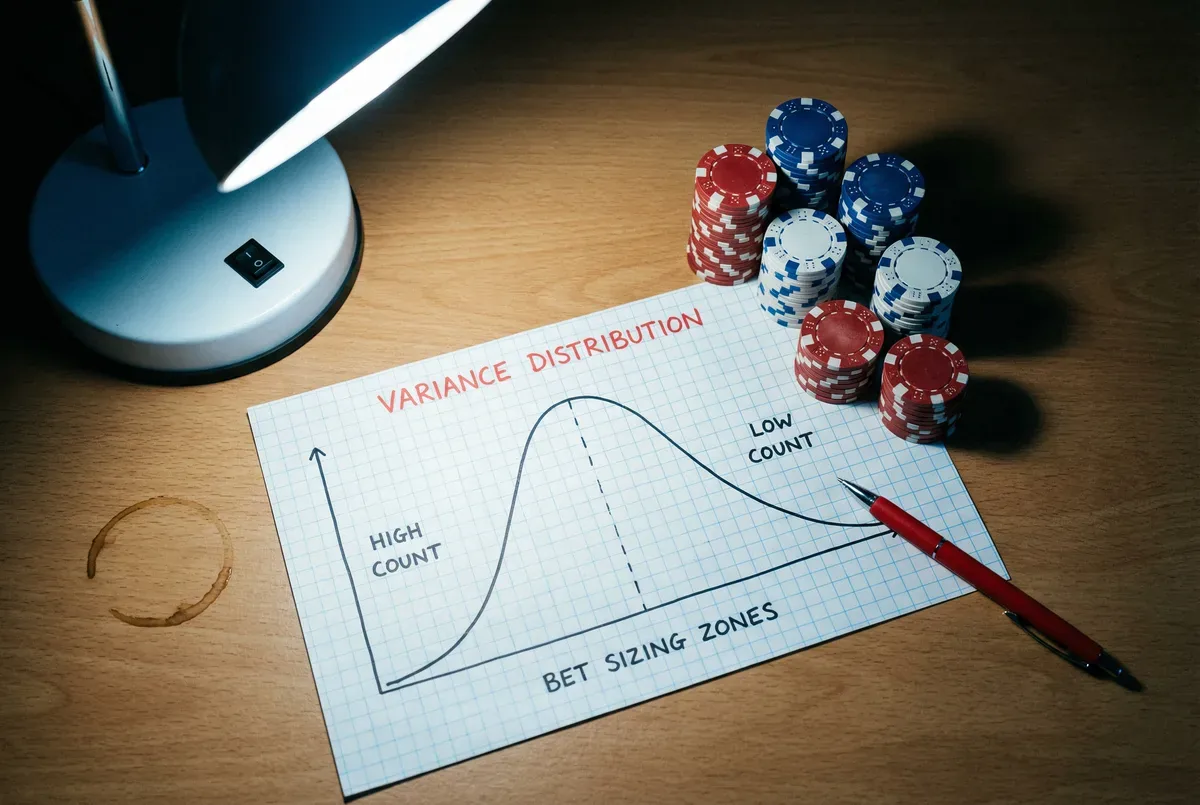
What Variance Actually Means for Card Counters
Most people understand that a coin flip is 50/50, but fewer appreciate that a series of coin flips regularly produces runs of five or six identical results. Blackjack is more complex than a coin flip, which means variance runs deeper and longer than intuition suggests. A counter who has spent 200 hours training a precise Hi-Lo system is not immune to this mathematics they are subject to the same statistical laws as every other player at the table.
Understanding variance is not optional for serious counters. It is the first line of defense against tilt, bankroll destruction, and abandoning a winning system at exactly the wrong moment.
Session Standard Deviation = √N × Bet Size × 1.14 where N is the number of hands played. A 200-hand session at $25 average bet produces SD = √200 × $25 × 1.14 ≈ $403.
Variance Formula
What Is the Standard Deviation Per Hand vs Per Session?
The standard deviation of a single blackjack hand is approximately 1.14 bet units when using blackjack basic strategy meaning a single hand result swings more than one full bet in either direction on average. This per-hand figure is the seed of all session-level variance.
Session standard deviation scales by the square root of the number of hands. A 100-hand session has SD of roughly 11.4 units. A 400-hand session about four hours at a busy table has SD of roughly 22.8 units. These numbers dwarf the expected value a counter earns. At a +1% edge with a $25 average bet, 400 hands produces expected profit of only $100. The session SD around that expectation is $570. The math demands humility.
The practical takeaway is that even a correct, proven counting system will produce sessions that look like random amateur play. One standard deviation below expectation means losing $470 in a session where you mathematically expected to profit $100. That result is not unlucky it is statistically ordinary.
Losing streak (5+ hands) at +1% edge
% probability per session
Sessions lost at +1% edge (100-hand)
%
Hands needed for edge to dominate 95%
hands
How a +1% Edge Produces 40-Hand Losing Streaks?
A +1% player edge means the counter wins $1 for every $100 wagered in expectation but expectation only converges over thousands of hands, not over dozens. In the short run, the binomial distribution of individual hand results allows long sequences of losses to appear with regularity.
Consider the mathematics directly. At a 48% win rate per hand (realistic for a counter including pushes and blackjack bonuses), the probability of losing 10 hands in a row is approximately 0.48^10 around 0.065%, or once in every 1,500 hands. That sounds rare, but a counter playing 500 hands per week will hit a 10-hand losing run roughly every three weeks of play. Losing streaks of 20-30 hands are experienced by every serious counter multiple times per year.
The 40-hand losing streak which sounds catastrophic sits at the far tail of the distribution but within the realistic experience of high-volume counters. At a flat bet of $100, a 40-hand losing streak costs $4,000. This is not a failure of the system; it is the system behaving exactly as probability theory predicts.
Why 50 Sessions Proves Nothing and How to Frame Your Results?
The confidence interval problem is one of the most misunderstood aspects of blackjack card counting. Even 50 full sessions of play roughly 10,000 hands at 200 hands per session may not produce results that statistically confirm a positive edge with 95% confidence.
To determine whether results are statistically distinguishable from chance, counters must calculate the confidence interval around their observed win rate. With 10,000 hands and a true edge of +1%, the expected profit is $1,000 at $10 average bet. The 95% confidence interval spans roughly ±$2,280. That interval includes zero meaning a losing result after 50 sessions is still consistent with being a winning counter.
This is not discouragement it is calibration. Counters who understand this frame short-run losses correctly: as noise within an expected distribution, not as evidence of system failure. The counter who abandons their system after 30 losing sessions may be quitting at exactly the statistical moment their edge was beginning to manifest. N-session confidence intervals demand patience measured in years, not weeks.
Common Myth
“A skilled card counter should be winning most sessions”
It seems logical that if you have an edge, you should win more often than you lose
The Reality
Even a +1% edge wins only about 53% of 200-hand sessions, meaning nearly half of all sessions are losing sessions
The edge compounds over thousands of hands, not over individual sessions short-run losing sessions are statistically normal and expected
Put Your Edge to Work at a Real Table Before the Next Downswing Hits
The best preparation for variance is logging real hands with real stakes where the psychological pressure of a downswing is authentic and your mental discipline gets tested. If you want to practice applying what you know about variance management under live conditions, absorb the variance swings at a real-money live table let you do exactly that, though you must be aware that real money is at risk and variance will work against you in the short run regardless of your skill level.
Frequently Asked Questions
Most analysts estimate 50,000 to 100,000 hands are required before your observed results converge tightly enough to statistically confirm a positive edge at 95% confidence. At 500 hands per week, that is two to four years of serious play. Short-run results even over thousands of hands remain heavily influenced by variance.
Yes. If your bet sizing is too aggressive relative to your bankroll, variance can produce a losing streak long enough to exhaust your funds before your edge has time to assert itself. This is called risk of ruin, and it is the primary reason bankroll management formulas like the Kelly Criterion exist to size bets so that variance cannot destroy the bankroll before expectation takes over.
You can reduce variance by flattening your bet spread, playing fewer hands per hour, or moving to a game with more favorable rules that raise your base win rate. However, reducing bet spread also reduces your expected value. The practical balance most counters strike is using a 1-to-8 or 1-to-12 spread and maintaining a bankroll of at least 200 max-bet units to weather normal variance.
Before you test these plays at a real table, run them through our free blackjack simulator practice unlimited hands at zero cost until every move becomes automatic.
Mathematical Risk Warning
Card counting requires extensive practice, a verified bankroll strategy, and realistic expectations about short-run variance. Even skilled counters lose money in the short term. Never play with money you cannot afford to lose.
Blackjack Academy is an educational resource. All strategy is based on mathematical expectation. Always play within your means.

Written by
Mark AnurakProfessional card counter since 2009 · 500,000+ hands logged · Former Macau advantage player. Studied under Thorp, Griffin & Wong methodology. Full bio →
Learn More
Continue your education with these related lessons.

The Powerful Big Player Technique for Spreading Bets Without Heat
The Big Player technique lets card counters spread bets dramatically without triggering casino heat by entering tables only at positive…

How to Build Your Card Counting Bankroll From Scratch
Starting a card counting bankroll requires capital you build before sitting at a table not profits from underfunded sessions. Learn…

How Casinos Use Shuffle Countermeasures to Beat Card Counters
Casinos deploy a precise arsenal of shuffle countermeasures from continuous shuffle machines to mid-shoe reshuffles specifically designed to neutralize card…