

When and Why Serious Counters Track Aces with the Ace Side Count
In Hi-Lo, Aces are tagged -1 alongside 10-value cards Kings, Queens, Jacks, and Tens. The logic is sound for playing decisions: Aces and 10s together produce blackjacks and dealer bust pressure. But for betting decisions, Aces and 10-value cards are not interchangeable. Aces are the only cards that create a natural blackjack paying 3:2. A shoe rich in Aces carries a materially higher probability of producing that bonus payout than a shoe rich in 10-value cards alone. Hi-Lo cannot distinguish between these two states, because it groups them under the same tag.
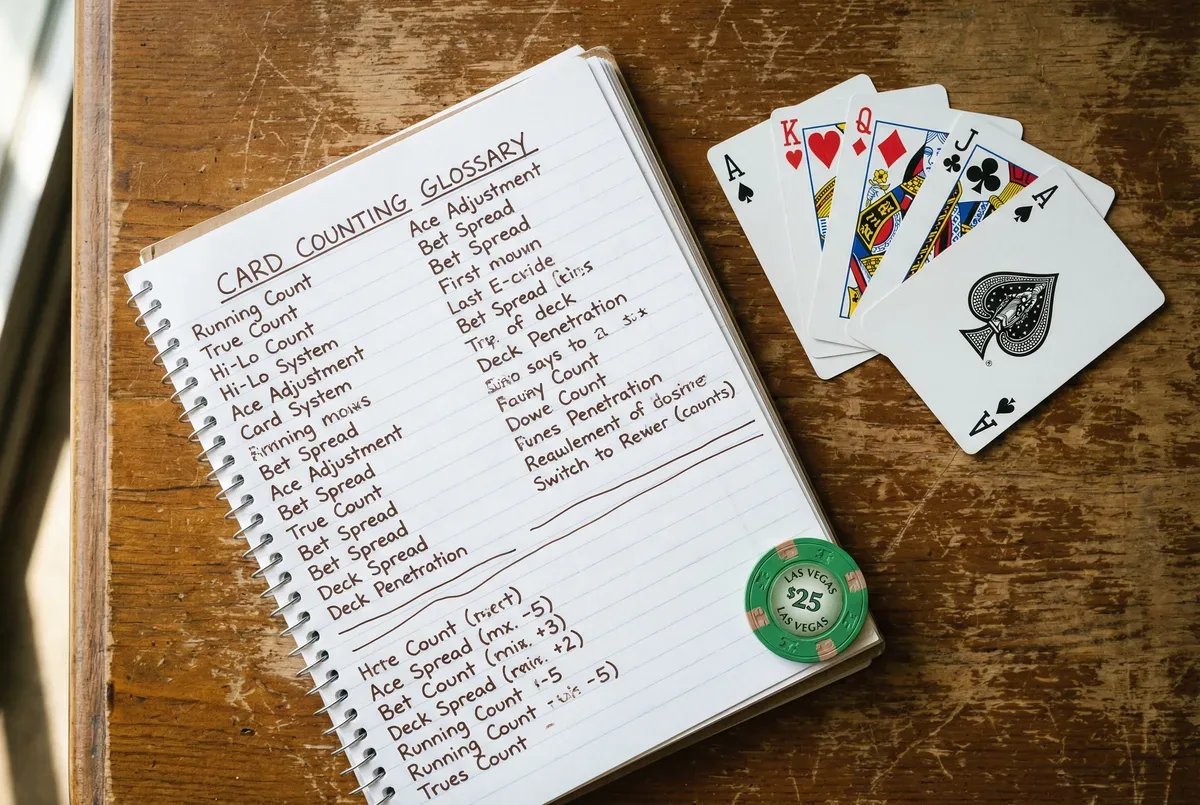
Why Aces Need Their Own Count The Betting Correlation Problem
This is what statisticians call a betting correlation problem. Hi-Lo’s betting correlation of 0.97 is exceptionally strong, but it is not 1.0 and the primary source of that 0.03 gap is the Ace. By treating Aces identically to 10s in the running count, the system slightly overvalues decks with many 10s but few Aces, and slightly undervalues decks with few 10s but many Aces. Over hundreds of shoes, that imprecision costs a measurable fraction of edge. The Ace side count is designed specifically to close that gap.
The structural reason Aces diverge from 10s at the betting level is the natural blackjack payout. Every natural where the player holds an Ace and a 10-value card pays 3:2, adding 0.5 units to the player’s expected value versus a regular win. In a deck saturated with 10-value cards but depleted of Aces, that bonus is unreachable regardless of what the true count says. Tracking Aces separately lets you adjust your bet to reflect the actual natural frequency the remaining shoe supports not just the blunt count signal.
Hi-Lo assigns Ace as -1 (same as 10-value cards). But Aces matter differently for betting vs playing decisions. For betting: Aces are critical a deck rich in Aces produces more blackjacks (3:2 payouts). For playing: Aces are less important than 10s for individual hand decisions. The Ace side count tracks Aces separately from the main count, allowing a correction factor: if more Aces remain than expected, increase bet slightly above what the true count alone suggests. If fewer Aces remain, reduce bet.
The Ace Side Count Principle
How the Ace Side Count Works in Practice?
The Ace side count runs as a separate tally alongside your Hi-Lo running count. You begin each shoe knowing the total number of Aces in the shoe four per deck, so a 6-deck shoe contains 24 Aces. Every time an Ace is exposed anywhere on the table your hand, another player’s hand, the dealer’s up card, or the dealer’s hole card when revealed you decrement your side count by one. You are tracking how many Aces remain, working downward from the starting total. The Hi-Lo count continues in parallel, unchanged.
The cognitive load of running two simultaneous counts is not trivial. The side count is a simple whole number tracked independently of the running count it does not interact with the main count during the hand. The interaction happens only at decision time, when you convert to a true count and apply the correction. Many counters use a separate mental channel for the side count: keeping the Hi-Lo total in one part of working memory and the Ace count in another. Some use a physical chip or token system during practice to build the habit of maintaining two separate totals before merging them mentally.
During practice, the key discipline is never letting the side count corrupt the main count. The most common error when adding the Ace side count is momentarily tagging an Ace as -1 in the main count while also decrementing the side count which is correct but then losing one or both totals in the process. At the start of each practice session, run 50 hands counting only the side count. Then run 50 hands counting only Hi-Lo. Only then combine both. That sequencing builds the two-channel habit before merging them.
Expected Aces per deck
in a standard deck
Ace density effect on player edge
per extra Ace per deck remaining
Betting correlation improvement
over Hi-Lo alone
What Is the Ace-Adjusted True Count How to Apply the Correction?
The correction formula compares how many Aces have actually been dealt against how many should have been dealt at this point in the shoe. Expected Aces dealt equals 4 multiplied by the number of decks dealt so far. If you are three decks into a six-deck shoe, you expect to have seen 12 Aces. Count how many Aces you have actually observed. If you have seen 10 Aces instead of 12, two extra Aces remain the shoe is Ace-rich relative to expectation. If you have seen 14 Aces, two Aces are missing the shoe is Ace-poor.
The correction factor is: (actual Aces seen minus expected Aces seen) divided by decks remaining. A result of +1 means one extra Ace per remaining deck you adjust the true count upward by approximately 1 for betting purposes. A result of -1 means one Ace short per remaining deck you adjust the true count downward by approximately 1. This adjusted true count is used only for your bet sizing decision. The unadjusted Hi-Lo true count remains the input for all playing decisions and index deviation triggers. The two are never mixed.
In practice, the correction is usually small most shoes stay close to expected Ace distribution for the majority of play. The adjustment becomes meaningful at extremes: when the shoe has burned through an unusual number of Aces early, or when it is exceptionally Ace-rich in the back half. These are precisely the situations where Hi-Lo alone gives you a misleading betting signal. Applying the correction in those specific instances not on every hand is what the Ace side count is actually for. It is a precision tool for edge cases, not a constant recalculation.
The Ace side count is a layer, not a foundation. Master Hi-Lo and true count conversion first both to error-free execution. Then add the side count as a separate parallel track. Most counters who attempt the Ace side count too early introduce counting errors that cost more EV than the side count provides. The Ace side count is worth adding only after you can count a full 6-deck shoe without a single main count error at casino speed.
When the Ace Side Count Is Worth the Added Complexity?
The Ace side count is worth the complexity in specific, narrow circumstances. It produces the largest benefit in high-penetration games shoes where the dealer deals 75% or more of the shoe before shuffling. Deep penetration creates longer runs of Ace-rich or Ace-poor shoe sections, giving the correction factor more time to matter. In a shallow-penetration game where the dealer shuffles at 50%, the shoe rarely drifts far enough from expected Ace distribution for the correction to significantly change a bet decision.
The benefit also scales with bet spread. A counter running a 1-6 spread gains less absolute value from the Ace correction than a counter running 1-12, because the correction only shifts the bet by a unit or two at most. At 1-12 spread, nudging the max bet trigger one step earlier or later due to Ace adjustment can represent a meaningful additional expected value per shoe. At 1-4 spread, the adjustment rarely clears the noise floor. Assess your spread before deciding whether the Ace side count earns its cognitive cost in your specific game.
There is a real execution cost to weigh against the theoretical gain. Every cognitive resource spent maintaining the side count is a resource unavailable for cover behavior, table awareness, and error-free main count maintenance. If adding the side count causes even a modest increase in main count errors say, one error per shoe that error cost likely wipes out the entire advantage gained. The side count only improves your edge when executed perfectly alongside a flawless main count. For most counters, reaching that combined standard takes months of dedicated practice beyond Hi-Lo mastery.
Adding the Ace Count to Your Practice Routine Before Live Play
The correct point to introduce the Ace side count into practice is after you can consistently run a 6-deck shoe at casino speed one card per second with zero main count errors. Time yourself across ten consecutive shoes. If any shoe produces a non-zero result at the end, your main count still has errors that must be fixed first. The standard is not just speed; it is error-free speed. That benchmark reliably takes most dedicated students three to five months of daily practice to reach. Anything less and the side count will introduce net harm.
Once the main count is solid, add the Ace side count in isolation for two weeks before combining it with Hi-Lo. Deal through shoes tracking only Ace departures no running count, no true count conversion, just decrementing the Ace tally and computing the correction factor at the halfway point and three-quarter point of each shoe. This builds the habit of knowing exactly where Ace distribution stands at any shoe depth without it touching the main count. After two weeks of isolated Ace side count practice, begin merging it back into full counting sessions.
When both counts run cleanly in practice, the final step before live application is pressure testing. Deal three simultaneous player hands plus a dealer hand, hold a simple conversation, and maintain both counts. If either count drifts, the combination is not yet ready for a casino. At that point, a live-dealer session can function as a controlled stress test real cards, real dealer pace, real money on the line. Keep in mind that every hand at Blackjack Academy’s live tables carries genuine financial risk, so bring only what you are prepared to lose while testing whether the Ace side count survives casino pressure intact.
Frequently Asked Questions
Only your bet sizing. The Ace-adjusted true count is applied exclusively to bet decisions. All playing decisions hitting, standing, doubling, splitting, and index deviations continue to use the standard Hi-Lo true count without the Ace correction. The two are never mixed. Applying the Ace correction to playing decisions would produce errors, not improvements.
In a well-penetrated 6-deck game with a 1-12 spread, the Ace side count typically adds 0.03% to 0.05% to overall player edge over Hi-Lo alone. That is a real but modest improvement. The gain is most meaningful for high-volume professional players. Recreational counters playing occasional sessions will find the practical edge gain smaller than the error risk introduced by running two simultaneous counts.
The Ace side count is most commonly paired with Hi-Lo because Hi-Lo's balanced structure makes the correction formula clean to compute. It can theoretically be applied to other balanced systems, but unbalanced systems like KO do not pair well with the side count because the running count baseline varies. If you are using Hi-Lo, the Ace side count is a natural extension. For other systems, verify the compatibility of the correction formula before adding the complexity.
Before you test these plays at a real table, run them through our free blackjack simulator practice unlimited hands at zero cost until every move becomes automatic.
Use our free blackjack calculator to model the exact expected value for any rule combination or hand situation before you sit down.
Advanced Counting Techniques Carry Execution Risk
The Ace side count improves theoretical edge but only when executed correctly alongside an error-free main count. Mistakes in either track cost more than the side count gains. Never play with money you cannot afford to lose, and never apply advanced counting techniques in a live game until you have verified both counts run cleanly under casino-speed conditions.
Blackjack Academy provides educational content only. Card counting does not guarantee winnings. Gambling carries financial risk. Play within your means and in accordance with local laws.

Written by
Mark AnurakProfessional card counter since 2009 · 500,000+ hands logged · Former Macau advantage player. Studied under Thorp, Griffin & Wong methodology. Full bio →
Learn More
Continue your education with these related lessons.

The Difference Between Running Count and True Count in Practice
Running count tells you what happened. True count tells you where you stand. Learn the mental division process, deck estimation,…

How to Track Your Card Counting Sessions and Measure Your Edge
Serious card counters don't guess at their edge they measure it. Learn exactly what to record after every session, how…

The Complete Guide to Back-Counting (Wonging)
Wonging back-counting a shoe and entering only at positive counts is theoretically the most efficient use of counting skill. Here…