

The True Bankroll Requirements Every Card Counter Needs to Survive
Most players learning to count cards underestimate the bankroll required to play with a real edge. Basic strategy players only need to manage session money a few hundred dollars is a reasonable buy-in for a $10 minimum game. Card counters face a fundamentally different problem. Bet spread the ratio between minimum and maximum bet creates dramatic swings that require substantial capital reserves to survive. Without the right bankroll behind that spread, even a technically perfect counter will experience ruin during normal variance, not because counting fails, but because the bankroll is too thin to absorb the inevitable downswings that occur before the long-run edge materialises.
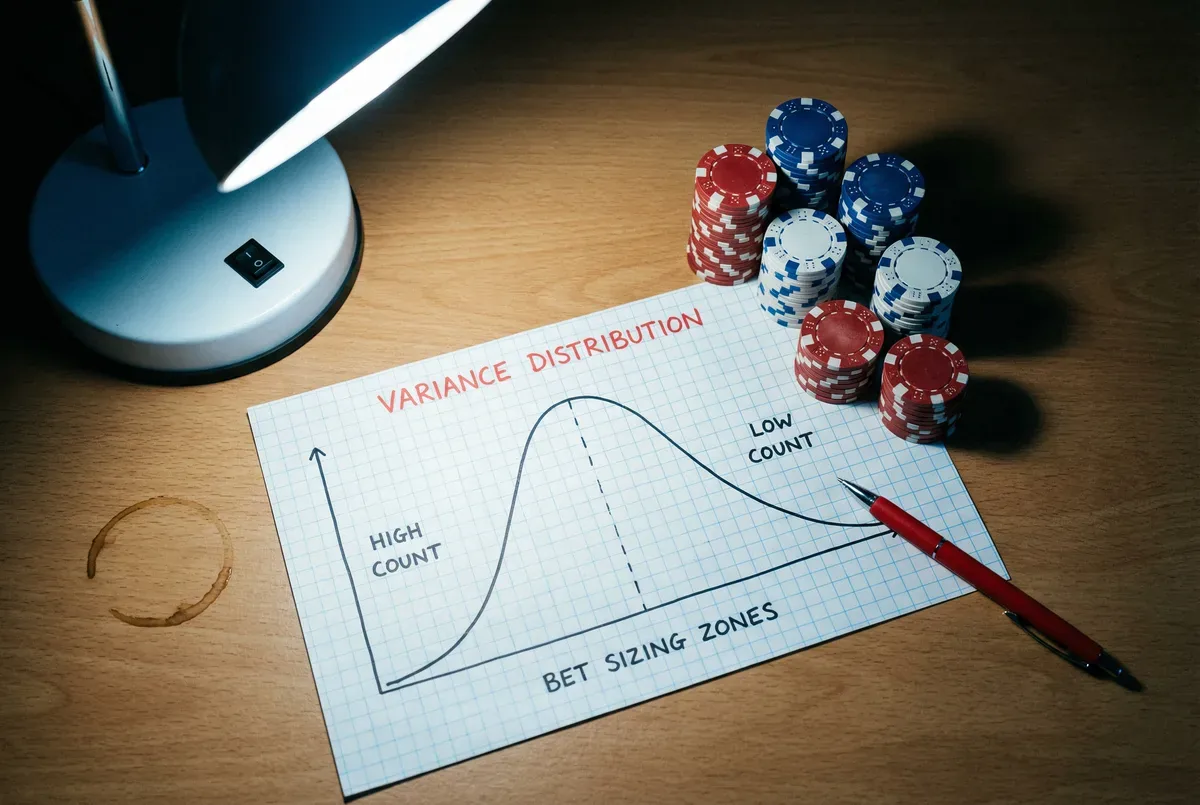
1-4 spread RoR 5%
total bankroll required
1-8 spread RoR 5%
total bankroll required
1-12 spread RoR 5%
total bankroll required
Why Card Counters Need Larger Bankrolls Than Basic Strategy Players
A blackjack basic strategy player at a $10 table bets a fixed amount each hand and faces a roughly -0.5% blackjack house edge. The variance is real but bounded there is no planned escalation, no moment when the bet suddenly increases tenfold. A card counter, by design, bets minimum during negative counts and escalates to maximum during positive counts. A 1-12 spread means that at peak counts, the counter is betting twelve times more per hand than at trough counts. This is where the variance comes from. A sequence of ten maximum-bet losing hands completely normal at the table represents a loss of 120 units in a short span, which evaporates a small bankroll before any statistical edge has time to manifest.
The mathematical framework for counter bankroll is expressed in terms of units, where one unit equals the size of the minimum bet. A 400-unit bankroll at $10 minimum bet is $4,000. At $25 minimum, it is $10,000. The unit framework matters because bankroll requirements scale directly with the minimum bet not the maximum. This surprises many beginners who calculate bankroll relative to average bet size. The correct calculation uses minimum bet unit as the base because the system’s variance is driven by the bet spread relative to that unit, not by the average.
How to Calculate Your Required Bankroll by Bet Spread?
Bankroll requirements are not arbitrary they follow from the mathematics of risk of ruin (RoR), which is the probability of losing the entire bankroll before achieving a target profit or doubling up. The standard professional threshold is a 5% risk of ruin, meaning a 95% chance of surviving long enough to realise the long-run edge. Higher RoR thresholds mean a smaller required bankroll but a substantially higher probability of losing everything during a downswing.
For a Hi-Lo counter in a standard 6-deck game with 75% penetration, the approximate bankroll requirements at 5% RoR are: 200 units for a 1-4 spread, 400 units for a 1-8 spread, and 600 to 800 units for a 1-12 spread. These figures come from simulation studies of thousands of simulated sessions. The wide range at 1-12 spread reflects rule-set variation deeper penetration and more liberal doubling rules reduce variance and allow the lower end of the range. Tighter games with shallower penetration push toward the upper end. If you are unsure about the specific rules of your target game, plan for 800 units when running a 1-12 spread.
What Are Risk of Ruin What It Means and How to Set It?
Risk of ruin is the probability that a series of negative results will reduce a bankroll to zero before the mathematical edge produces a net positive outcome. It is not a measure of skill it is a measure of the relationship between bankroll size, bet spread, and variance. A counter with perfect accuracy and optimal bet sizing can still experience ruin if the bankroll is insufficient relative to the spread. This is the key insight that separates professional counting from amateur attempts: the edge is real but it requires the capital to survive the path to long-run results.
Setting your personal RoR threshold is a financial risk tolerance decision. A 5% RoR is standard in professional literature because it represents a 1-in-20 chance of total bankroll loss a level most serious players find acceptable. A 1% RoR requires roughly double the bankroll of a 5% RoR target for the same spread, which may be unrealistic for recreational counters. A 10% RoR reduces the required bankroll by approximately 25% but means a 1-in-10 probability of losing everything before your edge pays off. Most experienced counters target the 5% threshold as a balance between capital efficiency and ruin protection.
The single biggest mistake new counters make is starting with too small a bankroll. With a $10 base bet and 1-12 spread, unit value is $10. A 5% risk-of-ruin bankroll requires approximately $6,000-$8,000. Most beginners start with $500. This produces a near-certainty of ruin during normal variance swings, even with a real edge. Build to a proper bankroll before increasing spread. Start with 1-4 spread until the bankroll supports 1-8.
10% RoR (Aggressive)
1% RoR (Conservative)
- 200 units ($2,000)
- 200 units ($5,000)
- 200 units ($10,000)
- 200 units ($20,000)
- 20-30 units
- 500 units ($5,000)
- 500 units ($12,500)
- 500 units ($25,000)
- 500 units ($50,000)
- 20-30 units
What Is the Session Bankroll vs Total Counting Bankroll?
Total bankroll and session bankroll serve different functions. Total bankroll is the full capital reserve from which the counter draws over weeks and months the 400 to 800 units required at the chosen spread and RoR target. Session bankroll is the amount brought to a single session, which does not need to equal total bankroll. Bringing the entire bankroll to one session is counterproductive: a bad session at a single table does not require liquidating all reserves, and carrying excessive cash to a casino creates unnecessary risk.
A standard session bankroll guideline for a 1-12 spread is 50 to 100 units. This represents the realistic worst-case swing for a two-to-four hour session with maximum-spread play. At 50 units, a counter running a $10 minimum buys in for $500. If that session buy-in is lost, the session ends this is a stop-loss decision, not a failure of strategy. The total bankroll of 600 to 800 units remains intact except for the session loss, and the next session begins with a fresh buy-in drawn from the reserve. Never rebuy beyond the session allocation in a single session. Chasing losses within a session using total bankroll reserves is the fastest path to actual ruin.
Executing Your First Counted Session with Correct Bankroll
The first time you count at a real table, the instinct is to test the system at the lowest possible stakes. This is correct instinct. But the session bankroll still needs to support the spread you plan to run. Buying in with 20 units for a 1-12 spread means that two or three maximum-bet losing hands a sequence that will occur regularly can end the session before the count has any chance to provide an advantage. A minimum viable session buy-in is 30 units; 50 units is recommended for a 1-12 spread at real tables.
If your total capital does not yet support the full bankroll requirements of a 1-12 spread, the correct response is not to run a 1-12 spread with insufficient bankroll it is to reduce the spread until your bankroll matches the requirements. A 1-4 spread requires only 200 units and still produces a measurable edge in good conditions. Build the bankroll at 1-4 spread, then expand to 1-8 once the unit count supports it. This is slower, but it means you are still in the game after normal variance instead of having burned through capital that was never sufficient for the spread you were running. Real-money play at live tables is where counting execution is tested against actual variance but be clear that every session at those stakes involves genuine financial risk, not just practice. If you want to observe how count distribution plays out across full shoes before risking your own funds, the live tables at Blackjack Academy let you watch the shoe unfold in real time though live play means real money is at stake, so only use it when your bankroll is prepared.
Frequently Asked Questions
The increase is driven by the squared relationship between bet spread and variance. Variance in blackjack grows roughly with the square of the bet spread. Moving from 1-8 to 1-12 spread increases the top bet by 50% but increases variance far more than proportionally. This requires a disproportionately larger bankroll to maintain the same risk of ruin threshold. Additionally, 1-12 spread triggers more casino scrutiny, requiring more frequent table changes that reduce hands-per-hour and dilute the edge per unit of time.
Yes, and this is actually the standard approach for most recreational counters. Starting with a 1-4 spread at a bankroll sufficient for that spread, then gradually increasing the spread as unit count grows, is a sound method. The key discipline is to never expand the spread until the bankroll genuinely supports the next spread tier. Expanding the spread prematurely because you are ahead in the short term ignores that early wins are partially luck and the variance of a wider spread will soon test the full bankroll reserve.
No. The session stop-loss is absolute. If you lose your session allocation, the session ends. This is not optional. Rebuying beyond the session bankroll draws on total reserves that are meant to survive variance over hundreds of sessions, not to fund a single bad session. The mathematical edge that makes counting viable only operates over a very large sample of sessions destroying total bankroll reserves in one or two sessions eliminates the possibility of reaching the long-run numbers where the edge is realised.
Before you test these plays at a real table, run them through our free blackjack simulator practice unlimited hands at zero cost until every move becomes automatic.
Use our free blackjack calculator to model the exact expected value for any rule combination or hand situation before you sit down.
Mathematical Risk Warning
Card counting requires 200–800 units of dedicated bankroll depending on your bet spread. Insufficient bankroll produces near-certain ruin even when counting is executed perfectly. Short sessions are dominated by variance, not edge. Never risk money at live tables that you cannot afford to lose even a real mathematical advantage cannot prevent significant financial loss in the short term.
This article is for educational purposes only. Gambling involves risk of financial loss. Play within your means and in accordance with local laws.

Written by
Mark AnurakProfessional card counter since 2009 · 500,000+ hands logged · Former Macau advantage player. Studied under Thorp, Griffin & Wong methodology. Full bio →
Learn More
Continue your education with these related lessons.

How to Back-Count Tables and Wong Into Positive Shoe Counts
Wonging standing behind a blackjack table, counting cards without betting, and jumping in only at positive counts is the highest…
The Zen Count Is a Powerful Balanced Multi-Level System for Experts
The Zen Count is Arnold Snyder's balanced multi-level system that assigns finer card values than Hi-Lo to extract more edge…

How Casino Floor Managers Identify and Respond to Card Counters
How casino floor managers detect card counters: bet pattern analysis, surveillance software, escalation chains, and the legal limits of casino…