
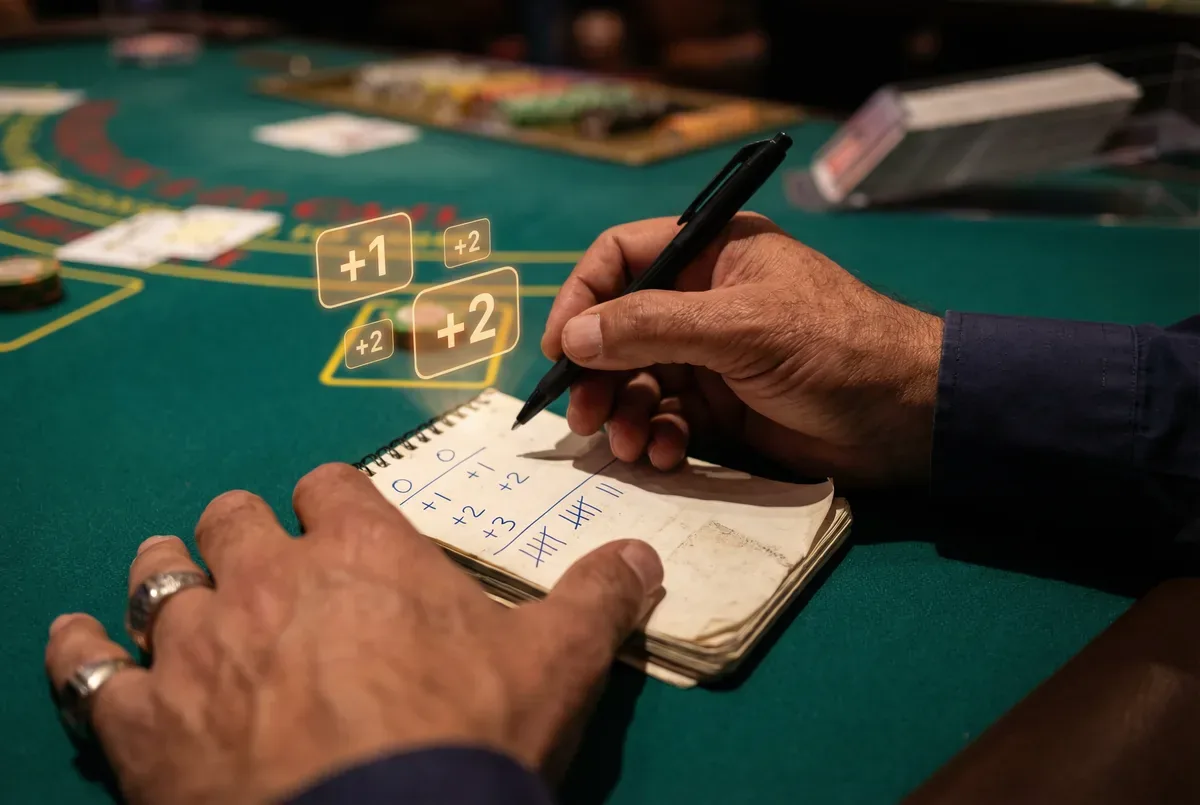
The KO Count Is the Most Beginner-Friendly Unbalanced Counting System
The KO Count, short for Knockout, and is an unbalanced counting system developed by Olaf Vancura and Ken Fuchs in their 1998 book of the same name. Its defining feature is deliberate imbalance: the card values assigned do not sum to zero across a full deck. This imbalance eliminates the need for true count conversion while preserving most of the edge that a balanced system like Hi-Lo generates.
The KO Count and How It Differs From Hi-Lo
In Hi-Lo, the 7 is a neutral card worth zero. In KO, the 7 is assigned +1, the same value as cards 2 through 6. Adding one extra +1 card means that a full 52-card deck counted through KO ends at +4 rather than 0 the system is unbalanced by exactly four points. This imbalance, spread across the shoe’s depth, does the mathematical work that true count division does in a balanced system. The running count itself absorbs the deck-depth adjustment automatically.
For a beginner, the practical implication is significant. With Hi-Lo, after every round you must estimate decks remaining, divide your running count by that estimate, and make betting decisions based on the result. With KO, you track the running count and compare it directly to predetermined trigger points. No division, no estimation, no true count. You count, you compare, you bet. The cognitive load reduction is substantial.
- 2, 3, 4, 5, 6, 7 → Count +1 (includes the 7 key KO difference)
- 8, 9 → Count 0 (neutral)
- 10, J, Q, K, A → Count -1 (same as Hi-Lo)
- Starting count (6-deck)-20 (not 0)
- Pivot pointwhen count reaches 0, player has slight advantage
- Maximum betcount reaches +4 or above
- AdvantageNO true count conversion needed running count is the signal
What Are KO Card Values and How the Unbalanced Start Count Works?
The card values in KO are nearly identical to Hi-Lo with a single exception. Cards 2 through 7 are all worth +1. Cards 8 and 9 are neutral at 0. Cards 10 through Ace are worth −1. The presence of the 7 as a plus card is the system’s entire structural difference from Hi-Lo, and it is what creates the imbalance that drives the system’s mechanics.
Because the system is unbalanced, you do not start the count at zero. In a 6-deck game, you start at −20. In a single-deck game, you start at −4. In a 2-deck game, the start is −8. The starting count is calculated as −4 multiplied by the number of decks in play. This negative starting point reflects the deck’s natural imbalance under the KO assignments and allows the running count to reach meaningful thresholds at roughly the same shoe-depth points where a Hi-Lo true count would signal an advantage.
The pivot point where the KO running count equals 0 represents a roughly neutral-to-slight-positive player edge, equivalent to a Hi-Lo true count of around +1. Above 0, your advantage grows. The key betting trigger point is +4 or higher, where the player edge is significant enough to justify maximum bet sizes. These trigger numbers are fixed regardless of how many cards have been dealt that is the entire point of the unbalanced design.
The tradeoff is precision. Because the KO running count bundles the deck-depth adjustment into the count itself rather than calculating it explicitly, it produces a slightly blurrier signal at any given moment compared to a precisely calculated Hi-Lo true count. At the beginner level, where true count estimation errors are common anyway, this imprecision is largely irrelevant. KO’s built-in approximation is more reliable than a beginner’s manual true count conversion.
How to Bet With the KO System Without True Count Conversion?
KO betting is structured around a simplified ramp that maps running count to bet size. In a 6-deck game, a common betting schedule looks like this: counts below −4 = 1 unit (minimum); counts −4 to −1 = 1–2 units; counts 0 to +3 = 2–4 units; counts +4 and above = maximum bet (6–8 units or whatever your spread allows). The exact bet sizes depend on your bankroll and the spread you are targeting, but the count thresholds are fixed.
This schedule is memorized before you sit at a table. When the count reaches a threshold, the next bet goes up. When it drops back below a threshold, the bet comes down. There is no calculation in real time only comparison. This is what makes KO fast under pressure. The mental bandwidth freed by eliminating true count conversion goes directly into better blackjack basic strategy accuracy, better cover behavior, and clearer awareness of the table environment.
One important note: KO’s betting thresholds are deck-count specific. The numbers above apply to a 6-deck shoe. In a 2-deck game, the relevant threshold for advantage is different because the starting count is different. Before playing any KO session, confirm your starting count and betting trigger points for the specific deck count in use at that table.
KO Count
Hi-Lo Count
- +1 (plus card)
- −20
- Not required
- 0.55
- 0.98
- Easier no division
- No
- 0 (neutral)
- 0
- Required every round
- 0.51
- 0.97
- More complex
- Yes
How Do You Choose the Right System?
The performance gap between KO and Hi-Lo is small. KO’s slightly higher playing efficiency (0.55 vs 0.51) means it makes marginally better strategy decisions in borderline situations. Hi-Lo’s true count precision gives it a slight edge in ideal conditions if the true count calculation is performed accurately. In practice, a beginner executing KO flawlessly outperforms a beginner executing Hi-Lo with estimation errors.
The strongest argument for learning Hi-Lo despite its added complexity is that it is the industry standard. Advanced techniques including the Illustrious 18 strategy deviations and the optimal betting ramps used by professional teams are all built around Hi-Lo. If you intend to develop into a serious counter, Hi-Lo is the foundation your advanced skills will rest on. KO is a path to that foundation, not a permanent alternative to it.
For a player whose goal is to reduce the blackjack house edge in recreational sessions without committing to a professional development path, KO is a legitimate and effective choice. It is not a simplified toy it is a well-engineered system that produces real edge with less mental overhead. Playing it correctly and consistently is more profitable than playing Hi-Lo sloppily.
KO is an excellent first counting system. Because it eliminates the division step, you can focus entirely on accuracy and speed before adding the true count layer. Many counters start with KO for 2–3 months, become proficient, then switch to Hi-Lo once the counting reflex is solid. The two systems are close in performance KO's slightly better playing efficiency and the simplicity advantage make it competitive with Hi-Lo at the beginner level.
Starting With KO Before Upgrading to a Balanced System
The KO-to-Hi-Lo transition is smoother than learning Hi-Lo from scratch because the two systems share nearly identical card values. When you switch from KO to Hi-Lo, you change two things: the 7 becomes neutral instead of +1, and you add true count conversion. The core counting reflex recognizing and tagging every card value instantly transfers completely. You do not start over. You build.
Many experienced counters recommend treating KO as a deliberate first phase rather than a shortcut. Spend two to three months achieving genuine KO proficiency: fast, accurate, distraction-resistant, with proper bet sizing and cover behavior. Then add the true count layer on top of a stable counting foundation. The result is a Hi-Lo counter who already has hundreds of hours of card-tracking practice, rather than one who is learning to count and divide simultaneously from day one.
When your KO skills are ready for a live test, a human-dealt shoe is the only environment that genuinely replicates casino conditions. The live blackjack tables at validate this count at a real table tonight immediately give you a real multi-deck shoe, a real dealer setting the pace, and real money on the line which means the psychological pressure of maintaining a count while managing bets and appearances is authentic. Treat it as a calibration session before stepping up to a casino floor, and understand that real losses are possible.
Frequently Asked Questions
The KO count assigns a value of +1 to the 7, making it an unbalanced system that starts at −20 in a 6-deck shoe rather than 0. This imbalance eliminates the need for true count conversion the running count itself signals betting opportunities. Hi-Lo treats the 7 as neutral, requires true count conversion through deck estimation and division, and is the industry standard for professional counters.
Multiply −4 by the number of decks in play. For a single-deck game: start at −4. For a 2-deck game: start at −8. For a 6-deck shoe: start at −20. For an 8-deck shoe: start at −28. The pivot point where you have a slight advantage occurs when the running count reaches 0 in all of these formats.
Yes, KO produces a genuine player edge when executed correctly. Its betting correlation (0.98) is nearly identical to Hi-Lo (0.97), and its playing efficiency (0.55) is slightly better. The edge it generates over a 6-deck game with correct bet sizing is real, though smaller than what a skilled Hi-Lo counter achieves with precise true count conversion and strategy deviations.
Before you test these plays at a real table, run them through our free blackjack simulator practice unlimited hands at zero cost until every move becomes automatic.
Use our free blackjack calculator to model the exact expected value for any rule combination or hand situation before you sit down.
Card Counting Involves Real Financial Risk
The KO system generates a genuine long-run edge, but individual sessions involve substantial variance. Positive counts do not guarantee winning rounds. Casino surveillance can identify and restrict counters. Never wager money you cannot afford to lose, and always apply proper bankroll management regardless of how strong your count feels.
Card counting is a long-run statistical skill. Short-term results are dominated by variance even with a significant running count advantage.

Written by
Mark AnurakProfessional card counter since 2009 · 500,000+ hands logged · Former Macau advantage player. Studied under Thorp, Griffin & Wong methodology. Full bio →
Learn More
Continue your education with these related lessons.
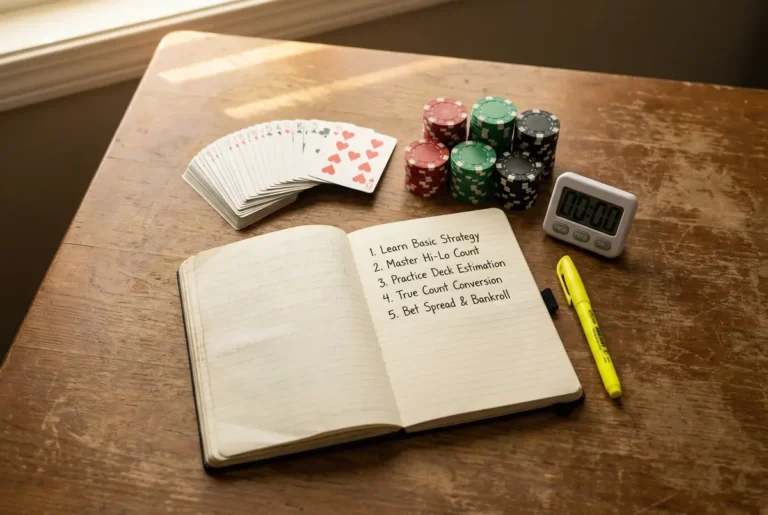
Your Complete Card Counting Action Plan
A complete six-stage roadmap for learning card counting from zero knowledge to your first live casino session. Each stage has…
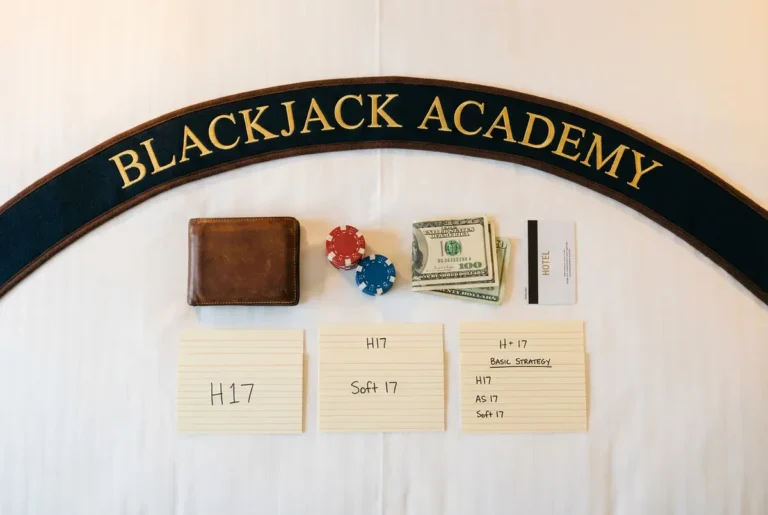
The Complete Card Counter’s Pre-Trip Checklist
A systematic pre-trip checklist for card counters covering game conditions research, speed and accuracy drills, bankroll verification, physical readiness, and…

The True Bankroll Requirements Every Card Counter Needs to Survive
Card counters need far more capital than basic strategy players to survive variance. Learn how bet spread determines required bankroll,…