

The Difference Between Running Count and True Count in Practice
- Why Running Count and True Count Can Tell Opposite Stories
- Why Does the Mental Division Proces at the Table Making It Automatic?
- How Deck Estimation Errors Affect Your Edge?
- What Is the Drills to Build True Count Conversion to Reflex Speed?
- Applying True Count Discipline From the First Hand of a Live Shoe
The running count is what your brain tracks hand by hand. The true count is what actually determines your edge. These two numbers frequently point in opposite directions, and confusing them is the most expensive mistake a counter can make in a multi-deck shoe.
Why Running Count and True Count Can Tell Opposite Stories
A running count of +8 sounds promising. But if five of six decks remain undealt, that +8 spreads across an enormous pool of cards and produces a true count of roughly +1.6 a marginal advantage that barely justifies a modest raise. Conversely, a running count of +6 with only one deck left generates a true count of +6, a point where max bets become correct. The counts look similar. The betting implications are worlds apart.
The running count is a raw tally. The true count is a normalized signal running count divided by decks remaining. Only the true count can be compared across different shoe depths or deck counts. Any bet-sizing decision based purely on the running count is operating on incomplete information.
Running count: +10. Shoe: 6 decks. Cards dealt so far: approximately 1.5 decks. Decks remaining: approximately 4.5.
True count = 10 ÷ 4.5 = +2.2. This is a moderate advantage worth a 2–3× base bet. The running count of +10 sounds dramatic, but the actual edge shift is modest. Now compare: same running count of +10, but 4.5 decks have been dealt and only 1.5 remain. True count = 10 ÷ 1.5 = +6.7. Maximum bet. Same running count, completely different strategic reality. Always convert.
Why Does the Mental Division Proces at the Table Making It Automatic?
The true count formula is RC ÷ decks remaining. The challenge is not the formula it is executing the division accurately and quickly while watching cards, monitoring dealer upcard, and maintaining conversation cover at a live table.
Deck estimation comes from watching the discard tray. In a 6-deck shoe, the tray is physically sized to hold six decks. When the tray looks one-third full, approximately two decks have been dealt and four remain. Half-full means three remain. When estimating, round to the nearest half-deck. You will rarely need precision beyond that, and agonizing over exact figures slows you down visibly.
The division itself can be simplified. If the running count is +9 and you estimate 3 decks remaining, the true count is +3 a clean division. If it is +9 with 3.5 remaining, round to +2.5 or simply +2 for betting purposes. Rounding down on borderline counts is conservative and correct you lose a fraction of EV in exchange for speed and accuracy under pressure.
The goal at the table is sub-two-second conversion. You glance at the discard tray, estimate remaining decks, divide, and make your bet decision before the next round starts. This speed is a trained reflex, not raw arithmetic. Reaching it requires structured practice away from the casino.
Set up a deck. Start counting cards one at a time. Every 52 cards (one deck dealt), convert: RC ÷ decks remaining.
Round 1: 1 deck dealt from 6 → RC ÷ 5
Round 2: 2 decks dealt → RC ÷ 4
Round 3: 3 decks dealt → RC ÷ 3
Target: conversion in under 2 seconds.
Practice 15 minutes daily for 3 weeks.
How Deck Estimation Errors Affect Your Edge?
Deck estimation is where most intermediate counters silently bleed edge. An error of half a deck in either direction produces a true count error of roughly half a unit acceptable. An error of a full deck or more at a low-remaining-deck count can shift your true count by two or three units, which is the difference between a table-minimum bet and a maximum bet.
The error amplifies at the end of the shoe. When only 1.5 decks remain, a half-deck estimation error represents 33% of the total remaining pool. The same half-deck error at the shoe’s midpoint, with 3 decks remaining, represents only 17%. Estimation discipline matters most precisely when the count is richest at the end of the shoe, where most of your big bets occur.
Consistent overestimation of remaining decks produces systematically low true counts, causing you to underbet when an advantage exists. Consistent underestimation inflates your true count and causes overbetting during neutral or negative shoes. Either bias erodes your long-run edge even if your card count is perfectly accurate.
Deck estimation error ±0.5 decks
acceptable
Deck estimation error ±1.5 decks
serious problem
Speed target for TC conversion
at the table
What Is the Drills to Build True Count Conversion to Reflex Speed?
Speed in true count conversion is built through isolated repetition, not through casino play. The casino is where you execute a skill that already exists. It is not a classroom. Building the conversion reflex at home before you sit at a live table is the only approach that protects your bankroll during the learning phase.
The most effective drill sequence starts with pure arithmetic. Write running counts on index cards: +7, +12, -3, +9, +4. Pair them with remaining deck estimates: 4.5, 2, 3.5, 1.5, 5. Practice dividing and calling the true count aloud until the pairs feel immediate. Time yourself. Your goal is to process each pair in under two seconds before moving to live cards.
Once the arithmetic is fast, integrate counting and conversion into a single drill. Count through a six-deck shoe (six shuffled decks), converting every time you hit a deck boundary. The count should flow without hesitation at each checkpoint. Add a distraction a podcast, television, a timer alarm to simulate the noise of a live table environment.
A final validation drill involves a partner calling out interruptions: “What’s the count?” or “True count?” mid-shoe. Answering immediately and accurately under this unpredictable questioning reflects real table conditions where dealers and players create conversational disruptions at random intervals.
Applying True Count Discipline From the First Hand of a Live Shoe
The first hand of a fresh shoe starts with a running count of zero and five to six full decks remaining. Your true count is zero. There is no advantage yet. The correct response is to play base strategy and bet table minimum, not to jump ahead based on anticipation or pattern assumptions. Discipline at the shoe’s start is as important as discipline at the rich end.
As cards are dealt, update the running count on every card you see your hand, the dealer’s upcard, and all other players’ cards as they are exposed. The more cards visible, the more accurate your running count and the more reliable your true count calculation. In a full seven-player game, you see many more cards per round than heads-up, making your count updates more frequent and your edge more precisely known.
At a live table with real money at stake, the process becomes visceral in ways that home practice cannot fully replicate. If you want to apply these skills against a real shoe before committing serious bankroll to a casino floor, the live dealer environment at put this count to work with real stakes in your next session gives you a genuine multi-deck shoe dealt by a human dealer where the running count moves, the discard tray fills, and real money is on the line. One session there is worth more than a week of solo drills for sharpening your true count timing under genuine pressure.
Frequently Asked Questions
The running count is a cumulative tally of card values seen since the last shuffle. The true count normalizes that figure by dividing it by the number of decks remaining in the shoe. The true count is the number that determines actual player edge and drives bet-sizing decisions.
An estimation error of half a deck is acceptable and produces only a small true count error. Errors of one deck or more especially late in a shoe when few decks remain can shift the true count by two to three units and lead to significant overbetting or underbetting. Aim to estimate within half a deck at all times.
Most dedicated practitioners reach sub-two-second conversion after two to three weeks of fifteen-minute daily drills. The skill requires isolated arithmetic practice first, then integrated counting-and-conversion drills, then distraction-testing before it becomes a reliable reflex at a live table.
Before you test these plays at a real table, run them through our free blackjack simulator practice unlimited hands at zero cost until every move becomes automatic.
Use our free blackjack calculator to model the exact expected value for any rule combination or hand situation before you sit down.
Card Counting Involves Real Money and Real Variance
Even a correct true count does not guarantee a winning session. Counting shifts the long-run edge in your favor but cannot eliminate short-term variance. Sessions with max bets can and do produce losses. Never bet money you cannot afford to lose, and always treat bankroll management as seriously as the count itself.
Card counting is a long-run skill. Short-term results are dominated by variance regardless of counting accuracy.

Written by
Mark AnurakProfessional card counter since 2009 · 500,000+ hands logged · Former Macau advantage player. Studied under Thorp, Griffin & Wong methodology. Full bio →
Learn More
Continue your education with these related lessons.

How to Convert Running Count to True Count
The running count alone can mislead you. True count normalizes it by decks remaining and that single division is what…

The Omega II Count Delivers Advanced Accuracy for Serious Counters
The Omega II count uses multi-level values (+2/-2) to achieve 0.67 playing efficiency well above Hi-Lo's 0.51. Learn whether the…
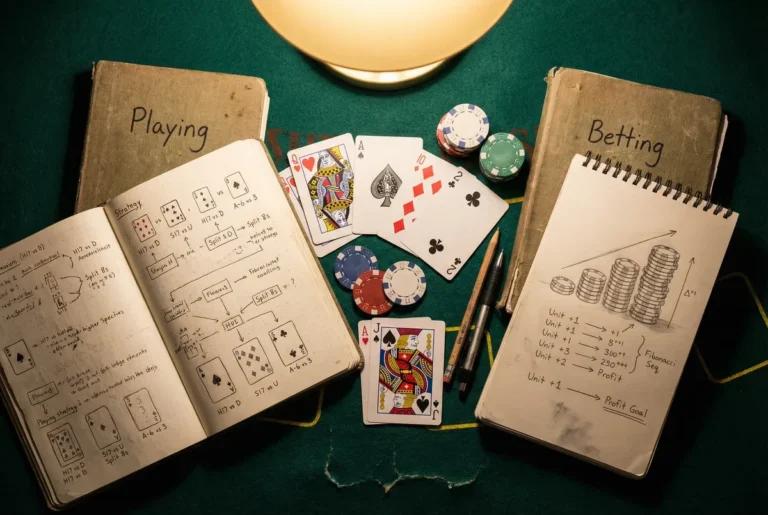
Playing Efficiency vs Betting Efficiency Which Card Counting Metric Wins
Playing efficiency and betting efficiency measure completely different things and confusing them leads counters to pick the wrong system. Here…