
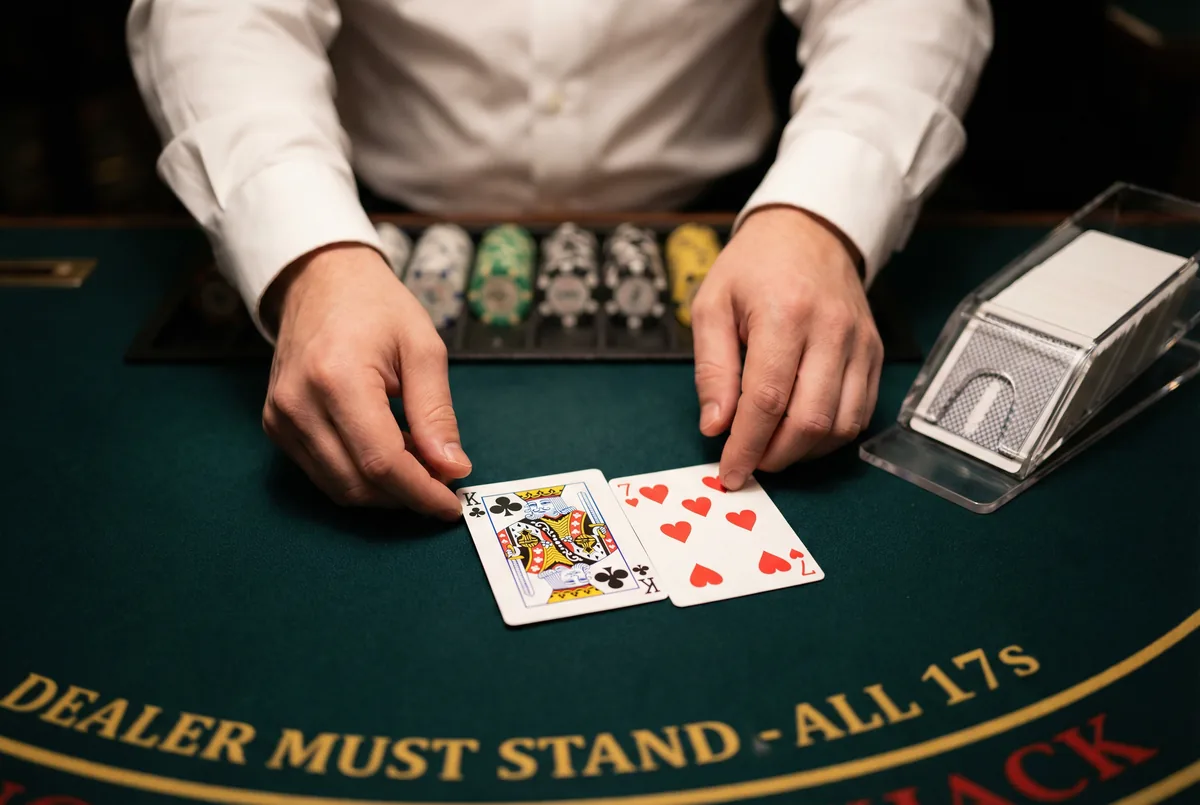
What the Dealer Must Do and How the House Manages the Game
The dealer is a machine. I mean that literally. I learned this my first week playing seriously, and it changed how I saw every hand after that. The dealer at a blackjack table has zero decision-making authority. Every action is predetermined by the rules printed on the felt. The dealer cannot choose to stand on 15. The dealer cannot choose to hit 17 to try to beat a strong hand. The dealer executes a fixed algorithm, the same way every time. Once you understand that algorithm, you stop reacting and start calculating. That shift is where your edge begins.
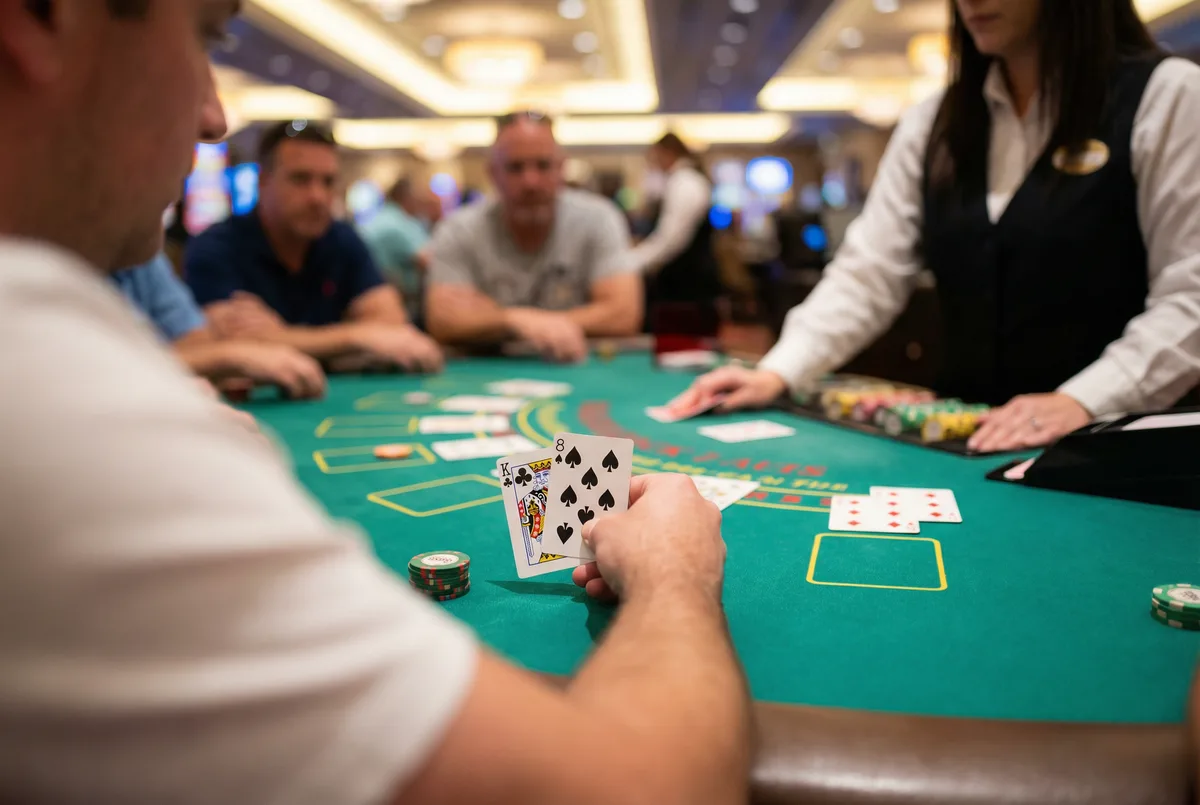
The dealer must draw to any total of 16 or less and must stand on any hard 17 or higher. At H17 tables, the dealer also draws on soft 17. These rules apply on every hand, for every player, without exception or variation. The dealer cannot modify this rule set.
The Dealer's Binding Rule
The Dealer’s Mandatory Rule Set
Blackjack dealer rules are uniform at the institutional level and vary between casinos only in a few specific ways. The universal rule is that the dealer must draw to any total of 16 or less and must stand on any total of hard 17 or higher. This rule applies regardless of what the players at the table hold. If the dealer holds hard 17 and every player at the table holds 18 or higher, the dealer still stands. The dealer cannot improve their position to try to beat strong hands.
The rule that varies between casinos is how the dealer handles soft 17. A soft 17 is any Ace-containing hand that totals 17 with the Ace counted as 11: Ace-6 is the most common, but Ace-2-4, Ace-3-3, and other combinations also produce soft 17. At S17 tables, the dealer stands on soft 17. At H17 tables, the dealer must draw again on soft 17. The H17 rule adds exactly 0.22% to the blackjack house edge. Over 80 hands at $25, that difference equals $4.40 in additional expected cost compared to an S17 table.
What Is the Soft 17 Rule?
When the dealer hits soft 17, they can improve to 18 through 21 without busting because the Ace absorbs the excess, adding 0.22% to the blackjack house edge compared to a table where the dealer stands on all 17s. A dealer drawing on soft 17 with a 4 does not bust: the Ace drops to 1 and the dealer holds hard 21. This ability to improve on a soft 17 hand, which would be a standing hand at S17 tables, shifts expected value to the house. The 0.22% edge increase from H17 sounds small, but combined with other unfavorable rules, it accumulates into the single-session difference between a 0.5% and a 0.72% blackjack house edge.
The practical advice is simple: prefer S17 tables. On the Las Vegas Strip, H17 is the majority rule. Off-Strip, downtown, and locals casinos more frequently offer S17. When the minimum bet size is comparable, always choose S17 over H17. At equal bet size, you can evaluate the S17 advantage in dollar terms: over a 200-hand session at $25, the difference is $11 in expected cost.
Dealer Shows
Your Hand
The dealer holds soft 17 against your 19 at an H17 table. What does the dealer do?
At an H17 table, the dealer must draw on any soft 17, including Ace-6. The dealer cannot stand on soft 17 even when it would benefit the house to do so. The drawing rule is mandatory and applies regardless of player hand totals.
What Is the Hole Card Protocol?
In American blackjack, the dealer receives one card face up (the upcard) and one card face down (the hole card), and checks for a natural before players act whenever the upcard is an Ace or 10-value card. The face-down card is called the hole card. When the dealer shows an Ace or a 10-value card face up, the dealer peeks at the hole card before players act. If the dealer holds a natural blackjack, the round ends immediately and all player bets are collected before players spend additional chips on doubles or splits. This dealer peek rule protects players from investing extra money into a losing round.
In European blackjack and many non-American variants, the dealer does not receive a hole card until all players have acted. The dealer draws the second card only after all player decisions are complete. This no-hole-card rule adds approximately 0.11% to the blackjack house edge because players may split or double additional chips only to lose them all when the dealer later draws a natural. Always confirm whether a table uses dealer peek before sitting.
How Do Pit Bosses and Surveillance Work Together to Manage Each Table?
The pit boss is a floor supervisor responsible for overseeing a cluster of tables, monitoring bet sizing, watching for unusual patterns, and authorizing payouts above the dealer’s limit: the surveillance system above supplements that floor-level observation with a continuous video and data record of every hand, every bet, and every chip movement at the table. Together they form a two-layer monitoring structure that runs on every blackjack table in every regulated casino.
A pit boss pays attention to bet spread, meaning the difference between your minimum bet and your maximum bet across a session. A player betting $25 on most hands and suddenly placing $200 triggers a rating review. Card counters raise bets when the count is favorable. Flat bet size across all hands, regardless of count, is the simplest signal of a non-counter. I do not count cards, but I know how the review works because understanding why you are being watched tells you what a normal playing pattern looks like from the casino’s perspective.
Surveillance cameras record every table continuously. When a dispute arises, a pit boss calls for a tape review. This is why hand signals matter: the camera needs a clean visual record of your decision. It is also why chip placement matters. Chips stacked on top of the betting circle, chips placed late, or bets that appear to grow after a favorable card can all trigger a review. None of this should concern a player using blackjack basic strategy correctly. It is context that helps you understand how the game is managed from above the felt.
How the House Manages Payouts and Collections
The blackjack house edge in blackjack operates through volume, not through individual hand manipulation. Casinos profit from blackjack because millions of hands are dealt each year and the mathematical edge held on each hand compounds across that volume. A 0.5% edge on $25 bets over 10,000 hands generates $1,250 in expected revenue per player-position. The dealer’s job is to execute the fixed rule set efficiently and accurately, not to maximize the blackjack house edge hand by hand.
You now know the dealer’s entire algorithm. I check for the soft 17 rule at every table I sit at. It takes two seconds and it tells me more about my expected cost than anything else on the felt. Watch this rule in action at a live table. Check whether the dealer stands or hits on soft 17 before your first chip goes down. Then play 20 hands and watch the dealer execute the exact protocol you just learned. Every chip on the table represents real money, so cap your session at an amount you chose before sitting down.
Frequently Asked Questions
No. The dealer follows a fixed rule set with no discretion. The dealer must draw on any total of 16 or less and must stand on hard 17 or higher. At H17 tables, the dealer also draws on soft 17. The dealer cannot deviate from these rules regardless of the player hands at the table.
The soft 17 rule determines whether the dealer hits or stands on a soft 17 hand (any Ace-containing total of 17 with the Ace counted as 11). At S17 tables, the dealer stands on all 17s including soft 17. At H17 tables, the dealer must draw on soft 17. The H17 rule adds 0.22% to the house edge, equal to $4.40 extra cost over 80 hands at $25.
In American blackjack, when the dealer shows an Ace or 10-value card face up, the dealer checks the hole card before players act. If the dealer holds a natural blackjack, the round ends immediately before players can double down or split and lose additional chips. The peek rule protects players from investing extra money into hands already lost to a dealer natural.
Before you test these plays at a real table, run them through our free blackjack simulator practice unlimited hands at zero cost until every move becomes automatic.
Know Your Edge Before You Bet
The calculator shows the correct play for any hand total against any dealer upcard under your exact table rules.
Blackjack Academy is an educational resource. All strategy is based on mathematical expectation. Always play within your means.

Written by
Mark AnurakProfessional card counter since 2009 · 500,000+ hands logged · Former Macau advantage player. Studied under Thorp, Griffin & Wong methodology. Full bio →
Learn More
Continue your education with these related lessons.
Why Dealers Follow the Rule of 17 Without Choosing Strategy
Dealers at every licensed blackjack table follow a fixed algorithm: draw to 16, stand on all 17s. They make no…
Exactly Where to Place Your Wagers in the Blackjack Betting Box
The betting box is a printed circle or rectangle on the felt directly in front of your seat. Place your…
Major Differences in Skill Between Blackjack and Poker
Most people assume poker requires more skill than blackjack. The reality is more complicated. Both games reward skill at the…