

Why the Martingale System in Blackjack Always Fails Mathematically
The Martingale system appears to solve blackjack’s fundamental problem. Lose a hand double the bet. Lose again double again. Eventually you win, and that single win recovers every previous loss plus a profit equal to your original stake. The logic feels airtight. In practice, the Martingale does not change the casino’s expected profit from your session by a single cent. It restructures when you lose, not whether you lose.
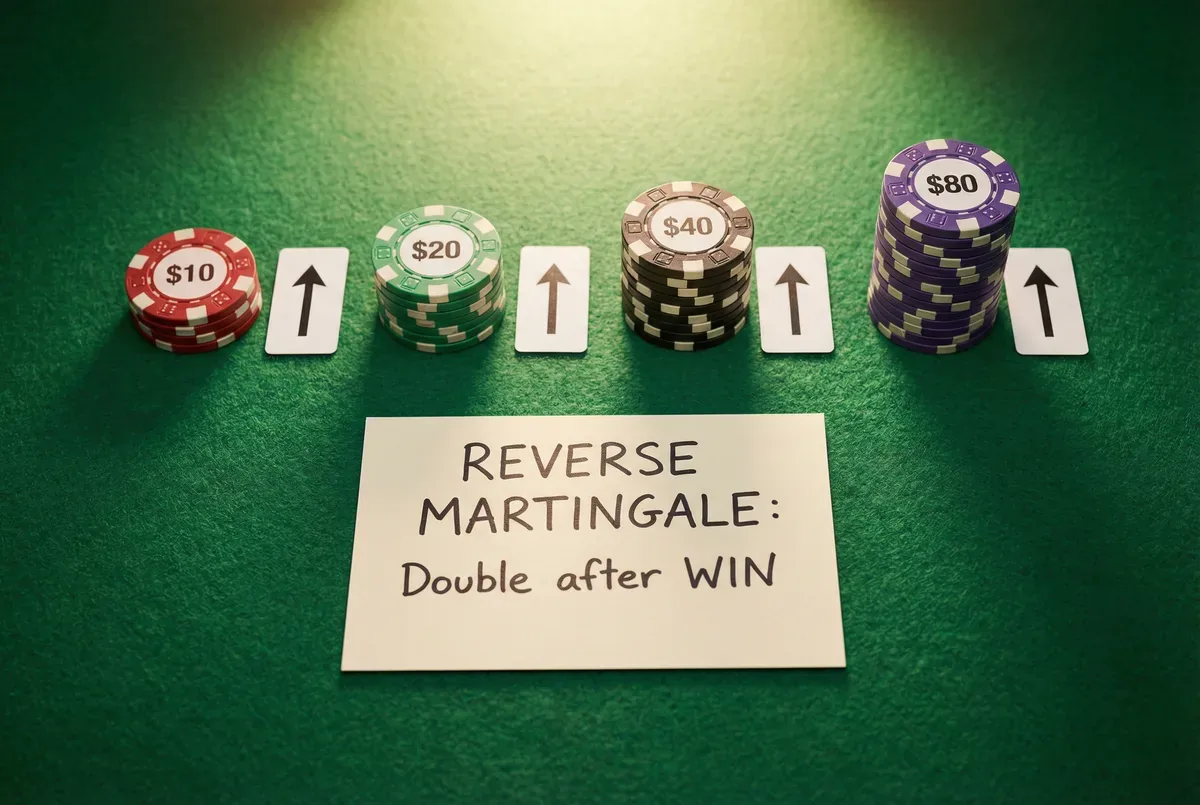
The system’s appeal rests on an intuition that is mathematically wrong: that a string of consecutive losses becomes increasingly unlikely and therefore increasingly safe to bet against. Consecutive losses do become less probable, but the doubling requirement grows exponentially to match. The Martingale does not beat variance it amplifies it, converting a series of small, manageable losses into a single event that can eliminate an entire bankroll.
How the Martingale System Works in Blackjack
The Martingale starts with a base bet. After each loss, the player doubles the next bet. After each win, the player returns to the base bet. The goal is to recover all losses from the current streak plus a net profit of one base unit when the inevitable win arrives.
At a $10 base bet, the sequence looks like this: $10, $20, $40, $80, $160, $320, $640, $1,280. Each step doubles the previous wager. A win at any point returns the player to $10 and books a $10 net profit for the sequence. After eight consecutive losses, the player has committed $2,550 in total wagers to chase a $10 profit. The next bet to continue the sequence would be $2,560.
In blackjack specifically, the Martingale interacts with blackjack basic strategy decisions. The doubling sequence determines the bet size on each hand. Basic strategy still determines how to play each hand whether to hit, stand, double, or split. These are independent systems. A player using Martingale still executes correct strategy on every hand; the system only governs the wager, not the decisions.
Timeline
Bet $10
Normal hand: Base unit, expected loss 5 cents at 0.5% house edge
Loss
Bet $20: One loss triggers double. Expected loss 10 cents on this hand
Loss
Bet $40: Two consecutive losses. Sequence deepening
Loss
Bet $80: Three losses. $150 committed to sequence so far
Loss
Bet $160: Four losses. Pressure to continue mounts strongly
Loss
Bet $320: Five losses. $310 committed, still chasing $10 profit
Loss
Bet $640: Six losses. $630 committed to a single sequence
Table limit hit or bankroll exhausted
Sequence breaks the entire committed amount is lost
Why the Martingale Fails to Change Expected Value?
Expected value in blackjack is calculated per dollar wagered. With a 0.5% blackjack house edge, every dollar bet carries an expected loss of 0.5 cents regardless of the sequence history. The Martingale changes how many dollars are bet on each hand, but it does not alter the 0.5% rate applied to each dollar. Expected loss on the doubled bet is still 0.5% of the doubled amount.
This is the fundamental error in Martingale reasoning. The system appears to guarantee recovery because a win always covers previous losses plus base profit. But each hand in the sequence carries its own independent expected loss. The house does not offer a discount for being in a losing streak. The 0.5% applies to every bet on its own merits, and the sum of all expected losses in a Martingale sequence equals exactly what those hands would cost at flat betting over the same number of total dollars wagered.
More precisely: the Martingale produces frequent small wins and rare catastrophic losses. The net expected value of the full distribution all winning sequences plus all losing sequences weighted by probability equals the flat-bet expected value over the same total amount wagered. The distribution of outcomes is radically different. The average result is identical. You are trading session-outcome smoothness for extreme tail risk.
Dealer Shows
Your Hand
You're using Martingale and just lost 4 straight hands. Dealer shows 6. You have 5-5. What do you do?
Double hard 10 against dealer 6 regardless of the Martingale sequence you are in. The Martingale determines your bet size; basic strategy determines your action. Hard 10 vs dealer 6 has EV of approximately +0.33 per dollar one of the most favorable doubles in basic strategy. Never let a betting system override a correct strategy decision. The doubled wager is correct here. The loss streak is irrelevant to this hand's EV.
Why Does the Table Limit Problem Where the Martingale Break Down Mechanically?
Every blackjack table has a maximum bet limit. A typical $10 minimum table caps bets at $500 or $1,000. The Martingale sequence at $10 base reaches $1,280 on the eighth consecutive loss. Most tables do not permit that wager. The sequence is mechanically broken before the player can execute the system’s recovery mechanism.
At a $500 maximum table with a $10 base bet, the Martingale survives six losses before hitting the ceiling: $10, $20, $40, $80, $160, $320, $640 (blocked). The sixth loss commits $630 to the sequence. The seventh bet required to continue is $640, which exceeds the table maximum. The player cannot double and cannot recover. The entire $630 loss is finalized.
Casinos set table limits partly for this reason. The minimum-to-maximum ratio on most tables is approximately 1:50 to 1:100, which constrains the Martingale to five or six doublings in practical play. The system requires an unlimited doubling range to function as its proponents describe. No such range exists in any regulated casino. The table structure itself enforces a hard cap on how many consecutive losses the system can absorb.
Max doublings at $10 min / $500 max table
before hitting table ceiling
Total committed at 5 losses ($10 base)
chasing $10 net profit
Probability of 6 consecutive losses (blackjack)
independent hands at ~49% player win rate
What Are Bankroll Requirements and Ruin Probability With Martingale?
Ruin probability for a Martingale player depends on three inputs: base bet size, bankroll depth, and table limit. The most common framing is how likely a player is to reach a losing sequence long enough to either exhaust the bankroll or hit the table ceiling before winning a hand to reset the count.
To survive an eight-step Martingale sequence at $10 base $10, $20, $40, $80, $160, $320, $640, $1,280 a player needs $2,550 in bankroll. That full amount is committed over the course of one losing streak. The net profit if the eighth bet wins: $10. The probability of losing eight consecutive hands in blackjack at approximately 49% win rate per hand is roughly 0.39%. Low probability, but over a long session it arrives often enough to matter.
A more realistic framing: in a 200-hand session with a $10 base bet and a $500 table ceiling, a player is effectively capped at five doublings. The probability of encountering at least one six-consecutive-loss sequence during that session which exceeds the table limit and breaks the sequence is approximately 28%. For a player who entered with $310, that single sequence eliminates the entire session bankroll. The math is not theoretical. It arrives within a normal evening of play for roughly one in four players using the system.
What the Martingale Risk Looks Like Before Real Money
The ratio of what the player risks to what the player gains in each Martingale sequence is the structural problem that no session plan can solve. Each completed sequence one that ends in a winning hand produces a $10 profit. A sequence that hits the table limit or exhausts bankroll produces a loss of $310 or more. The system requires approximately 31 successful sequences for every one catastrophic failure just to break even on the high-loss events. The math does not support this ratio over a full session.
Understanding the risk distribution before sitting down changes how you evaluate the system. Most players who use the Martingale report many winning sessions because the catastrophic sequence does not arrive every time. The 28% per-session probability means 72% of sessions end without hitting the ceiling. The problem is asymmetric: the 72% of sessions produce small wins, and the 28% produce a loss that wipes out many session’s profits in a single sequence.
If you want to observe Martingale dynamics in real time before committing real money to a session, a live dealer table lets you watch the bet-doubling sequence unfold with real financial consequences understand that real money is at stake in live dealer play, and set a session limit equal to what you are genuinely prepared to lose before a single hand is dealt.
Frequently Asked Questions
No. The Martingale does not change expected value. With a 0.5% house edge, every dollar wagered carries an expected loss of 0.5 cents regardless of bet sequence history. The system converts frequent small wins into rare large losses without altering the long-run average result. Table limits additionally cap the number of doublings available, preventing recovery after six or more consecutive losses at most bet levels.
At a $10 base bet with a $500 table maximum, six consecutive losses exhaust the doubling range. The sequence reaches $320 on the sixth bet, requiring $640 on the seventh which exceeds the typical table ceiling. Total committed through six losses: $630, chasing a $10 base profit. In a 200-hand session, the probability of encountering at least one such six-loss run is approximately 28%.
No. The Martingale governs bet size only. Basic strategy governs every decision whether to hit, stand, double, or split and should be followed exactly regardless of where you are in a Martingale sequence. A doubled Martingale bet on hard 10 against a dealer 6 is still correct to double down on for strategy purposes. Letting bet sequence pressure override correct decisions compounds both the Martingale's structural flaws and the underlying strategy error.
Before you test these plays at a real table, run them through our free blackjack simulator practice unlimited hands at zero cost until every move becomes automatic.
Betting Systems Cannot Beat the House Edge
Use the Blackjack Calculator to model expected session results at flat betting vs progressive systems.
Blackjack Academy is an educational resource. No betting system alters expected value in blackjack. All session results are subject to variance and a house edge that produces expected long-term losses for non-counting players. Always set a hard session limit before wagering real money.

Written by
Mark AnurakProfessional card counter since 2009 · 500,000+ hands logged · Former Macau advantage player. Studied under Thorp, Griffin & Wong methodology. Full bio →
Learn More
Continue your education with these related lessons.

Why You Always Split Aces and 8s in Every Version of Blackjack
Splitting aces and 8s is the one pair-splitting rule that never changes. Here is the mathematical case for both unconditional…

How Late Surrender Saves Your Bankroll on 15s and 16s
Late surrender on hard 15s and 16s against strong dealer upcards is one of the most underused plays in blackjack.…

Hitting 12 Through 16 Against a Dealer 7 Through Ace
Stiff hands against strong dealer upcards are the most painful spots in blackjack. Learn exactly when to hit 12 through…