
How to Minimize Losses on Hard 15 and Hard 16
- Why Hard 15 and Hard 16 Are the Worst Hands in Basic Strategy
- Why Does the Surrender Rule When -0.50 EV Beat All Other Options?
- What Is the Hard 15 vs Dealer 10 One of the Closest Decisions in the Game?
- How Composition Affects Hard 15 and Hard 16 in Single-Deck Games?
- Building Emotional Tolerance for the Stiff Hand Decisions
Hard 15 and hard 16 are the two hands where blackjack basic strategy offers no good option only a choice between bad ones. Every decision the chart prescribes loses money in expectation. The entire goal with these hands is damage control: make the play that loses the least, repeat it consistently, and resist the impulse to deviate based on how the session has been going.

Why Hard 15 and Hard 16 Are the Worst Hands in Basic Strategy
Hard 16 vs dealer 10 illustrates the problem clearly. Standing produces an expected value of approximately -0.54 per dollar wagered. Hitting produces approximately -0.48. Both are losing outcomes by a wide margin. The correct play hit saves roughly six cents per dollar compared to standing, which matters across a session but does not convert a losing hand into a winning one. You will lose this hand approximately seven times out of ten no matter what you do.
Hard 15 is marginally less catastrophic than hard 16 but follows the same logic. Against a strong dealer upcard it loses heavily. Against weak upcards it wins more often because the dealer is likely to bust but even then the player has a stiff total that busts on a 7 or higher. The chart exists to extract the best possible EV from a hand that has no upside scenario, only a less-bad one.
Hard 16 vs 10 Stand EV
per dollar
Hard 16 vs 10 Hit EV
per dollar
Hard 15 vs 10 Surrender
per dollar
Why Does the Surrender Rule When -0.50 EV Beat All Other Options?
Late surrender, when it is offered, changes the hard 15 and hard 16 calculation meaningfully. Surrendering returns exactly half your bet, which translates to an EV of -0.50 per dollar regardless of the situation. Any time the expected value of hitting or standing exceeds -0.50, surrender is the correct play.
For hard 16, surrender is correct against dealer 9, 10, and Ace. Hard 16 vs dealer 10 has a hit EV of -0.48 and a stand EV of -0.54 but if surrender is available, many charts still list surrender as the preferred play because the difference between hit and surrender is small and surrender eliminates variance on a hand you expect to lose. Hard 16 vs dealer 9 and Ace are cleaner surrender decisions: both hit and stand perform worse than -0.50 in expectation.
For hard 15, the primary surrender situation is dealer 10. Hard 15 vs dealer 10 produces a hit EV of approximately -0.50, which ties the surrender EV exactly. Most charts call for surrender here on the grounds that it removes the variance of the hand and avoids a bust. When surrender is not available at the table, hit hard 15 vs dealer 10 it is the correct fallback play. Never stand.
What Is the Hard 15 vs Dealer 10 One of the Closest Decisions in the Game?
Hard 15 vs dealer 10 is one of the most genuinely borderline cells on the blackjack basic blackjack strategy chart. When surrender is available, surrender. When it is not, hit. Standing is not part of the calculation hard 15 vs dealer 10 produces a stand EV of approximately -0.54, worse than either alternative.
The practical error players make here is standing. A player holding hard 15 sees a dangerous-looking total and freezes. They reason that hitting is likely to bust, so they stand and hope the dealer busts. The dealer will complete a hand from 10 more often than bust a 10 upcard leads to a dealer bust only about 23% of the time. Hoping for a bust while holding 15 and not hitting is a predictably expensive choice.
Dealer Shows
Your Hand
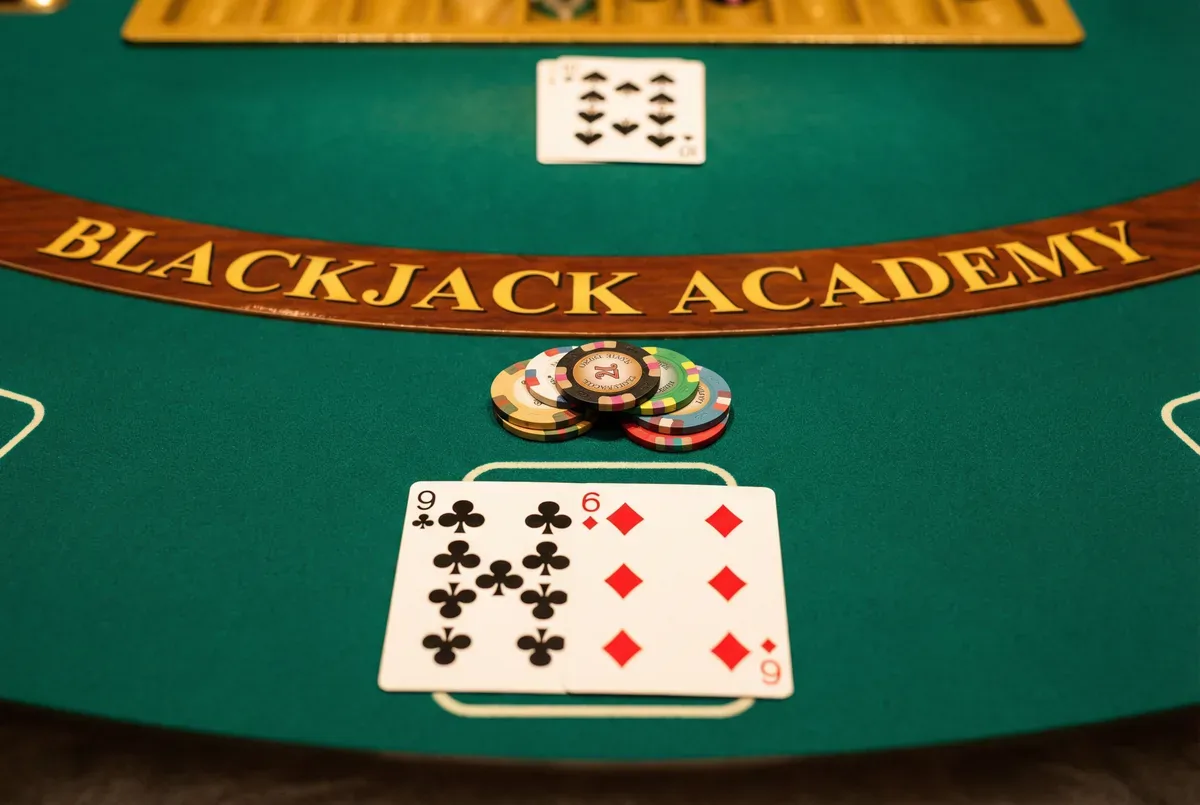
Dealer shows 10. You have hard 15 (9-6). Surrender or hit?
Hard 15 against dealer 10 (multi-deck, no surrender): hit. When surrender is not available, the decision is to hit standing on hard 15 vs dealer 10 has EV of approximately -0.54. Hitting has EV of approximately -0.50. The difference is small but real across hundreds of occurrences. When surrender IS available, surrender hard 15 vs dealer 10 (-0.50 exactly equals hitting EV either is correct; many charts call it surrender for simplicity). If only surrender vs dealer Ace is available, hit hard 15 vs dealer 10.
Hard 15 against dealer 7, 8, and 9 is a hit in all standard multi-deck charts. The dealer’s likely finishing range is strong enough that standing with a 15 produces a near-certain loss with no improvement opportunity. Hitting at least gives the player a draw at a total in the 17-21 range. Against dealer 2 through 6, hard 15 stands the dealer bust probability is high enough that the player benefits from not risking a bust of their own.
How Composition Affects Hard 15 and Hard 16 in Single-Deck Games?
In single-deck blackjack, specific card compositions create exceptions to the standard hard 15 and hard 16 decisions. The most widely recognized is 8-8 vs dealer 10 but 8-8 is a pair split, not a stiff hand decision. Always split 8-8 regardless of the dealer upcard. Treating a pair of 8s as a hard 16 hit or stand situation is a chart error; the split decision overrides entirely.
For non-pair hard 16 in single-deck, some composition-dependent blackjack strategy charts call for standing on 10-6 vs dealer 10 instead of hitting. The logic is that a 10 and a 6 being removed from a 52-card deck meaningfully reduces the remaining concentration of 10-value cards, which lowers the player’s bust probability on a hit but also reduces the dealer’s bust likelihood. Most single-deck sources still recommend hitting 10-6 vs dealer 10, and in multi-deck games there is no exception.
Multi-card hard 15 and hard 16 hands composed of three, four, or five cards that add up to 15 or 16 follow the same decision grid as two-card versions in multi-deck play. A five-card hard 16 does not unlock a stand vs dealer 7. The total governs the action, not the card count. The only meaningful composition adjustments for these hands occur in single-deck games, and even there the exceptions are narrow.
Hard 15 and 16 are hands you lose most of the time the goal is to lose less, not to win. Standing hard 16 vs dealer 10 loses 54 cents per dollar. Hitting loses 48 cents. You will lose this hand 7 times out of 10 regardless of which action you choose. The chart difference is: do you lose 48 cents or 54 cents when you lose? Always choose the smaller loss. Never freeze on a stiff hand. Make the chart play and move on.
Building Emotional Tolerance for the Stiff Hand Decisions
The hardest part of playing hard 15 and hard 16 correctly is psychological, not mathematical. Once you know the chart, you know that hitting hard 16 vs dealer 10 is correct. What is difficult is executing that hit when the bust is visible, when you are down in a session, or when another player at the table comments on your decision. The chart does not care about any of those variables.
Emotional tolerance for stiff hand losses is built through repetition at low stakes, not through reasoning alone. A player who has hit hard 16 vs dealer 10 a hundred times during practice sessions and seen the distribution of outcomes some busts, some wins, always the correct EV responds differently to the live situation than a player encountering it cold. The variance on this hand is high; you will sometimes hit and make 21, and you will sometimes bust immediately. Neither result changes whether the decision was correct.
Playing live dealer blackjack at low stakes is one of the most direct ways to accumulate those repetitions before moving to higher-stakes tables. If you want to build the habit of making the correct stiff hand decision automatically including surrendering hard 16 vs dealer 9 without hesitation a live game at bring this hard-total strategy to a live dealer gives you real table rhythm and actual decision pressure. Be aware that even minimum-bet live dealer games involve real money on every hand, so treat those sessions as paid practice with controlled exposure.
Frequently Asked Questions
Hit. Standing on hard 16 vs dealer 10 produces an expected value of approximately -0.54 per dollar. Hitting produces approximately -0.48. If late surrender is available, surrender hard 16 vs dealer 10 the -0.50 surrender EV falls between the two options and many charts prefer it to reduce variance. Never stand on hard 16 vs dealer 10.
Surrender hard 15 vs dealer 10 when late surrender is available. The surrender EV of -0.50 matches the hitting EV for this hand, and most charts recommend surrender to eliminate the bust risk. Hard 15 vs dealer Ace is also a surrender in many charts. Against dealer 7, 8, and 9 without surrender available, hit hard 15.
Yes. A pair of 8s is always split, regardless of the dealer upcard even vs dealer 10 and Ace. The 8-8 split decision overrides any stiff hand logic. Only non-pair hard 16 hands (10-6, 9-7, 8-5-3, etc.) use the hit or surrender framework. Never treat 8-8 as a hit or stand hand.
Before you test these plays at a real table, run them through our free blackjack simulator practice unlimited hands at zero cost until every move becomes automatic.
Use our free blackjack calculator to model the exact expected value for any rule combination or hand situation before you sit down.
Correct stiff hand strategy reduces the cost it does not eliminate the loss
Hard 15 and hard 16 are negative-EV hands in every situation. Basic strategy minimizes the damage but these hands lose more often than they win. Set session limits, never chase losses on stiff hand runs, and treat every correct chart play as the long-term win it is even when the short-term result goes against you.
Gambling involves financial risk. Past results do not predict future outcomes. Play within your means.

Written by
Mark AnurakProfessional card counter since 2009 · 500,000+ hands logged · Former Macau advantage player. Studied under Thorp, Griffin & Wong methodology. Full bio →
Learn More
Continue your education with these related lessons.
Best Times to Double Down on Hard 10 Against 2 Through 9
Hard 10 is one of the strongest doubling hands in blackjack. Against dealer upcards 2 through 9, the math always…
Best Basic Strategy to Reduce the House Edge Under 1 Percent
Basic strategy is a mathematically derived set of correct decisions for every possible blackjack hand. Applied consistently, it cuts the…
Why Standing on a Pair of 9s is Better Than Splitting
A pair of 9s is an 18 strong enough to win most hands. But three specific dealer upcards should change…