
Master the Blackjack Table Layout and Every Betting Position Fast
Do you know what I look at first when I approach a blackjack table? Not the cards. Not the other players. The placard. That small sign at the corner of the felt tells me the payout ratio, the dealer’s drawing rule, and the bet minimum. Those three numbers determine whether a table is worth my time before I spend a dollar. A standard blackjack table accommodates 5 to 7 players in a semicircle. Every position plays by identical rules. The only structural difference between seats is the order of play. This guide explains the physical layout, what the placard tells you, and how to evaluate any table before committing to a seat.

Pro Tip
Before You Sit: The 5-Second Table Check
Read the felt before placing any chips. Look for: (1) BLACKJACK PAYS, must say 3 TO 2, never 6:5. (2) DEALER MUST DRAW TO 16 AND STAND ON ALL 17S, this is the good rule. (3) Minimum and maximum bet sizes on the table placard. These three pieces of information are visible before you sit and determine whether the table is worth playing at all.
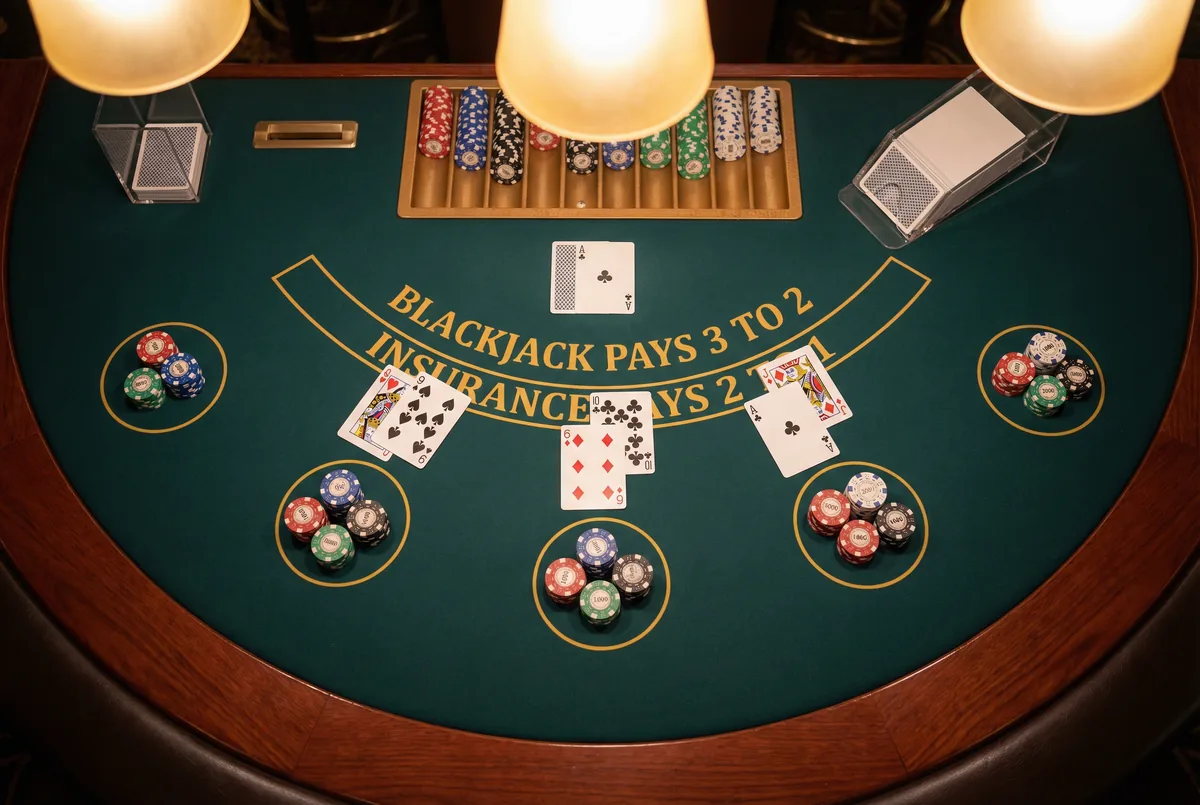
The Physical Layout of a Blackjack Table
The blackjack table is a semicircular felt surface with a padded rail along the curved player side. The flat edge faces the dealer, who stands in a recessed area with the chip rack directly in front of them. The felt is printed with the betting circles, one per player position, arranged in an arc. Each betting circle is where you place your chips before cards are dealt. The area above the arc, between the circles and the dealer, is where your dealt cards are placed face up.
The chip rack sits at the center of the dealer’s position and holds casino chips organized by denomination. The discard tray sits on the dealer’s right and holds all played cards face down between shuffles. The shoe, the mechanical card holder in multi-deck games, sits to the dealer’s left. In handheld games, the dealer holds the deck in their hand and deals by pitching cards face down to players. The entire surface layout is designed to give both the dealer and the surveillance cameras above a clear view of every card and every chip.
- BLACKJACK PAYSmust be 3 TO 2 (not 6 to 5)
- DEALER RULEstands on all 17s is better than hits soft 17
- Minimum betprinted on table placard (typically $10–$50 on Strip)
- Maximum betalso on placard, relevant if you plan to double or split
- Number of decksask the dealer or check the shoe size
- Surrender ruleposted or ask before sitting, not all tables offer it
How to Read the Betting Circle and Table Placard?
The betting circle is a printed ring on the felt directly in front of each seat where you place your chips before cards are dealt, chips placed outside this circle before the deal are not considered a valid bet. Your chips go inside that circle before the hand starts. Chips placed outside the circle before the deal are not considered a bet. The bet amount is locked once the first card leaves the shoe, with the exception of splits and doubles, both of which require placing an additional wager equal to the original bet. The placard at the corner of the table displays minimum bet, maximum bet, and key rules. Read it every time you sit at a new table.
The table placard is the most underused piece of information in blackjack. New players focus on the felt and the cards. Professional players read the placard first. That is where the payout rule, the dealer drawing rule, and the bet range live. A $25 minimum table with a 6:5 payout rule costs $27.80 more per 80 hands than a $25 table with 3:2. Both tables look identical. The difference is on the placard.
How Do You Play Positions?
First base is the position immediately to the dealer’s left and receives cards first on every hand; third base is the position immediately to the dealer’s right and acts last before the dealer draws. Third base is the position immediately to the dealer’s right, which acts last before the dealer draws. In a 5-position table, positions 2, 3, and 4 sit between them. In a 7-position table, positions 2 through 6 fill the arc. The dealing order runs left to right from first base to third base. The dealer receives the final card on each pass.
Third base has a reputation among recreational players for carrying responsibility for the dealer’s outcome because the third-base player acts immediately before the dealer draws. This perception is mathematically false. Over thousands of hands, no seat position changes the blackjack house edge. The correct play at third base is the same correct play at first base. If the player at third base makes an incorrect decision and the dealer benefits, that same incorrect decision would have helped the dealer approximately as often as it hurt the dealer over the long run.
Advantages
- No other player decisions visible before yours
- Receive cards first in fast-paced games
- Less psychological pressure from other players
- Less social friction from others tracking your choices
Disadvantages
- All player cards visible but strategy decision is unchanged
- Others may comment on your choices at the table
- Falsely attributed responsibility for dealer draws
- Last position to act before the dealer draws each round
What to Check on the Table Placard Before You Sit Down?
The table placard is a small sign mounted at the corner of the felt that contains the four most important numbers at any blackjack table: the natural payout, the dealer drawing rule, and the minimum and maximum bet limits. Every one of these matters before you commit a chip.
First, find the natural payout. If it reads 6:5, walk away. The 6:5 rule adds 1.39% to the blackjack house edge and costs $27.80 extra per 80 hands at $25. If it reads 3:2, you are at a table worth evaluating further. Second, check the dealer rule. “Dealer stands on all 17s” (S17) is better for you than “Dealer hits soft 17” (H17). The H17 rule adds 0.22% to the blackjack house edge, which works out to $4.40 more per 80 hands at $25. Third, confirm the minimum matches your bankroll. A $25 minimum with a 25-hand session budget requires $625 set aside before you sit. Do not stretch the minimum.
I also ask the dealer two things before sitting: whether surrender is available, and how many decks are in the shoe. Surrender saves expected value on hard 15 and 16 against strong upcards. Fewer decks slightly favor the player on naturals. Neither question takes more than five seconds, and the answers change the math before a single card is dealt. Run through this checklist every time, even at tables you have played before. Rules change when management changes.
Choosing the Right Table as a New Player
Table selection matters more than seat selection. A 3:2 table with a dealer standing on all 17s and a $10 minimum is objectively superior to a 6:5 table at the same minimum. In Las Vegas, off-Strip properties consistently offer more player-favorable rules than Strip casinos at the same bet size. Downtown casinos and locals casinos in Henderson and North Las Vegas regularly run 3:2 games with better rule configurations than casinos on the Strip at double the minimum.
I do the 5-second table check at every table I sit at, and it has become automatic. You should make it automatic too. Try this at a live table: before your first bet, scan for the payout rule, the dealer rule, and the minimum. Do it every time until the scan becomes a habit. That five seconds saves you from sitting at a table that costs an extra 1.39% before you play a single hand. No practice mode here. Every chip is real money, so know your limit before you click deal.
Frequently Asked Questions
First base is the player position immediately to the dealer's left. The first base player receives their cards first and acts first on every hand. In a 5 to 7 player table, first base is the rightmost seat from the dealer's perspective. There is no mathematical advantage or disadvantage to sitting at first base compared to any other position.
Read the table placard for three things: (1) the natural blackjack payout, which must say 3 TO 2 to be worth playing at; (2) the dealer drawing rule, where standing on all 17s is better than hitting soft 17; and (3) the minimum and maximum bet limits. These rules are visible before you sit and determine the house edge before the first card is dealt.
Seat position has no mathematical effect on your house edge or expected results. The same house edge applies at first base, third base, and every position between them. Table selection matters far more than seat selection. Choose the table with the best rules first, then sit wherever a seat is available.
Before you test these plays at a real table, run them through our free blackjack simulator practice unlimited hands at zero cost until every move becomes automatic.
Know Your Edge Before You Bet
The calculator shows the correct play for any hand total against any dealer upcard under your exact table rules.
Blackjack Academy is an educational resource. All strategy is based on mathematical expectation. Always play within your means.

Written by
Mark AnurakProfessional card counter since 2009 · 500,000+ hands logged · Former Macau advantage player. Studied under Thorp, Griffin & Wong methodology. Full bio →
Learn More
Continue your education with these related lessons.
What the Dealer Must Do and How the House Manages the Game
The dealer has zero decision-making authority at a blackjack table. Every action is predetermined by fixed house rules. Understanding exactly…

Exactly Where to Place Your Wagers in the Blackjack Betting Box
The betting box is a printed circle or rectangle on the felt directly in front of your seat. Place your…
Best Free Blackjack Training Simulator to Practice Before Vegas
Discover the best free blackjack training simulators, how many hands you need to practice before Vegas, and how to transition…