
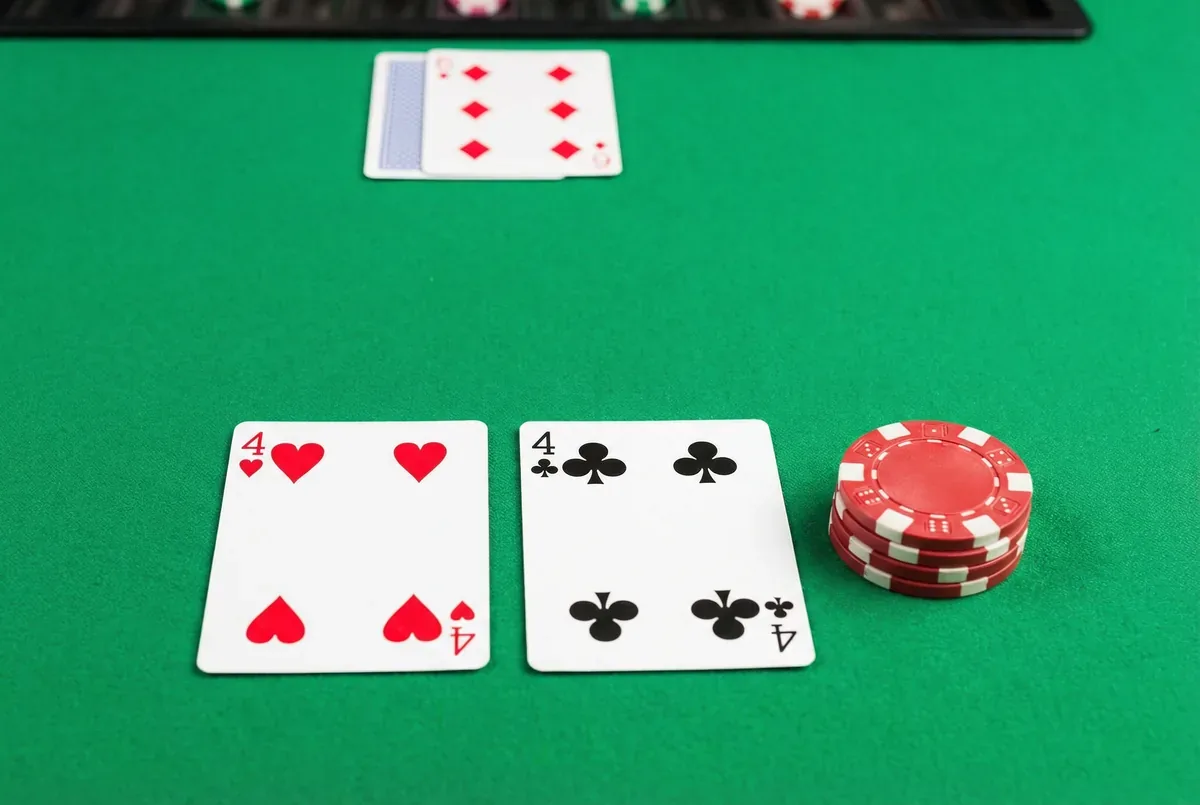
When to Split 4s Against a Dealer 5 or 6 Upcard
Splitting a pair of 4s looks wrong every time it comes up. Hard 8 is a clean total you can hit to 17 through 21 from there without any bust risk on the first draw. Splitting turns one acceptable hand into two hands that each start at 4, which is genuinely weak. And yet against dealer 5 or 6 with Double After Split available, splitting 4-4 is correct. The reasoning follows every other counter-intuitive split: dealer vulnerability does the work. Two hands starting at 4 against a dealer who will bust 42 percent of the time and where DAS allows doubling the strong totals those 4s draw to outperforms keeping the hard 8 as a single hand.

Split 4-4 against dealer 5 or 6 only when DAS is available. Against every other dealer upcard, and at any table without DAS, hit the hard 8. This is the narrowest correct-split rule in basic strategy two upcards, one prerequisite condition, no exceptions.
The Rule
Why Splitting 4s Against Dealer 5 or 6 Is Correct When DAS Applies
The logic behind splitting 4-4 against dealer 5 and 6 follows the same structure as every DAS-enabled split. When you split two 4s, each resulting hand can draw to hard 8, 9, 10, or 11 the best doubling totals in the game. Against a dealer showing 5 or 6, those doubling opportunities carry maximum value because the dealer is most likely to bust before completing a strong total. Without DAS, those resulting hands must hit or stand without doubling, which removes the concentrated winning position the double creates and reduces the split’s value below hitting the 8.
Dealer 5 and dealer 6 are the only two upcards where this calculation produces positive split EV for 4-4. Both have approximately 42 percent bust probability the highest in the game. Against dealer 2, 3, or 4, the dealer’s bust probability drops enough that splitting into two 4-starting hands no longer outperforms the single hard 8. Against dealer 7 through Ace, the dealer completes a strong total too often for any weak-starting split to produce positive value.
What Are EV Difference Between Splitting 4-4 and Hitting?
Against dealer 5 in a 6-deck DAS game, the EV of splitting 4-4 is approximately +0.08 per dollar. Hitting hard 8 against dealer 5 returns approximately +0.03 per dollar. The 0.05 EV advantage from splitting is consistent across standard configurations and comes directly from the doubling opportunities DAS creates when split hands draw to 9, 10, or 11. Against dealer 6, the margin is slightly wider due to fractionally higher bust probability.
Without DAS, the split EV drops below hitting. A pair of 4s that draws to hard 10 or 11 on each half the most promising split outcomes must hit rather than double when DAS is absent. The subsequent multi-card draw from those totals produces uncertain outcomes rather than the concentrated winning position a single-card double creates. The EV gap reverses: at a no-DAS table, hitting hard 8 outperforms the split against dealer 5 or 6 by approximately the same margin the split holds over hitting at a DAS table.
Dealer Shows
Your Hand
Dealer shows 5. You have a pair of 4s. DAS is available. Split?
Splitting 4-4 against dealer 5 is correct when DAS is available. Dealer 5 busts approximately 42% of the time, and DAS means any 8-11 formed on a split hand becomes a doubling opportunity. The combined EV advantage over hitting is approximately 0.05 per dollar. Without DAS, hit the hard 8 instead.
How Does Dealer Upcards Should You Never Split 4s Against?
The correct range for splitting 4-4 is exactly dealer 5 and dealer 6 nothing else. Against dealer 2, 3, and 4, the dealer’s bust probability is high enough to justify standing on 12 through 16, but not high enough to make splitting two weak hands the better play. Hitting hard 8 against these upcards hits more profitably than managing two starting-at-4 hands. Against dealer 7, 8, 9, 10, and Ace, the dealer completes a strong total far more often than they bust, and splitting 4-4 into two positions that frequently need multiple draws to reach competitive totals is a losing proposition across the full distribution of outcomes.
Players who split 4-4 widely against dealer 4 or dealer 7, for example are extending the logic of the dealer 5-6 rule beyond its valid range. The EV support that justifies the dealer 5-6 split does not carry to neighboring upcards. Basic strategy is not a sliding scale: 4-4 hits against dealer 2 through 4 and dealer 7 through Ace without exception.
- Split 4s ONLY when DAS (Double After Split) is allowed
- Split only vs dealer 5 or 6 the two weakest upcards
- Without DASalways treat 4-4 as a hard 8 never split
- With DASsplitting creates two hands starting at 4, doubling possible
- EV of splitting 4s vs dealer 6 with DASapproximately +0.08 per unit vs hitting
Novice: Never splits 4-4 hard 8 feels safe, splitting seems risky
Intermediate: Splits 4-4 everywhere hears it is sometimes correct, overcorrects
Learning: Discovers the dealer 5-6 condition narrows the range
DAS check: Learns DAS is required narrows further
Mastery: Split 4-4 vs 5 or 6 with DAS only. Hit everything else.
[/bja_timeline]
How DAS Availability Changes the Entire Split 4s Decision?
At a table without DAS, the correct play for 4-4 is to hit in every situation against all upcards, including dealer 5 and 6. This makes 4-4 one of five pairs in blackjack basic strategy where DAS status changes the correct initial decision. The others 2-2, 3-3, and to some extent 6-6 and 7-7 at certain upcards all follow the same logic: the split only produces positive EV if resulting hands can be doubled when strong totals form. Without that option, the split cost exceeds the benefit.
The practical consequence is that players who do not check DAS availability before sitting will occasionally split 4-4 at a no-DAS table against dealer 5 or 6 a play that costs EV rather than gaining it. The error is invisible in any single session because the outcomes are variable. Over a long run of identical decisions, the cost accumulates. Checking DAS before the first hand is the single action that eliminates this category of error permanently.
How to Build the Split 4s Habit With Live Repetition
The split 4s rule is abstract until a pair of 4s appears against dealer 5 in a real session. Open the live lobby now, confirm DAS in the rules panel, and commit: any 4-4 against dealer 5 or 6 gets split without hesitation. Every chip on the table is real from the first deal set your session budget before clicking in and let the chart make the decision automatically when the hand appears.
Frequently Asked Questions
No. Splitting 4-4 is correct only against dealer 5 or 6 upcard when Double After Split (DAS) is available. Against all other upcards, and at any table without DAS, hit the hard 8. The split's positive EV depends on the ability to double strong totals formed on the resulting hands, which only exists when DAS is offered.
Splitting 4-4 produces positive EV against dealer 5 or 6 specifically because resulting hands often draw to 8-11 strong doubling totals. DAS allows doubling those hands for an additional bet, which concentrates the advantage into fewer higher-value outcomes. Without DAS, those totals must hit under normal rules, the split's EV drops below hitting, and the correct play is to hit the hard 8.
In a 6-deck DAS game, splitting 4-4 against dealer 5 produces approximately +0.08 EV per dollar compared to approximately +0.03 for hitting hard 8. The 0.05 EV advantage comes from DAS-enabled doubling opportunities on resulting hands. Without DAS, the split EV drops below hitting by a comparable margin.
Before you test these plays at a real table, run them through our free blackjack simulator practice unlimited hands at zero cost until every move becomes automatic.
Model Split 4s EV With and Without DAS
The calculator shows exact expected value for splitting 4-4 versus hitting against dealer 5 or 6 at any deck count and DAS rule combination.
Blackjack Academy is an educational resource. All strategy is based on mathematical expectation. Always play within your means.

Written by
Mark AnurakProfessional card counter since 2009 · 500,000+ hands logged · Former Macau advantage player. Studied under Thorp, Griffin & Wong methodology. Full bio →
Learn More
Continue your education with these related lessons.
Composition-Dependent Basic Strategy and When It Gives You Real Edge
Composition-dependent basic strategy goes beyond your hand total the specific cards you hold can change the correct play. The multi-card…

Free Printable Blackjack Strategy Chart for Every Possible Hand
A blackjack strategy chart maps every possible player hand against every dealer upcard and tells you the mathematically correct play.…

Proven Ways to Use a Blackjack Strategy Calculator for Perfect Accuracy
A blackjack strategy calculator runs the probability distribution for every possible action on every hand. It does not approximate it…