
How Much the No Double After Split Rule Costs You
What does it actually cost to sit at a no-DAS table without adjusting your strategy? The rule removal adds 0.14 percent to the blackjack house edge. But the more expensive problem is not the edge change it is the player who keeps splitting 4-4 against dealer 5 and 6, keeps splitting 2-2 against dealer 2, and keeps making splits that are only correct when doubling after splitting is available. No-DAS is not just a passive edge reduction. It is an active strategy violation waiting to happen, and most players who sit at no-DAS tables have no idea which plays they need to change.

⚠ Alert
No-DAS Changes Which Splits You Should Make
The Expected Value Cost of Playing Without DAS
The 0.14 percent edge increase from the absence of DAS is spread across all pair-splitting situations in a session. On its own, that number is modest smaller than the H17 vs S17 dealer rule at 0.22 percent, and far smaller than the 3:2 vs 6:5 payout gap at 1.39 percent. The 0.14 percent figure assumes the player adjusts their strategy correctly for no-DAS conditions. A player who does not adjust who continues splitting pairs that are only correct with DAS pays the 0.14 percent edge difference plus additional EV loss on each incorrect split made.
The combined cost of the missing rule plus unadjusted strategy depends on table conditions and how often affected pairs appear. Pairs arrive roughly once every 13 hands on average. A session of 80 hands produces approximately 6 pairs. If three to four of those pairs fall into the DAS-dependent category and the player plays them incorrectly, the total EV cost for that session exceeds the rule’s baseline 0.14 percent in realized play.
Dealer Shows
Your Hand
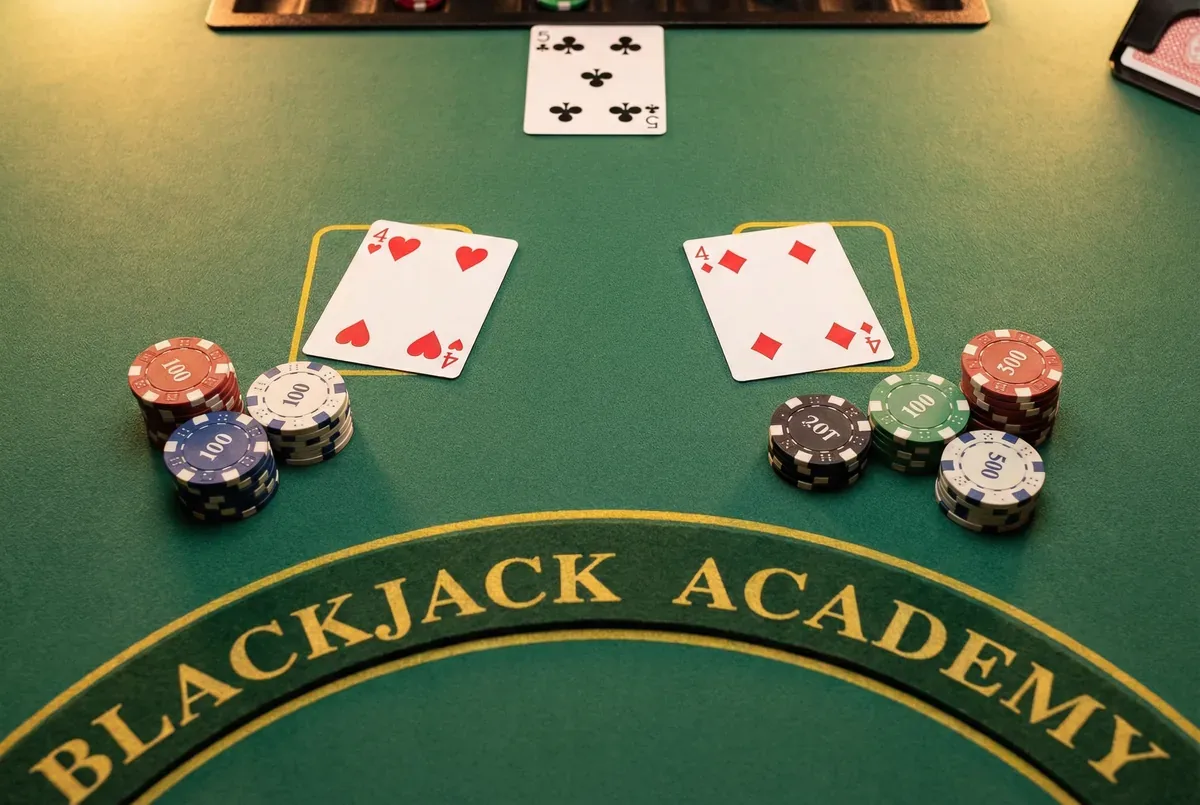
DAS is available. You hold 4-4 vs dealer 5. What is the correct play?
4-4 vs 5 with DAS: split. Without DAS: hit. The difference is the ability to double the resulting 8 vs 5, which has positive EV. No DAS eliminates that opportunity.
How Does Pair Splits to Remove From Your Strategy at No-DAS Tables?
The primary pairs to adjust at a no-DAS table are 2-2, 3-3, and 4-4. Without DAS, 2-2 and 3-3 should not be split against dealer 2 or 3 hit instead. Against dealer 4, 5, and 6, splitting 2-2 and 3-3 remains correct even without DAS, because the dealer bust probability is high enough to justify the split independent of doubling opportunity. Splitting 4-4 against dealer 5 or 6 becomes incorrect without DAS hit the hard 8 instead of splitting into two potential starting positions that cannot be doubled.
For 6-6 and 7-7, most of the standard splits remain correct without DAS against the dealer upcards where splitting is strong specifically dealer 2 through 6 for sixes and dealer 2 through 7 for sevens. The no-DAS adjustment removes some marginal splits at the edge of the range. Aces and 8s are always split regardless of DAS availability no adjustment required. 9-9 and 10-10 are never split based on DAS status. The critical adjustments are concentrated in the small pairs.
With DAS
Without DAS
- Split 2-2 vs dealer 2 or 3
- Split 3-3 vs dealer 2 or 3
- Split 4-4 vs dealer 5 or 6
- Split 7-7 vs dealer 8 (some configurations)
- Hit 2-2 vs dealer 2 or 3
- Hit 3-3 vs dealer 2 or 3
- Hit 4-4 vs dealer 5 or 6
- Hit 7-7 vs dealer 8
How to Adapt Your Splitting Chart When DAS Is Not Available?
The simplest way to adapt is to memorize the five pairs that change and the specific dealer upcards where they change. The rest of the blackjack basic blackjack strategy chart stays intact. Hard double decisions, soft doubles, standing decisions, and non-affected pairs all remain the same DAS affects only the pairs listed above, and only against specific upcards. Players who try to memorize a separate full no-DAS chart create unnecessary complexity. The no-DAS adjustment is a five-item override, not a new chart.
The practical drill is to run through the affected pairs before sitting at a no-DAS table: 2-2 and 3-3 hit against 2-3, split against 4-6. 4-4 hit against everything no splits. 6-6 and 7-7 use narrowed splitting ranges but most core splits survive. Aces, 8s, and 9s do not change. This review takes under sixty seconds and eliminates the systematic errors that no-DAS tables silently exploit in players who skip it.
What Are Casino Games and Venues That Restrict Double After Split?
No-DAS rules are most common in European blackjack variants and single-deck games at properties that have reduced the rule set to increase hold. European No Hole Card (ENHC) games frequently bundle no-DAS with other restrictive rules as a package. Some online live dealer platforms default to no-DAS for their base-limit tables and offer DAS only at higher-stake variants. Budget table minimums at physical casinos particularly in regional gaming markets are more likely to carry no-DAS rules than premium sections.
The presence of no-DAS is not always obvious at a glance. The table felt typically shows payout ratio, insurance terms, and sometimes surrender options splitting rules are often omitted. Never assume DAS is available because you have seen it at previous tables in the same casino. Rule sets can differ table by table, and the absence of DAS at one table does not tell you anything about the next. Check the rules card or ask the dealer before every session at a new table.
How to Recognize and React to No-DAS in a Real Session
The fastest way to test no-DAS adjustment under real conditions is to open the live lobby right now, check the rules panel for the first game that catches your eye, and confirm whether DAS is offered before placing a single chip. If it is not, run through the five pair adjustments mentally before the first card falls. Every dollar in a live session is real from hand one set your limit before you open the lobby, and know your correct splitting chart before you need it.
Frequently Asked Questions
No-DAS adds approximately 0.14% to the house edge compared to a game with DAS, assuming the player adjusts their splitting strategy correctly. A player who continues making DAS-dependent splits at a no-DAS table pays the 0.14% edge difference plus additional EV loss on each incorrect split the combined cost exceeds the rule's baseline impact.
No. Splitting 4-4 against dealer 5 or 6 is only correct when Double After Split is available. The split's expected value depends on the ability to double the 9, 10, or 11 formed on resulting hands. Without DAS, hitting hard 8 is the better play. This is one of the most important no-DAS adjustments to internalize.
European blackjack variants and single-deck games at properties that have reduced their rule set are the most common no-DAS environments. Some online live dealer platforms default to no-DAS on base-limit tables. Budget table minimums at regional casinos are more likely to carry no-DAS rules than premium sections at major properties. Always confirm by checking the rules panel or asking the dealer.
Before you test these plays at a real table, run them through our free blackjack simulator practice unlimited hands at zero cost until every move becomes automatic.
Model No-DAS Splitting Decisions Before Every Session
The calculator shows correct split decisions with and without DAS for any pair, dealer upcard, and deck count. Run your adjustments before you sit.
Blackjack Academy is an educational resource. All strategy is based on mathematical expectation. Always play within your means.

Written by
Mark AnurakProfessional card counter since 2009 · 500,000+ hands logged · Former Macau advantage player. Studied under Thorp, Griffin & Wong methodology. Full bio →
Learn More
Continue your education with these related lessons.
When Doubling Down Is Wrong
The five hands beginners over-double soft 19, hard 12, pair of 5s as 10, hard 10 vs Ace, hard 9…

When to Never Take Insurance and When It Is Actually the Right Call
Insurance pays 2:1 but the dealer needs a 10-value hole card more than 33.3% of the time for it to…

The Real Math Behind Splitting Pairs and Why It Boosts Your Edge
The EV math behind every pair splitting decision in blackjack which pairs always split, which never split, and the conditional…