Why Free Blackjack Games Online Are the Best Strategy Training
Conventional wisdom says you learn best by doing things for real. For blackjack, that advice backfires. Real money tables punish every hesitation and every wrong decision instantly, which creates anxiety that actively disrupts learning. Free play removes the punishment loop and lets the correct decisions become automatic before any money is at risk.
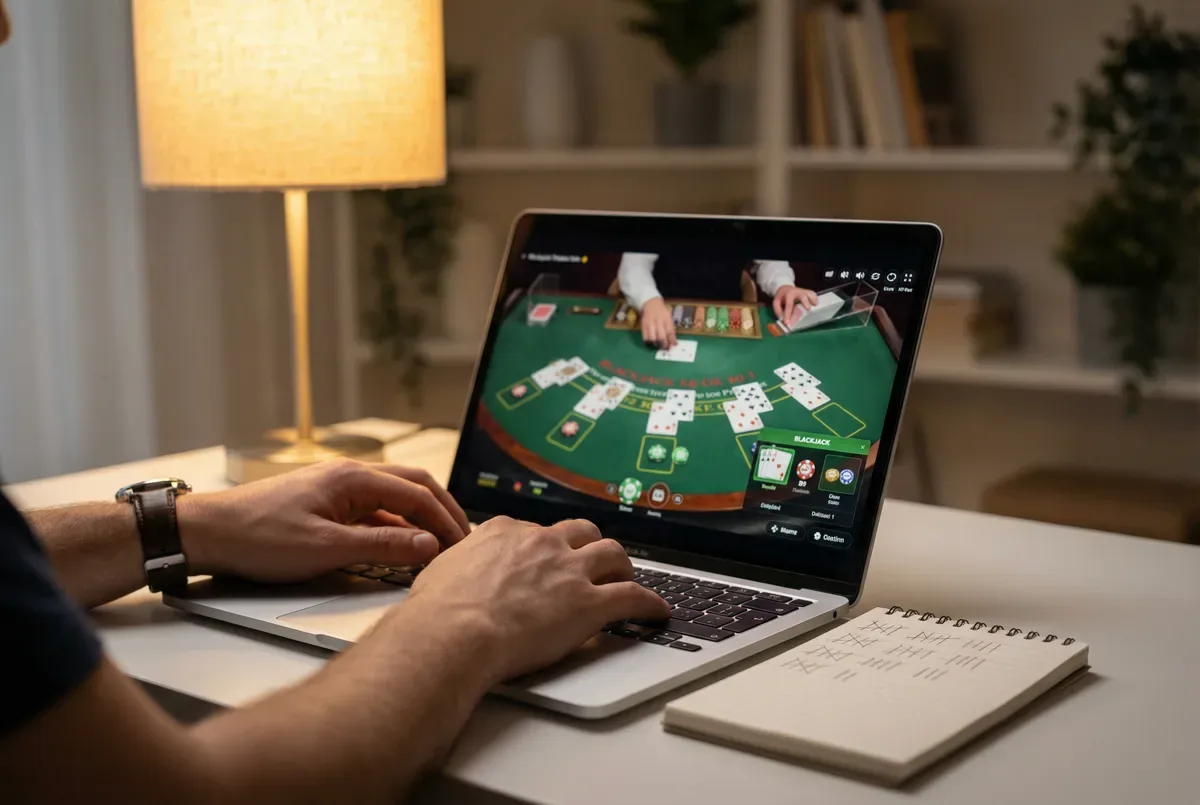
This is a contrarian position worth examining carefully. Free games do have genuine limitations. But for strategy acquisition, the research on learning under threat consistently shows that high-stakes pressure narrows attention and reduces the bandwidth available for forming new habits. Free blackjack removes that barrier entirely.
Why Playing Without Stakes Actually Speed Up Strategy Learning
Cognitive load theory explains the mechanism. When financial stakes are present, part of your working memory is occupied monitoring the risk. That occupied bandwidth is not available for learning. Research on skill acquisition consistently shows that stress-free practice environments produce faster and more durable learning than pressure-filled ones.
At a real money table, a player facing a soft 17 against dealer ace has three competing streams of attention: what is the correct play, how much is at stake, and what will the other players think. In a free game, only the first question matters. That narrow focus is exactly the condition that produces rapid skill encoding.
This is why expert poker players routinely practice hands in play-money mode before moving to high-stakes sessions. The principle is not unique to blackjack. Low-stakes practice for high-stakes execution is a well-documented learning strategy across athletic, musical, and financial training.
Common Myth
“Real money pressure teaches you faster than free play.”
Conventional wisdom assumes stakes create focus. The logic feels intuitive: skin in the game should sharpen your attention.
The Reality
Financial pressure narrows working memory and reduces learning bandwidth. Free play produces faster strategy acquisition because the brain is not simultaneously monitoring financial risk.
Studies on motor skill learning under threat show performance degradation of 15-30% in high-anxiety conditions compared to neutral practice environments.
What Is the Free Blackjack Games Teach That Paid Play Cannot?
Free games let you test rule variations without financial exposure. When you encounter a table with H17 (dealer hits soft 17) instead of S17, the blackjack basic strategy adjustments are real and specific. In free play, you can confirm those adjustments are locked in before sitting at that variant in a casino.
Free games also enable deliberate error recovery. In a real money game, a wrong decision triggers loss-chasing instincts. In a free game, you can stop after each mistake, consult the chart, understand the correct play, and continue. This deliberate review is only possible when stakes are removed.
Volume is the third advantage. A free online game generates 200 hands in 30 minutes versus 60 to 80 at a casino table. Strategy researchers estimate that encoding blackjack basic strategy requires 500 to 1,000 correct repetitions. At casino pace, that takes weeks. In free play, it takes days.
200
in free play
60-80
at casino table
500-1000
needed to encode strategy
What Is the Free Games Not Teach You?
Free games cannot replicate the psychological experience of real financial risk. The moment you place a bet you care about, your decision-making process changes. Anxiety, loss aversion, and the impulse to deviate from strategy under perceived pressure are skills you can only practice with real money on the line.
Free games also cannot teach social table management. In a casino, you must handle other players asking about your decisions, dealers waiting for your action, and the general pace pressure of a live table. These dynamics are absent from solo free play and can cause hesitation even for strategy-proficient players in their first real session.
Tipping etiquette, buy-in procedures, and the physical mechanics of a casino table are also outside the scope of free online play. Your first real session will have a procedural learning curve even if your strategy is perfect. Knowing this in advance prevents it from disrupting your decision-making.
How to Use Free Games to Test Different Rule Variations?
Every significant rule variation in blackjack changes the correct blackjack basic strategy for at least some hands. S17 versus H17 affects a handful of soft total decisions. Double-after-split versus no-DAS changes several pair strategy decisions. Free games let you test these variants before encountering them at a casino.
The correct process is: identify the rule set of the casino you plan to visit, find a free game matching those exact rules, print or bookmark the matching blackjack strategy chart, and practice with that specific configuration for at least 300 hands before your visit. Generic strategy practice against the wrong rule set creates habits that cost you money.
Single-deck games require a completely different blackjack strategy chart than 6-deck games. If you practice on a single-deck free game but plan to play a 6-deck shoe in Vegas, you are building the wrong habits. Rule-set matching is the most important and most overlooked aspect of free game training.
Knowing When to Leave Free Play and Sit at a Real Money Table
The transition point is not a fixed hand count. It is a performance threshold. When your error rate in free simulation drops below 2 per 100 hands across three separate sessions, your strategy retrieval is reliable enough for a low-stakes real money table.
The transition should be gradual. Start with the lowest minimum bet available. A $10 minimum table is a better first real-money environment than a $25 table. The lower stakes keep the financial pressure manageable while still introducing the psychological experience you cannot replicate in free play.
Before your first real session, observe a live dealer table for 15 to 20 minutes. The live blackjack environment at graduate from free games to a live dealer table lets you watch professional dealers before committing your own real money. Note that this is a genuine real-money table, so treat your first visit as observation only.
Frequently Asked Questions
For strategy acquisition specifically, free games are more effective because they eliminate the anxiety that reduces learning bandwidth. Real money play becomes valuable after strategy is already encoded, as a way to practice decision-making under financial pressure. The two serve different training purposes.
Yes, and you should. Find a free game that matches the exact rules of your target casino (deck count, S17 vs H17, DAS, surrender). Use the matching strategy chart. Practicing against mismatched rules builds habits that cost money at the real table.
Free play has delivered its value when your error rate is below 2 per 100 hands and you are no longer making the same mistakes repeatedly. At that point, the remaining gaps in your game (pressure management, social dynamics, tipping, table pace) can only be filled by real money play at low stakes.
Before you test these plays at a real table, run them through our free blackjack simulator practice unlimited hands at zero cost until every move becomes automatic.
Free Games Train Strategy. Real Money Tests It.
Free blackjack games are a legitimate and effective training tool, but they do not replicate the financial risk of a real casino table. When you transition to real money play, the house edge applies on every hand. Set a clear session budget, never exceed it, and treat real money blackjack as paid entertainment with a studied edge.
All real money blackjack involves financial risk. Free practice improves decision accuracy but does not guarantee profitable results at the casino.

Written by
Mark AnurakProfessional card counter since 2009 · 500,000+ hands logged · Former Macau advantage player. Studied under Thorp, Griffin & Wong methodology. Full bio →
Learn More
Continue your education with these related lessons.
Complete Roadmap to Becoming a Professional Blackjack Player
Becoming a professional blackjack player is a 4-stage progression that takes most people two to four years of deliberate practice.…
The Complete History of Blackjack from Vingt-et-Un to Modern Casinos
Blackjack started as a French parlor game called Vingt-et-Un. Here's how 400 years of rule changes, name shifts, and strategy…
How a Natural Blackjack Works and the Power of the Ace
A natural blackjack hits roughly 4.8% of the time and pays 3:2 at a proper table. The Ace makes it…