

Complete Guide to Playing Blackjack for Beginners and Winning
I remember my first real blackjack session. No chart, no plan, just $200 and a vague idea that face cards were worth 10. I lost $140 in forty minutes. The guy next to me had a laminated strategy card propped against his chip stack. He walked away up. The difference was not luck. Without a strategy reference, the average player gives the casino a 1.5 to 2 percent edge. With correct basic strategy, that drops to 0.5 percent. Over 80 hands at $25, that gap costs roughly $30. This guide covers everything I wish someone had handed me before that first session: card values, every table decision, payout rules, and the four mistakes that cost beginners the most.
Common Myth
“The goal of blackjack is to get as close to 21 as possible.”
This assumption leads directly to hitting a hard 13 against a dealer 5, one of the most common and costly errors at the table. Players maximize their total on instinct rather than reading the dealer's position.
The Reality
Your goal is to beat the dealer's hand without going over 21. When the dealer is showing a bust card, the highest expected value play is often to stand on a low total and let the dealer draw into trouble.
The dealer busts roughly 42 percent of hands when showing a 6. Standing on hard 13 vs. dealer 6 costs about 27 cents per dollar wagered. Hitting costs about 40 cents. Stand every time.
How Blackjack Works
Blackjack is played against the dealer, not the other players at your table. Each player runs an independent hand against the dealer and outcomes have no connection to each other. Make every decision as if you are the only person at the table, because strategically, you are.
Every hand follows the same sequence. You place a bet, receive two cards face up, and the dealer takes one card face up and one face down. You act first, making decisions based on your total and the dealer’s visible card. After all players act, the dealer reveals the hole card and draws until reaching at least 17. If you bust before the dealer draws, your bet is collected immediately, even if the dealer would have busted on the same hand.
Minimum and maximum bet sizes are printed on the table placard at each seat. Place your chips in the circle or box on the felt before cards are dealt. You cannot change your bet amount after cards are dealt except through a doubling or splitting decision.
- Cards 2 through 9worth face value (a 7 = 7 points, a 3 = 3 points)
- Cards 10, Jack, Queen, Kingall worth 10 points
- Aceworth 11 or 1, whichever prevents a bust
- Soft handcontains an Ace counted as 11
- Hard handno Ace, or an Ace forced to count as 1
- Natural blackjackAce plus any 10-value card on your first two cards
Card Values and the Ace Advantage
The Ace’s dual value is the most strategically important mechanic in the game. Ace-6 is a soft 17. Hit it and draw a 10, and instead of busting at 27, the Ace drops to 1 and you hold a hard 17. That downside protection lets you play soft hands more aggressively than hard equivalents of the same total, because the risk of busting is temporarily removed.
Soft and hard hands of the same total are not the same situation. Basic strategy calls for hitting soft 18 against a dealer 9, 10, or Ace because you can improve without the bust risk present on a hard 18. A natural blackjack pays 3:2 at a standard table, meaning a $25 bet returns $37.50. At a 6:5 table that same hand pays $30. That 1.39 percentage point difference adds $27.80 to every 80 hands at $25. Check the payout line printed on the felt before sitting down.
| Result | Payout on $25 Bet | Notes |
|---|---|---|
| Natural blackjack (3 | 2 table) | |
| Natural blackjack (6 | 5 table) | |
| Regular win | +$25.00 | |
| Push (tie) | $0.00 | |
| Dealer busts | +$25.00 | |
| You bust first | -$25.00 |
Your Five Table Decisions
Once your opening two cards are dealt, you have up to five options. Not all are available on every hand, but you need to understand each one before your first bet.
Hit means drawing one additional card. You can hit repeatedly until you stand or exceed 21. Stand means taking no more cards. Signal a stand by waving your hand flat over your cards. These two decisions are available on every hand without restriction.
Double down is your most powerful offensive tool. You place a second bet equal to your original wager and receive exactly one more card, with no additional draws after the double. Doubling on 11 against a dealer 6 captures a strong win probability while the dealer sits in a bust position, and missing the right spots costs measurable positive equity over time.
Split is available when your first two cards match in rank. Place a second equal bet and each card becomes the start of a separate hand. Always split Aces and 8s: two hands starting from 11 is dramatically stronger than a combined 12, and splitting 8s converts the worst starting hand in the game into two workable positions.
Never split 10-value cards or 5s: a 20 is too strong to break, and 5s play better as a 10 for doubling against weak dealer cards. Surrender, where offered, lets you fold before any draw and recover half your bet. Hard 16 vs. a dealer 9, 10, or Ace is the primary use case.
The Mathematics Behind the House Edge
The house advantage in blackjack comes from one rule: you act first. If you bust, the bet is collected immediately regardless of what the dealer would have drawn. In any hand where both players would bust, the house wins. That asymmetry is the only structural edge baked into the game against a player using basic strategy.
Basic strategy removes most of it. When the dealer shows a 6, standing on hard 15 costs about 27 cents per dollar wagered. Hitting costs about 41 cents. Standing transfers the bust risk to the dealer without additional cost to you, and that logic applied consistently to every decision in the game is why the house edge drops from 2 percent to 0.5 percent.
Four Mistakes That Cost New Players the Most
Playing without any strategy reference is the most expensive mistake a beginner can make. I know because I did it for my first dozen sessions and paid for every one of them. You do not need to memorize basic strategy. Print a chart or use one on your phone. Most casinos allow it at the table, and one session guided by a reference beats a hundred sessions of instinct.
Sitting at a 6:5 table eliminates most of the mathematical case for playing blackjack. Before placing any bet, read the payout line on the felt. If it says “Blackjack Pays 6 to 5,” the house edge on naturals alone adds $27.80 to every 80 hands at $25. Walk to the next table.
Taking the insurance bet when the dealer shows an Ace looks like protection. The math says otherwise. Insurance pays 2:1 if the dealer holds a natural, but the expected loss is roughly 7.4 cents per dollar wagered. It is a side bet with a built-in house advantage, not a defensive play. Decline it every time.
Adjusting bet size based on streaks has no mathematical basis. Each hand is statistically independent of every hand before it. Increasing your bet after losses because a win feels overdue is a cognitive error. Bet sizing should follow a pre-planned structure tied to your session bankroll, not how the last few rounds felt.
I still remember the first time I played with a strategy chart open. Within 20 hands I realized how many spots I had been guessing wrong for years. Try it yourself: sit down at a real table and play 30 hands with the chart visible. Every time you want to deviate, write down the hand. Those are the spots where your instincts cost you the most. The money is real from the first deal, so set your session limit before you start and treat it as tuition.
Know Your Edge Before You Bet
The calculator shows the correct play for any hand total against any dealer upcard under your specific table rules.
Blackjack Academy is an educational resource. All strategy is based on mathematical expectation. Always play within your means.
Frequently Asked Questions
The goal is to beat the dealer's hand without going over 21. It is not to reach 21 or get as close to it as possible. When the dealer is showing a weak upcard like a 5 or 6, standing on a total as low as 12 is often the correct decision because the dealer carries a high bust probability in that position.
The house edge comes from one rule: you act before the dealer. If you bust, you lose your bet immediately, even if the dealer would have busted too. With correct basic strategy, this edge drops to approximately 0.5 percent in a standard 6-deck game. Without any strategy, it typically runs between 1.5 and 2 percent.
No. Basic strategy charts are permitted at most casino tables and you can use one on your phone. Casinos allow it because even perfect basic strategy only reduces the house edge to 0.5 percent, it does not eliminate it. Starting with a reference beats playing by instinct, and most players naturally memorize the key decisions within a few sessions.

Written by
Mark AnurakProfessional card counter since 2009 · 500,000+ hands logged · Former Macau advantage player. Studied under Thorp, Griffin & Wong methodology. Full bio →
Learn More
Continue your education with these related lessons.
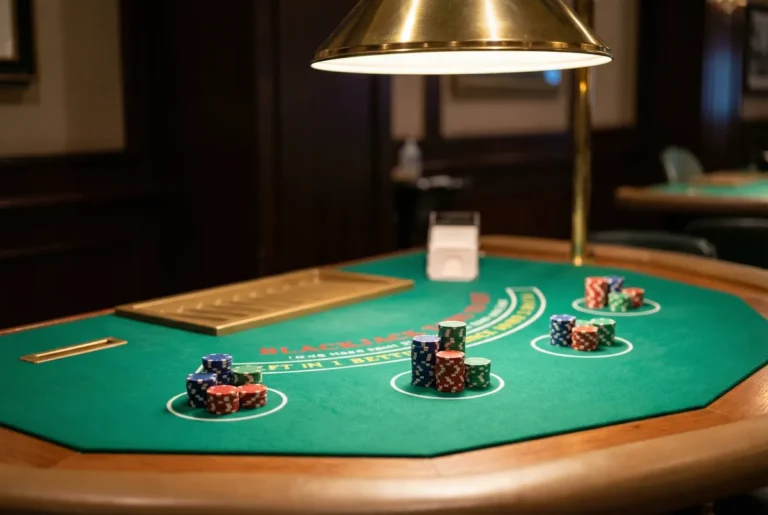
Is Playing Multi Hand Blackjack Actually Better for Your Profit?
Multi-hand blackjack looks like a shortcut to bigger wins but it exposes more money per round. Here is when it…
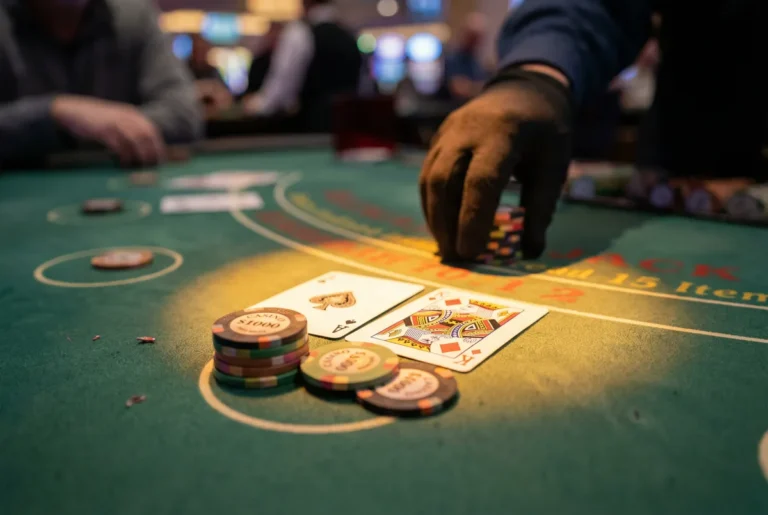
What Is a Blackjack Natural and Why It Is the Most Powerful Hand
A blackjack natural is an ace plus any ten-value card on the initial two-card deal. Here's why 3:2 vs 6:5…

How Casino Surveillance and the Eye in the Sky Monitor Tables
Casino surveillance operates on two levels: the floor staff you can see and the monitoring room above you. Understanding how…