
Why the Dealer Has the Advantage on Stiff Hands
Blackjack is structurally asymmetric. The player acts before the dealer and that sequencing carries a hidden cost. When a player busts, the hand is immediately over and the bet is collected, regardless of what the dealer does next. If the dealer would also have busted, no refund occurs. This rule commonly called the double-bust rule is the single primary source of blackjack house edge in blackjack. Without it, the game would be nearly break-even or player-favorable. With it, the house gains an advantage on every hand where both parties face the same risk of busting. Understanding this mechanism explains why blackjack basic strategy is built the way it is: the entire chart is a systematic effort to minimize exposure to double-bust scenarios while forcing the dealer to take all the bust risk whenever possible.
The House Edge Has One Root Cause: You Act First
House edge from double-bust rule
raw disadvantage before strategy
Basic strategy reduction
of that raw edge
Residual house edge (6-deck H17)
after perfect basic strategy
What Is the Mechanics of the Double-Bust Penalty?
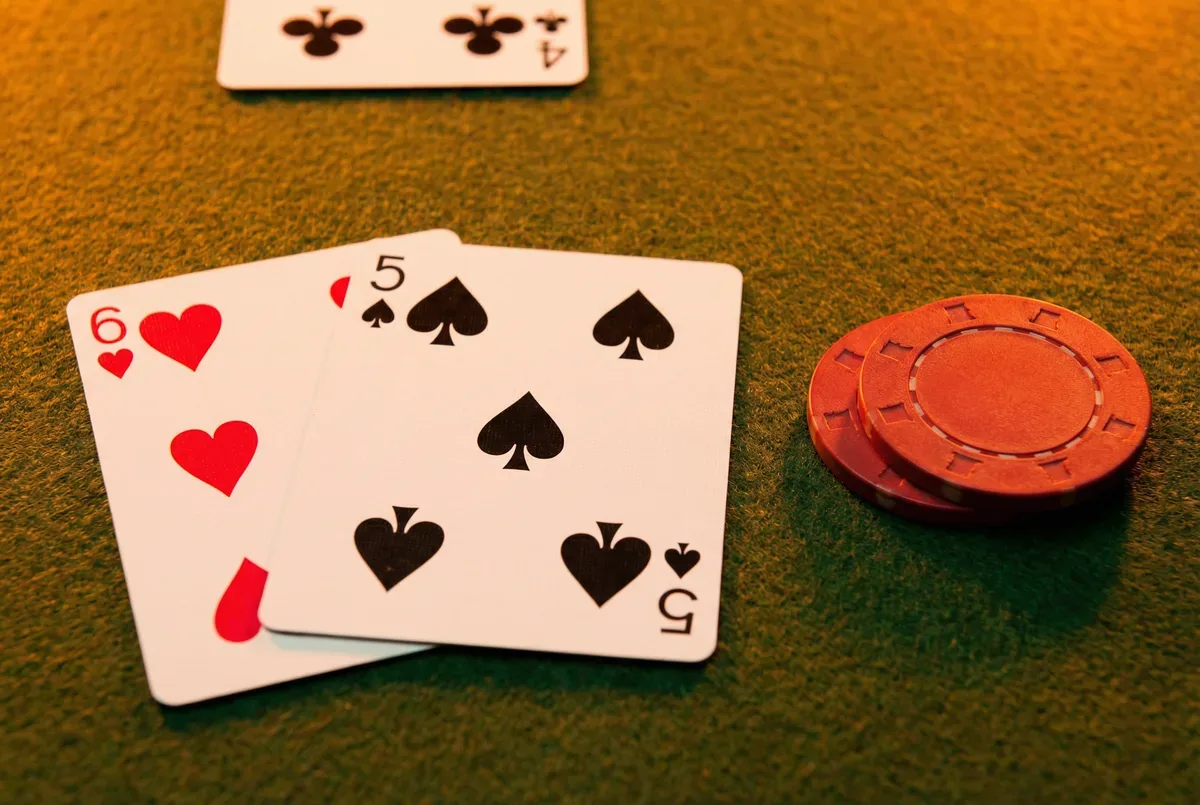
Consider a stiff hand: you hold hard 15 and the dealer shows a 5. The correct play is to stand. Here’s why the double-bust rule makes standing essential in this spot: when you hold a stiff hand against a weak dealer upcard, the dealer has a meaningful probability of busting on their own. If you hit your hard 15 and bust, you lose even if the dealer would have also busted. By standing, you preserve the chance to collect the dealer’s self-destruction. The dealer will bust approximately 41.7% of the time when showing a 5. Every hit you take on a stiff hand against a weak upcard converts some of those dealer-bust wins into double-bust losses.
Against a dealer 7 or higher, the dynamic reverses. The dealer’s bust probability drops below 27% and they are more likely to complete a strong hand. Standing on hard 15 vs dealer 7 means you lose whenever the dealer reaches 17 or better which is most of the time. In that scenario, the double-bust rule is less relevant because the primary threat is the dealer’s made hand, not their bust. Hitting and risking your own bust is the lesser of two expected losses.
Common Myth
“The dealer busts all the time just stand on everything and wait”
Players who understand the double-bust rule sometimes overcorrect, assuming standing is always correct to avoid any bust risk.
The Reality
Standing is correct vs dealer 2-6 on stiff hands. Against dealer 7-A, hitting stiff hands is mandatory the dealer rarely busts and you must improve.
Standing on hard 15 vs dealer 7 produces an EV of approximately -36 cents per dollar. Hitting produces about -27 cents. Hitting is less bad. The double-bust rule only justifies standing when the dealer's bust probability is high enough to compensate.
How Do You Quantify the Double-Bust Cost?
The raw blackjack house edge before any strategy adjustment if both player and dealer made random decisions would be approximately 8% player disadvantage, driven almost entirely by the double-bust rule. Basic strategy systematically eliminates most of this disadvantage by ensuring that: players never take unnecessary hits on stiff hands against weak dealer upcards (minimizing double-bust exposure), and players hit aggressively against strong dealer upcards (where standing on a stiff hand is a guaranteed near-loss anyway). The result is a residual blackjack house edge of approximately 0.44% in standard 6-deck H17 conditions. That 7.5-point reduction from the raw 8% penalty is entirely the work of the blackjack strategy chart optimizing around the double-bust constraint.
Players who deviate from this logic hitting stiff hands vs dealer 5 or 6 out of impatience, or standing on hard 16 vs dealer 10 out of fear are essentially handing back part of that 7.5-point recovery. Each deviation is small in isolation. Over hundreds of hands, the accumulation is significant.
The entire strategy chart is an answer to one structural asymmetry: you bust first, and the dealer pockets those losses regardless of what they would have done. Your job at the table is to stand when the dealer is likely to bust themselves, and hit when standing is a near-certain loss. Never let impatience or fear override that framework.
How Do Other Rules That Affect the Double-Bust Calculation?
The double-bust rule is fixed and universal. Other game rules, however, modulate the overall blackjack house edge around it. The H17 vs S17 rule (does the dealer hit soft 17?) adds approximately 0.2% to the blackjack house edge in H17 games because a soft 17 that would otherwise stand sometimes improves to a stronger total. The number of decks affects the frequency of certain hand compositions that interact with stiff-hand decisions. Blackjack 3:2 vs 6:5 payouts directly offset or amplify the double-bust cost a 6:5 game adds roughly 1.4% to the blackjack house edge on top of everything else. None of these variations change the fundamental double-bust mechanics, but they shift the residual edge after strategy is applied.
Experience the Double-Bust Dynamic Firsthand
Understanding this rule conceptually is one thing. Sitting at a live table with a stiff 15 vs dealer 6 resisting the urge to hit while every instinct says to do something, is another. If you want to condition yourself to stand correctly in those moments, the fastest path is repeated live exposure. take this to a live blackjack table provides exactly that environment with the important caveat that real money changes hands in those games, so only use it when your stiff-hand rules are fully locked in. Our blackjack calculator shows the exact EV shift when the dealer holds a stiff hand — enter any dealer upcard and see how bust probability reshapes every decision in your hand.
Frequently Asked Questions
Yes. In all standard blackjack variants, if the player busts, the hand ends immediately and the bet is collected regardless of what the dealer would have done. This is the double-bust rule and it is the primary mathematical source of the house edge.
No. The double-bust rule is structural and applies to all hands where the player acts first. Basic strategy minimizes its cost by ensuring you only take bust risk when the alternative (standing) has even higher expected loss never by eliminating the rule itself.
A typical blackjack session involves roughly 20-30 stiff-hand decisions per 100 hands. Each error hitting a stiff hand against dealer 5 instead of standing costs approximately 5-10 cents per dollar wagered. Over 25 stiff hands at $10 per hand, repeated errors of this type cost approximately $12-25 per 100 hands beyond what basic strategy would lose.
Before you test these plays at a real table, run them through our free blackjack simulator practice unlimited hands at zero cost until every move becomes automatic.
Mathematical Risk Warning
Even with perfect basic strategy that minimizes double-bust exposure, the house retains a mathematical edge. No strategy eliminates expected loss over the long run in a standard casino environment.
Blackjack Academy is an educational resource. All strategy is based on mathematical expectation. Always play within your means.

Written by
Mark AnurakProfessional card counter since 2009 · 500,000+ hands logged · Former Macau advantage player. Studied under Thorp, Griffin & Wong methodology. Full bio →
Learn More
Continue your education with these related lessons.
How the Reno Rule and Restricted Doubling Changes Your Play
The Reno rule limits doubling down to hard 9, 10, and 11 only. Learn which hands lose EV, how to…
Complete Soft Totals Strategy Reference for Every Soft Hand and Upcard
Every soft total from A-2 through A-9 mapped to the correct play against every dealer upcard, with the reasoning behind…

Complete Late Surrender Guide for Blackjack Hands You Should Never Play
Late surrender is one of the most underused rules in blackjack. Know exactly which hands to surrender hard 16 vs…