
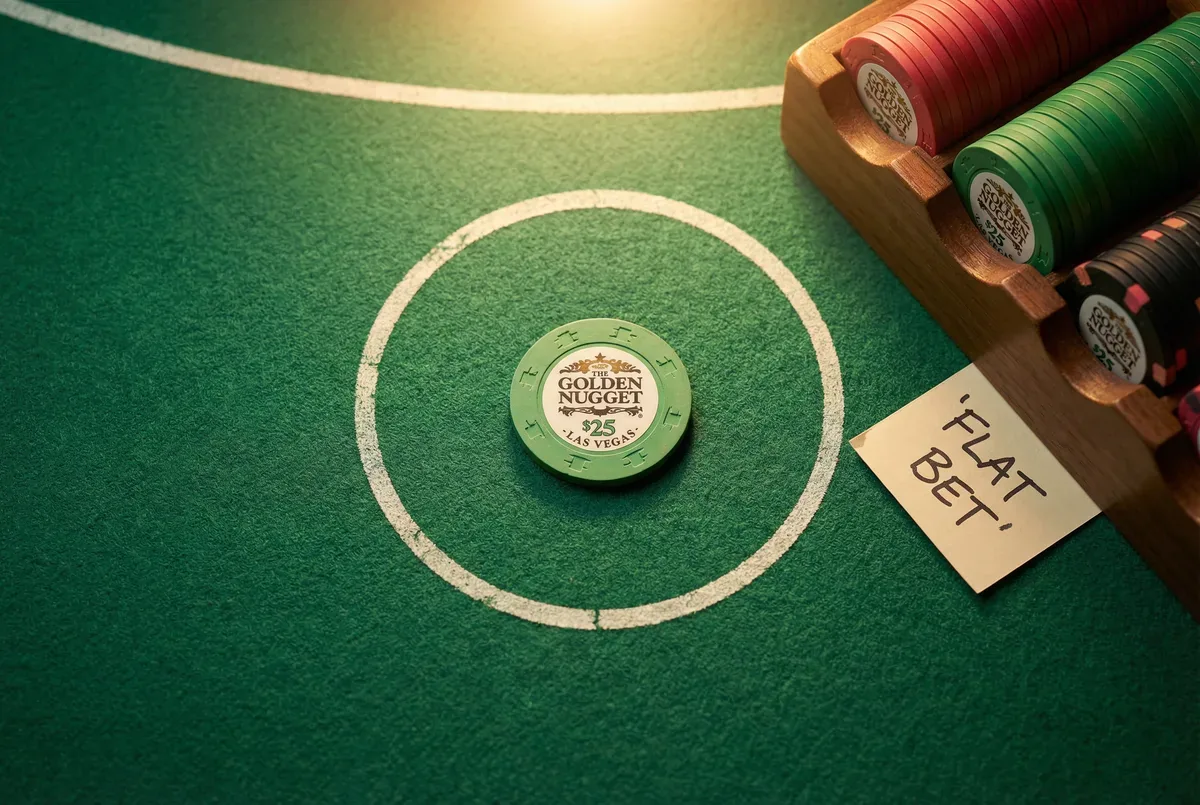
Why Basic Strategy Is Not Intuitive
Basic strategy is derived from computer simulations of hundreds of millions of hands. It tells you the mathematically optimal play for every situation the decision that produces the highest expected return across a large sample. But many of those decisions feel deeply wrong when you are sitting at a real table with real money on the line. Human intuition is built around loss aversion: the pain of losing feels worse than the pleasure of winning the equivalent amount. Blackjack strategy, on the other hand, is built around expected value it accepts certain losses when the alternative is a bigger expected loss. Three moves in particular trigger the strongest resistance from beginners, and those three moves cost players more money than almost any other category of error.

Intuition Is Optimized for Survival Not Blackjack
Hit 12 vs 3 (correct)
vs standing: -25 cents
Double A-8 vs 6 (correct)
vs standing: +22 cents
Split 8s vs 10 (correct)
vs standing (hard 16): -54 cents
How Do You Hitt Hard 12 vs Dealer 3?
Every beginner’s instinct says: stand on 12 vs dealer 3. The dealer is showing a low card, they might bust, and hitting 12 risks busting yourself. The emotional calculus feels correct. The mathematical calculus says otherwise. Against dealer 3, the dealer busts approximately 37% of the time meaningful, but not enough. When you stand on hard 12, you win in those 37% bust scenarios and lose in roughly 63% of resolved hands where the dealer completes a total that beats 12. When you hit, you improve a large portion of your hands to 13–21, and the distribution of outcomes across all those draws produces a slightly better expected value than standing. The difference is small, about 2 cents per dollar, and but it is real and consistent.
The chart says hit 12 vs dealer 2 and 3, stand vs 4, 5, 6. The clean mnemonic is: only three upcards (4, 5, 6) justify standing on 12. Against every other upcard, you hit. Most recreational players invert this and stand on 12 whenever the dealer shows anything below 7. That error, compounded over hundreds of hands, is measurable and costly.
Common Myth
“Stand on 12 vs dealer 3 the dealer might bust”
The dealer shows a low card, so players assume the bust probability justifies passivity.
The Reality
Hit hard 12 vs dealer 2 and 3. The bust probability against a 3 isn't high enough to make standing profitable.
Standing on hard 12 vs dealer 3 costs approximately 2 cents per dollar versus the correct hit. Over 200 hands per session, that compounds into a measurable loss from this single error alone.
How Do You Doubl Soft 18 (A-7) vs Dealer 6?
Soft 18 looks like a completed hand. Most players see 18 and stand automatically, in the same way they would stand on hard 18. But soft 18 vs dealer 6 is one of the most profitable doubles on the table. Dealer 6 has a 42.3% bust rate the highest of any upcard. You have a soft hand that cannot bust on a single draw. The combination means that doubling your bet in this spot produces an expected value of roughly 34 cents per dollar wagered, compared to about 22 cents for simply standing. That 12-cent difference is enormous when multiplied across hundreds of sessions.
Why does it feel wrong? Because players conflate the risk of not improving drawing a 2 to get soft 20, say with the risk of losing the hand. But when the dealer busts 42% of the time and you are getting paid double for a hand the dealer frequently destroys themselves on, the outcome distribution is strongly in your favor regardless of what card you draw. Soft A-7 should be doubled against dealer 3, 4, 5, and 6 in all standard 6-deck games. Standing in those spots is a compounding error.
When you hesitate to double soft 18 vs 6, ask yourself: am I making this decision based on what feels safe, or based on what I will earn across the next thousand hands? The answer always points to the double. Discipline means executing the math even when the instinct disagrees.
How Do You Splitt 8s Against a Dealer 10?
Splitting 8s vs dealer 10 is the move that generates the most table arguments and the most second-guessing. The logic chain runs like this: hard 16 is already the worst hand in blackjack, losing roughly 54 cents per dollar wagered. Splitting into two hands starting at 8 loses approximately 18 cents per dollar on each hand both losses are smaller than the single catastrophic hard-16 loss. You are not splitting because you expect to win; you are splitting because you can transform one awful situation into two marginally better ones. The total expected cost of splitting is approximately 36 cents versus 54 cents for playing hard 16 a 18-cent improvement per original dollar wagered.
The instinct says: don’t put more money in when the dealer shows a 10. That instinct is correct as a general principle but misapplied here. You are not adding money to a bad situation out of optimism you are paying to escape the single worst situation in the game. Always split 8s, against every dealer upcard, including 10 and Ace.
Building Discipline at a Real Table
The only way to override a trained instinct is repetition in conditions that mirror the real environment. If you want to drill these three decisions until they become reflexive, apply this strategy at a live table immediately provides genuine live-dealer pressure though real money is on the line in those games, so only play there when you are confident enough to execute without hesitation.
Frequently Asked Questions
No. Hard 16 is the worst starting hand in blackjack and splitting always outperforms standing or hitting. The math is consistent across all deck counts and rule variations. Always split 8s.
Because you are committing more money, and the outcome of the doubled hand depends on a single card. The risk feels concrete. But expected value is calculated across all possible draws and the distribution of draws on soft 18 vs dealer 6, combined with the dealer's 42% bust rate, produces a favorable outcome that standing simply cannot match.
Roughly 8-12 decisions that feel wrong to most beginners, depending on rule set. Beyond the three covered here, other common resistance points include: not taking insurance, hitting soft 17, and doubling hard 9 vs dealer 6. All are mathematically justified.
Before you test these plays at a real table, run them through our free blackjack simulator practice unlimited hands at zero cost until every move becomes automatic.
Mathematical Risk Warning
Understanding the math behind counter-intuitive plays does not eliminate variance. Even correct strategy decisions lose in the short term. Manage your bankroll accordingly.
Blackjack Academy is an educational resource. All strategy is based on mathematical expectation. Always play within your means.

Written by
Mark AnurakProfessional card counter since 2009 · 500,000+ hands logged · Former Macau advantage player. Studied under Thorp, Griffin & Wong methodology. Full bio →
Learn More
Continue your education with these related lessons.
The Correct Strategy for European No Hole Card Blackjack Explained
European no-hole-card blackjack costs you an extra 0.11 percent per hand if you play standard American basic strategy without adjusting.…
Making the Mathematically Correct Move Every Single Hand
Making the mathematically correct move every hand requires nothing more than a strategy chart and the discipline to apply it…
Why Hitting 16 Against a 10 Is Better Than Standing
Hard 16 against a dealer 10 is the most contested decision in basic strategy. Hitting feels like certain doom. The…