
Why Past Blackjack Hands Mean Nothing and the Gambler’s Fallacy Costs You
The gambler’s fallacy is the belief that past outcomes influence future probabilities in a random system. In blackjack, it shows up as expecting a win after a losing streak, or loading up bets because the table feels “hot.” Neither belief is mathematically sound. Each hand dealt from a freshly shuffled shoe is governed by whatever cards remain and in a continuous shuffle machine, even that connection disappears entirely. The probability of winning the next hand does not change because you lost the last five. The shoe has no memory, no debts, and no streaks to honor. Recognizing this fallacy is the foundational cognitive step for any serious player.
Each Blackjack Hand Is a Fresh Independent Event
Common Myth
“After losing five hands in a row, I'm due for a win I should increase my bet.”
The brain pattern-matches and interprets random clusters of losses as a reversion signal. It feels like probability must balance, because that feels fair.
The Reality
A losing streak carries zero predictive weight for the next hand. Increasing your bet after losses is the Martingale logic in disguise and it compounds expected loss, not reduces it.
Each hand's win probability is ~42-49% regardless of what preceded it. 'Due' wins do not exist.
What Are the Hot and Cold Table Illusion?
Casino floor culture is built partly around the hot/cold table narrative. Players will move to a table because “it’s been paying out” or flee one that “keeps beating everyone.” The statistical reality: a table’s recent history tells you nothing about its future behavior. The cards emerging from the shoe are randomly distributed. Any streak whether five consecutive dealer busts or five consecutive player losses is a normal feature of a random distribution. Given enough hands, such clusters appear at the expected frequency without any causal mechanism driving them.
The one genuine exception to hand independence in blackjack is blackjack card counting but that is not the gambler’s fallacy, it is the opposite. Card counting tracks the actual composition of remaining cards in the shoe using deductive reasoning. It works because it responds to concrete information about the deck, not to the perceived emotional temperature of the table. Counting is logic; hot/cold thinking is superstition. The two are not on the same spectrum.
When you feel the urge to increase a bet because you are 'due,' pause and ask: what specific information about the remaining shoe justifies that bet increase? If the answer is 'I've been losing' that's the fallacy. Return to your flat bet or your pre-planned unit size.
Why the Fallacy Is So Hard to Shake?
The gambler’s fallacy is persistent because it is rooted in a genuinely accurate intuition applied to the wrong domain. If you flip a fair coin and get ten heads in a row, the probability of the coin being biased does increase from a Bayesian standpoint that is a legitimate inference. The error is applying that logic to a casino shoe, where you already know the mechanism is random and the deck is periodically reshuffled. The brain applies a reasonable heuristic from one domain (diagnosing bias in a system) to another domain where it does not apply (predicting the next card in a known random process).
Timeline
Hand 1-5 lost
Brain registers pattern: 'losing streak'|Hand 6 decision|Fallacy triggers: 'must be due, raise bet'|Hand 6 outcome|Random 42% win probability same as always|Net result|Higher bet on hand with same EV = greater expected loss
What Is the Financial Cost of Fallacy-Driven Betting?
The most direct financial damage from the gambler’s fallacy comes when players use it to justify progressive betting after losses. If you double your bet after each loss expecting a “correction,” you are running the Martingale system which does not change expected value but dramatically increases variance and risk of ruin. The fallacy does not just cost you philosophically; it changes your bet sizing in ways that accelerate bankroll destruction. The math of independence is not optional: fighting it with your wallet is a losing proposition every time.
Testing Your Discipline Before Real Money Is at Stake
The ideal place to build fallacy resistance is in a low-pressure environment before you commit real money to a casino floor. Practice tracking your bet sizes across sessions, noting every moment you felt the urge to raise or lower a bet based on recent results. Then compare that to what the math prescribed. That gap is the cost of the fallacy. When you are confident your discipline holds under pressure, apply this at a live betting session connects you to live dealer action where every chip carries real financial consequence the fallacy’s price tag is no longer theoretical.
Frequently Asked Questions
No. Each hand is statistically independent. A losing streak has zero influence on the probability of the next outcome. Win probability stays in the 42-49% range regardless of recent history.
No. Card counting uses actual information about remaining deck composition to adjust bets. The gambler's fallacy uses perceived patterns in past outcomes with no informational content. They are conceptually opposite.
Commit to a pre-session bet plan and stick to it regardless of results. If your bet sizes are changing in response to how recent hands went not in response to count data you are acting on the fallacy.
Before you test these plays at a real table, run them through our free blackjack simulator practice unlimited hands at zero cost until every move becomes automatic.
Mathematical Risk Warning
Belief in hot streaks and due wins leads players to increase bets at moments of maximum psychological pressure. This is among the most common causes of session loss exceeding original stop-loss levels.
Blackjack Academy is an educational resource. All strategy is based on mathematical expectation. Always play within your means.

Written by
Mark AnurakProfessional card counter since 2009 · 500,000+ hands logged · Former Macau advantage player. Studied under Thorp, Griffin & Wong methodology. Full bio →
Learn More
Continue your education with these related lessons.
Proven Methods for Managing Professional Blackjack Earnings and Reinvesting
Professional blackjack earnings require the same financial management discipline as any self-employment income. How you allocate winnings between personal spending…
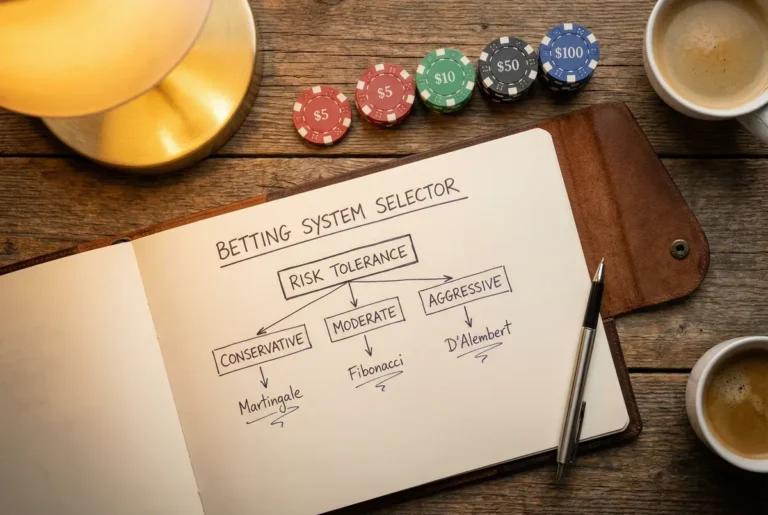
How to Choose the Right Betting System for Your Personal Risk Tolerance
The best betting system for you is the one that matches your risk tolerance, not the one with the most…
Why Winning Streaks are Just Short Term Statistical Variance
Winning streaks feel like momentum, but the mathematics say otherwise. Every hot run in blackjack is a cluster of positive…