
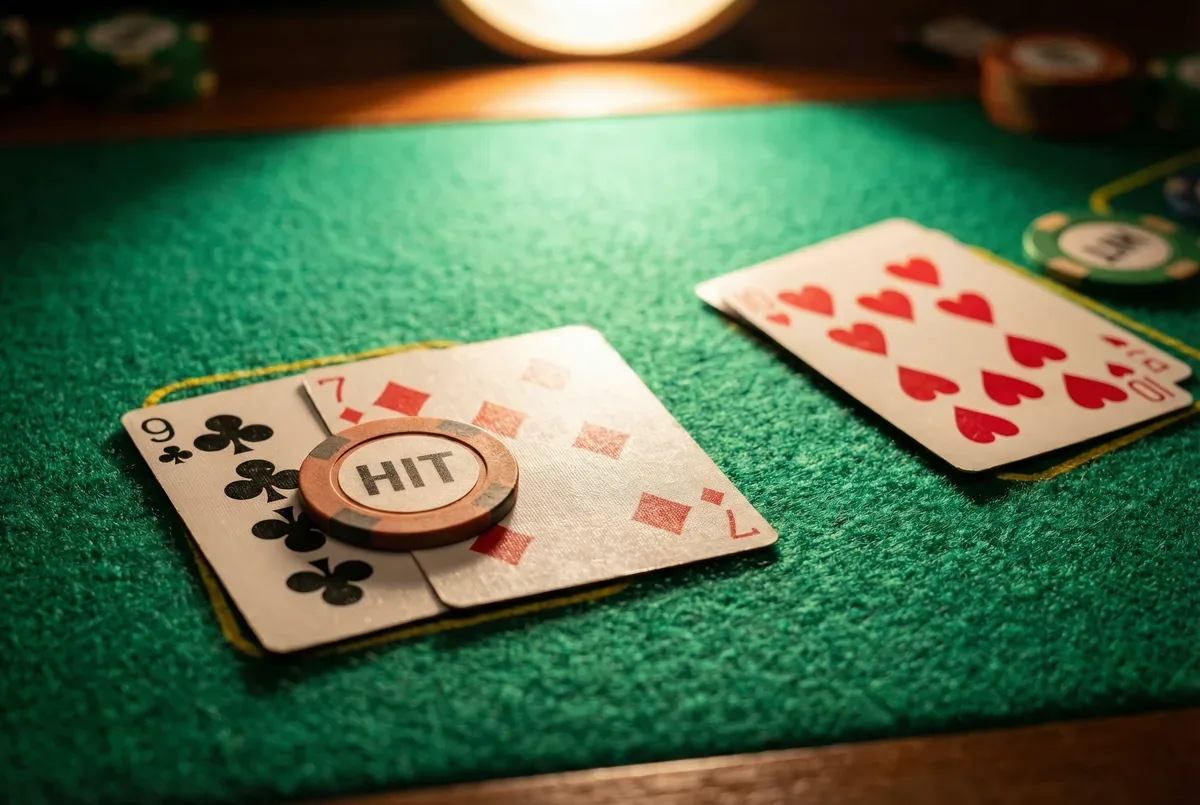
Complete Hard Totals Strategy Reference for Every Hand and Upcard
A hard total is any hand that either contains no ace or contains an ace that must count as 1 to avoid busting. Hard totals are the most common hand type you will face at the blackjack table roughly 70% of all starting combinations resolve as hard hands and getting every decision correct is the foundation of reducing the blackjack house edge below 0.5%. The strategy for hard totals is built entirely on two numbers: your total and the dealer’s upcard. Every decision in the chart below exists because it produces the highest expected value across tens of millions of possible continuations. Guesswork and instinct cost money. This reference eliminates both.
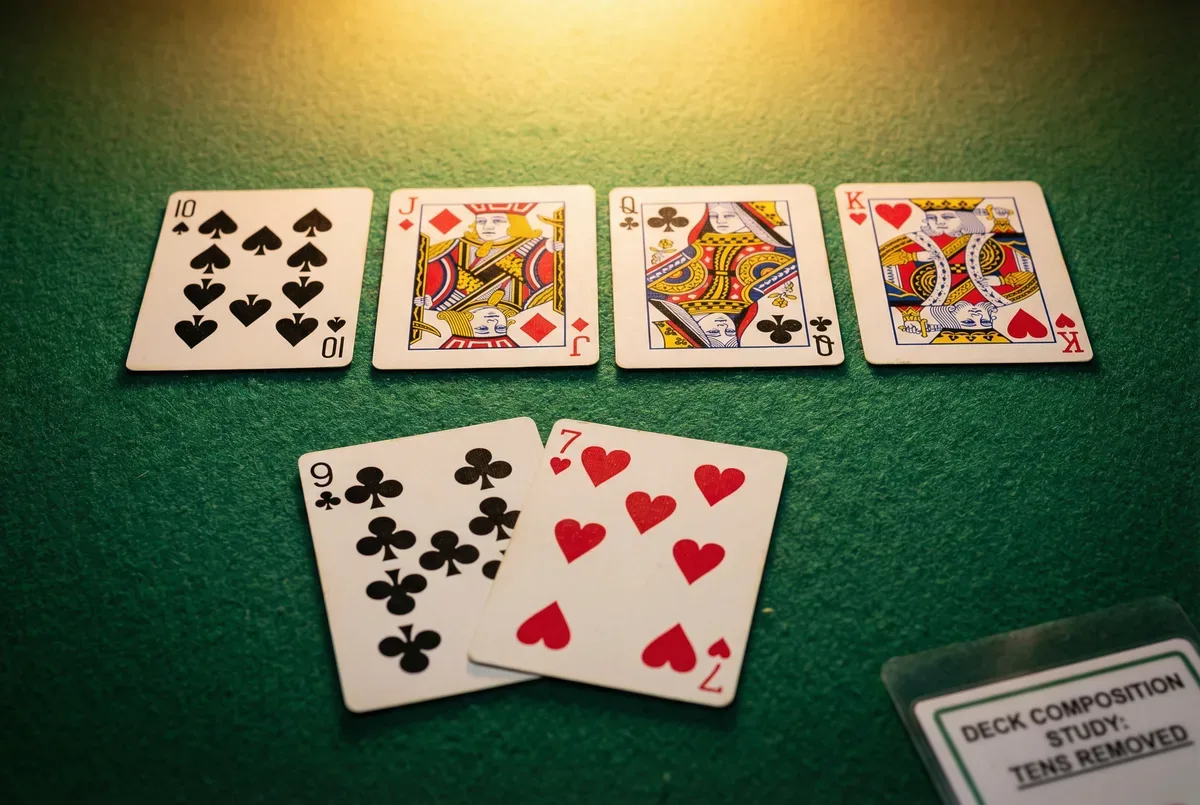
Hard Total Explained
- Hard 8 and belowalways Hit never enough to bust profitably
- Hard 9Double vs dealer 3-6, Hit all others
- Hard 10-11Double aggressively highest EV doubles in the game
- Hard 12-16 (stiff zone)Hit vs dealer 7-A, Stand vs dealer 2-6
- Hard 17-21Always Stand never risk a made hand
What Is Hard 5 Through 11?
Hard totals below 12 cannot bust on one card that single fact unlocks aggressive play. Hard 5 through 8 are straightforward: always hit. Your total is too low to win by standing, and since you cannot bust, there is no downside to taking a card. Hard 9 introduces your first doubling opportunity: double down when the dealer shows 3, 4, 5, or 6. These upcards put the dealer in the stiff zone (likely total of 13–16), meaning there is meaningful bust probability working in your favor. Against dealer 2 or 7 through Ace, the dealer is either strong enough to recover or the bust probability is too low you hit instead.
Hard 10 and hard 11 are the most valuable doubles in the game. Hard 10: double against dealer 2 through 9, hit against 10 and Ace. Hard 11: double against dealer 2 through 10, hit against Ace (in most 6-deck games; some single-deck rules favor doubling vs Ace). The logic is simple there are more 10-value cards in the deck than any other denomination, so you are most likely to complete a 20 or 21 when doubling on 10 or 11. The dealer cannot act on your double card, which means any 10 you catch is locked in as a strong made hand.
Dealer Shows
Your Hand
Hard 11 vs dealer 6. What is the correct play?
Dealer 6 has the highest bust probability of any upcard (42.3%). Hard 11 is the strongest doubling hand. Combine them: you collect double your bet while the dealer frequently destroys their own hand. EV of doubling here exceeds +40 cents per dollar wagered.
What Is Hard 12 Through 16?
Hard 12 through 16, the stiff zone, and is where most recreational players hemorrhage money. The rule is structurally simple: stand against dealer 2 through 6, hit against dealer 7 through Ace. The dealer’s bust probability above 35% for upcards 2 through 6 means you win a significant share of hands by doing nothing. When the dealer shows 7 or higher, their bust probability drops sharply and they are more likely to complete a strong hand. Your only path to winning those hands is to improve your own total, which means hitting despite the bust risk.
Hard 12 has one important exception: hit against dealer 2 and 3, stand against 4, 5, 6. At only 12, the dealer’s partial bust coverage against 2 and 3 isn’t strong enough to justify standing on such a weak total. Hard 13 through 16 all follow the clean rule: stand vs 2–6, hit vs 7–A. Never deviate from this inside a casino the EV difference between standing and hitting hard 16 vs dealer 7 is approximately -16 cents per dollar if you stand versus -27 cents if you hit, and hitting is still the correct choice despite both outcomes being negative.
Dealer 2-6 (Stand)
Dealer 7-A (Hit)
- Stand (except vs 2-3: Hit)
- Hit
How Do You Stand Is Non-Negotiable?
Hard 17 and above: always stand, against every dealer upcard, without exception. This rule is absolute. Hard 17 is a made hand it beats the dealer whenever they bust (which happens 28–42% of the time depending on upcard), and the probability of improving hard 17 by drawing is outweighed by the probability of busting. Players who hit hard 17 because the dealer shows an Ace are making an error that costs approximately 15 cents per dollar wagered over the long run. Hard 18 through 21 follow the same logic with even more force: the risk of busting is too high and the hand is already strong enough to win when the dealer fails.
Practice Hard Totals Against a Live Dealer
Knowing the chart is step one executing it under real conditions without hesitation is step two. If you want to pressure-test your hard total decisions before sitting down at a real table, apply this hard-hand play with real money is the fastest way to do it. You’ll face every dealer upcard repeatedly in a single session but note that the live tables use real money, so only play when your bankroll and your chart recall are both solid.
Frequently Asked Questions
Never. Hard 17 is a made hand. Hitting hard 17 against any dealer upcard is one of the costliest errors in basic strategy, losing approximately 15 cents per dollar compared to the correct stand. Always stand on hard 17.
Because the dealer's bust probability ranges from 40-42% when showing 4, 5, or 6. Standing on hard 12 lets the dealer destroy their own hand roughly 40% of the time. Your hand is weak, but so is the dealer's position you win more by doing nothing.
Most players struggle with hard 12 vs dealer 2 and 3 (hit, not stand) and hard 16 vs dealer 10 (hit, not stand). Both feel wrong but are mathematically correct. Hard 12 vs 2-3 is close, and hard 16 vs 10 loses money either way hitting just loses less.
Before you test these plays at a real table, run them through our free blackjack simulator practice unlimited hands at zero cost until every move becomes automatic.
Mathematical Risk Warning
Hard total strategy is based on expected value across millions of hands. Even perfect execution does not guarantee short-term profit. Variance is real and unavoidable.
Blackjack Academy is an educational resource. All strategy is based on mathematical expectation. Always play within your means.

Written by
Mark AnurakProfessional card counter since 2009 · 500,000+ hands logged · Former Macau advantage player. Studied under Thorp, Griffin & Wong methodology. Full bio →
Learn More
Continue your education with these related lessons.
Soft 19 Strategy for Doubling Down Against a Dealer 6
Soft 19 (Ace-8) against a dealer 6 is a doubling hand in single-deck play and a marginal case in multi-deck.…

Making the Mathematically Correct Move Every Single Hand
Making the mathematically correct move every hand requires nothing more than a strategy chart and the discipline to apply it…
Why 11 Is the Most Powerful Double-Down Hand in Blackjack
Hard 11 produces the highest expected value of any doubling hand in standard blackjack. Against every dealer upcard from 2…