
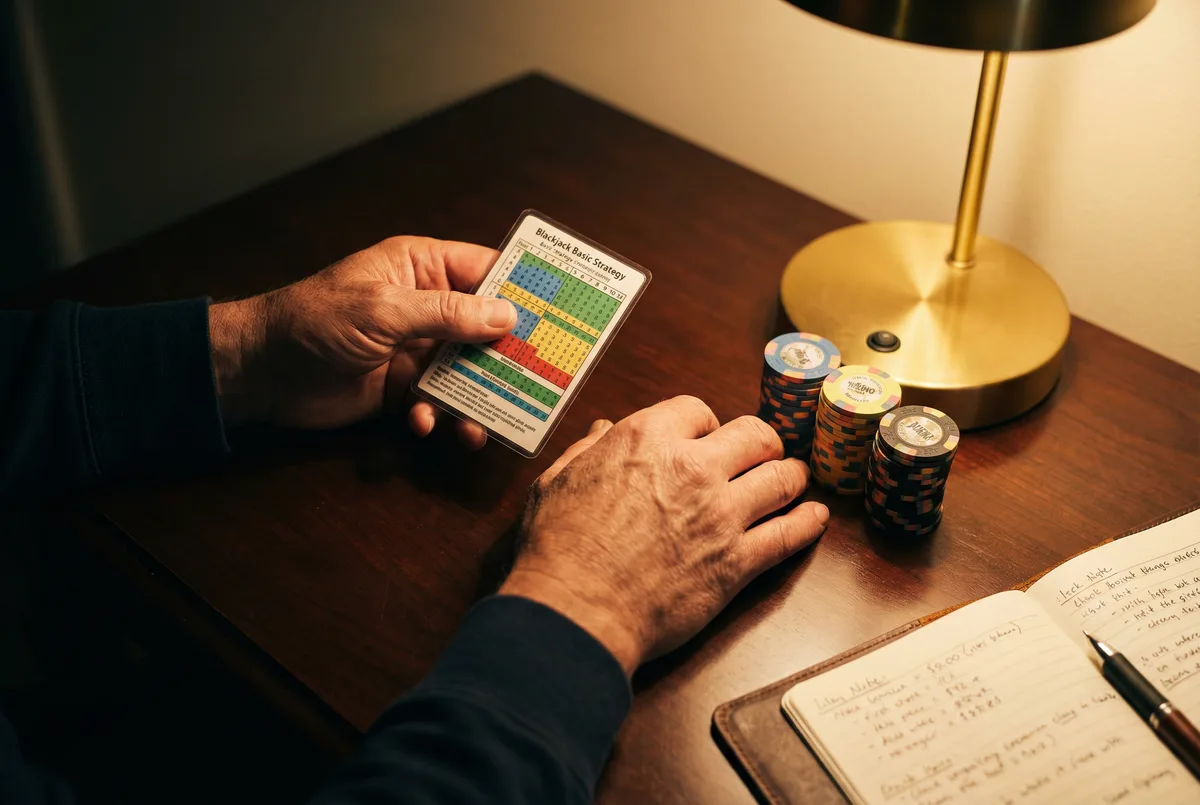
Complete Roadmap to Becoming a Professional Blackjack Player
Professional blackjack is the only casino game where a skilled player can hold a genuine mathematical edge over the house. That edge is small, typically between 0.5% and 1.5%, but it is real and it compounds across thousands of hands. Most players never reach it because they skip the stages that build it.

The four stages are not arbitrary. Each one represents a distinct skill threshold with a specific bankroll requirement and income potential. Skipping Stage 2 to reach Stage 3 faster does not accelerate the timeline. It produces a counter who makes expensive mistakes under pressure.
What It Actually Means to Play Blackjack Professionally
A professional blackjack player is someone whose expected value per hour of play is positive after accounting for all costs: travel, hotel, session variance, and risk of ruin. The word professional describes an EV calculation, not a lifestyle or a bankroll size.
At a 1% edge on a $25 average bet, playing 80 hands per hour, expected value is $20 per hour. That is not a high wage. It is a baseline. Building on it requires moving to higher stakes, finding better game conditions, or adding advanced techniques like team play.
Most people who call themselves professional blackjack players are card counters operating at the mid-stakes level with a bankroll between $20,000 and $100,000. A smaller subset uses team-based systems or hole-card play to push hourly EV into the $200 to $500 range.
Stage 1 timeline
hours to complete
Stage 2 timeline
months
Stage 3 bankroll
required
What Happens at Stage One?
Basic strategy is the mathematically optimal play for every hand combination in blackjack. It reduces the blackjack house edge to between 0.28% and 0.5% depending on blackjack table rules. No counting system works without it as a foundation.
The Stage 1 benchmark is simple: zero errors on a full blackjack strategy chart drill run at 200 hands per hour pace. This takes most people 100 to 200 hours of deliberate practice over 6 to 10 weeks. The practice environment matters as much as the time invested.
Drilling on a phone app in silence is not the same as drilling while someone is talking to you, a drink is near your right hand, and a dealer is waiting on your action. Build in distractions from week two onward. The casino floor is a distraction machine.
Bankroll requirement at Stage 1: none beyond table minimums. You should not be playing for income at this stage. You are building the substrate that everything else attaches to.
Common Myth
“You can learn basic strategy in an afternoon and start counting cards the next day.”
Strategy charts are simple to look at. The visual simplicity makes the skill seem proportionally shallow. Players underestimate the gap between knowing the chart and executing it flawlessly under casino conditions at speed.
The Reality
Flawless basic strategy under pressure requires 100 to 200 hours of deliberate practice. Speed matters as much as accuracy. A correct play made 3 seconds too slowly at a fast-dealing table is a practical error.
A single strategy error on a doubled hand costs roughly 4x the base bet in EV. Players making 3 errors per hour are surrendering the entire edge counting provides.
What Happens at Stage Two?
Card counting is the skill of tracking the ratio of high to low cards remaining in the shoe. When the remaining cards are rich in tens and aces, the player holds an edge and increases bets. The Hi-Lo count system assigns +1 to low cards (2 through 6), 0 to neutral cards, and -1 to high cards (10 through ace).
The Stage 2 benchmark is maintaining an accurate running count through a full 6-deck shoe while simultaneously playing blackjack basic strategy at full table speed. Most people reach this benchmark in 6 to 12 months of serious practice, logging 3 to 5 hours per week.
True count conversion is the most common sticking point. The running count must be divided by the number of decks remaining to produce the true count. This division happens continuously during play, not at a pause point. It requires enough mental automation that no visible calculation shows on your face or in your timing.
Bankroll requirement at Stage 2 entry: $3,000 to $5,000 for minimum bet tables. This covers roughly 100 to 150 betting units at a $25 minimum, which provides adequate protection against short-run variance. Playing underbanked at this stage produces ruin events that destroy confidence along with the roll.
Dealer Shows
Your Hand
The true count is +4. Basic strategy says hit hard 11 vs dealer 6. Should you double down instead?
Basic strategy doubling rules already apply here at neutral counts. At +4, the deck composition strongly favors the double. The dealer's 6 makes a bust likely. This is a high-confidence double.
What Happens at Stage Three?
Stage 3 is where the math starts producing meaningful income. The player now uses true count to make index plays (blackjack basic strategy deviations at specific counts) and spreads bets from 1 unit at negative counts to 8 to 12 units at high positive counts. This bet spread is what generates the edge.
At $25 minimum with a 1-to-12 spread and a 1% edge, expected hourly value is roughly $30 to $40 per hour. To reach $100 per hour requires moving to $100 minimum tables with the same spread. This requires a bankroll of $60,000 to $80,000 to sustain the variance safely.
The risk of ruin calculation is non-negotiable at this stage. Playing with 100 units of bankroll gives approximately 1% risk of ruin. Playing with 50 units pushes that to 10% to 15%. The bankroll is not a measure of how much you can afford to lose. It is a mathematical buffer against variance destroying your edge before it can compound.
Game selection becomes critical at Stage 3. A 6-deck S17 game with DAS and late surrender gives a skilled counter roughly 0.65% edge at a spread of 1-to-8. A 6-deck H17 game with no surrender at the same spread gives about 0.45%. Over 500 hours of annual play, that 0.2% difference is worth thousands of dollars.
Stage 2 Counter
Stage 3 Pro
- 1-4 units
- 0
- $8-12
- $3,000-5,000
- Any 6-deck
- 1-12 units
- 18 key deviations
- $30-40
- $20,000-40,000
- S17 + DAS + LS only
Deciding When Team Play and Advanced Techniques Are Worth Pursuing
Team play amplifies every advantage a skilled counter has while reducing individual heat from casino surveillance. The classic structure is a spotter counting at a minimum bet table and a big player entering only when the count is high. The big player never counts at the table and shows no visible pattern.
This matters because the biggest constraint on a solo counter’s income is not bankroll or skill. It is casino tolerance. A solo counter spreading $25 to $300 at a single-deck table will be backed off within hours. A team can cycle multiple big players through the same table without triggering the same surveillance thresholds.
Advanced solo techniques at Stage 4 include shuffle tracking (predicting card clumps through non-random shuffles), hole-card play (reading the dealer’s hole card on certain games with poor cut card technique), and ace sequencing. These techniques are rare, casino-specific, and require hundreds of hours of observation before they produce reliable edges.
The honest assessment of Stage 4 is that most serious counters never need it. A skilled Stage 3 player with good game selection and bankroll management can sustain a profitable career at $50 to $100 average hourly EV.
Stage 4 exists for those who want to push into the $200 to $500 range and are prepared for the additional complexity and casino scrutiny that requires.
If you want to put these principles to work in a real environment, try a live dealer game where the cards are real and the stakes are actual money from your first hand. Set a hard session budget before you sit, and treat it as a practice ground for the exact decision speed Stage 2 demands.
Frequently Asked Questions
Most players reach a genuinely profitable Stage 3 skill level in 2 to 4 years of serious practice. Stage 1 takes 3 to 6 months, Stage 2 another 6 to 12 months, and Stage 3 proficiency with real-money experience takes another 6 to 18 months. Rushing any stage produces expensive gaps.
At $25 minimum tables, a Stage 3 professional needs $20,000 to $40,000. At $100 minimum tables, $60,000 to $80,000 is required to keep risk of ruin below 1%. Bankroll is a mathematical buffer against variance, not a measure of how much you can afford to lose.
Card counting using only your mind is legal in every jurisdiction. Casinos are private property and can back you off or ban you, but using your brain to track cards breaks no law. Device-based counting aids, however, are illegal in Nevada and many other jurisdictions.
Before you test these plays at a real table, run them through our free blackjack simulator practice unlimited hands at zero cost until every move becomes automatic.
Mathematical Edge Requires Mathematical Discipline
Professional play only works with bankroll management as disciplined as your counting. Variance will test both before the edge pays off.
Blackjack Academy is an educational resource. Advantage play involves real financial risk. Never play with money you cannot afford to lose.

Written by
Mark AnurakProfessional card counter since 2009 · 500,000+ hands logged · Former Macau advantage player. Studied under Thorp, Griffin & Wong methodology. Full bio →
Learn More
Continue your education with these related lessons.

The 7 Blackjack House Rules That Secretly Change Your Expected Value
S17 vs H17, DAS, RSA, late surrender, number of decks each rule moves the house edge by a measurable number…

How the 1956 Baldwin Paper Created the First Winning Strategy
In 1956, four US Army mathematicians published a paper that changed blackjack forever. Roger Baldwin, Wilbert Cantey, Herbert Maisel, and…

How to Tell When a New Blackjack Shoe is Starting
A new shoe resets everything: the count, the penetration, and your decision-making baseline. Learn the visual signals that tell you…