
Why Casinos Use the Semicircular Table Design for Blackjack
- Why Blackjack Table a Semicircle Instead of a Rectangle Matters
- What Is the Purpose of Chip Tray Position?
- Why Betting Circles Printed on the Felt at Specific Positions Matter?
- How Does the Table Design Affect Your Experience as a Player?
- All Blackjack Tables Use the Same Design Across Different Casinos: The Evidence
Have you ever looked at a blackjack table and noticed that every element of its design appears in exactly the same position across every casino in the world? The arc shape, the chip tray, the betting circles, the cut card slot, the discard tray: none of it is decorative. Every element serves a specific function.
The semicircular blackjack table is one of the most refined pieces of gambling equipment in use. Its design solves three distinct problems simultaneously: dealer reach, player visibility, and surveillance coverage. Understanding why the table is built the way it is changes how you interact with it at every session.
Why Blackjack Table a Semicircle Instead of a Rectangle Matters
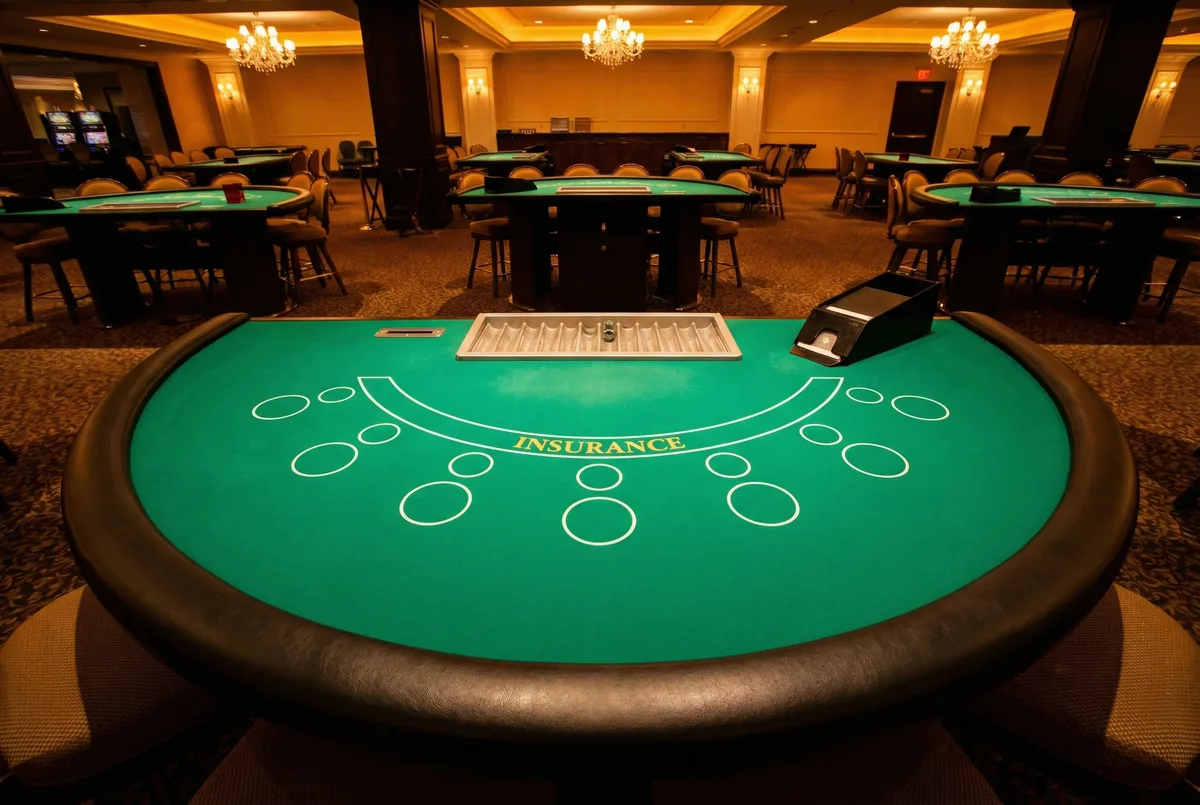
The semicircular shape solves a reach problem. A dealer standing at the flat edge can extend their arm to every seat along the arc without moving their feet.
On a rectangular table with the same number of seats, corner seats would require the dealer to lean or step sideways. The arc brings every player within the same comfortable reach.
The arc also maintains consistent card travel distance from the dealer to each seat. On a straight table, the center seats receive cards thrown a shorter distance than the end seats. On the arc, every seat sits at approximately the same distance from the dealing position. This consistency matters for both dealing speed and for the physical appearance of fairness.
Finally, the semicircle allows the dealer to face all players simultaneously without turning. The dealer sees every player’s hand, hand signals, and chip stack from a single standing position. Surveillance cameras mounted overhead have an unobstructed view of the entire playing surface and every player’s hands. The shape serves the camera as much as the dealer.
- Semicircular arcdealer reaches all seats without moving
- Chip traycentered at flat edge, visible to cameras and dealers
- Betting circlespre-marked positions confirm one bet per spot
- Discard trayright side of dealer, holds all played cards face-down
- Shoe/card trayleft side of dealer, feeds cards to the game
- Insurance linesecondary bet zone printed inside the arc
- Felt colorgreen or blue standard, chosen for card contrast
What Is the Purpose of Chip Tray Position?
The chip tray sits at the center of the flat edge, directly in front of the dealer. This position is not arbitrary. It places all chip movement at the most camera-visible point of the table. Every pay-out and collection happens directly above the tray, where overhead surveillance has the clearest unobstructed view.
The tray’s center position also minimizes the dealer’s movement during settlement. After resolving all hands, the dealer works from left (first base) to right (third base), paying winners and collecting losers. The chip tray sits midway along that path, reducing the number of steps and keeping chip handling fluid and time-efficient.
Chip tray design includes colored chip racks organized by denomination. Standard ordering runs from smallest to largest denomination left to right, allowing dealers to locate the correct chips by position without looking down. This procedural consistency speeds settlement and reduces denomination errors that would show up in table reconciliation.
Common Myth
“The blackjack table's design is primarily aesthetic”
Casino floors are designed for ambiance and the green felt and arc shape have become visual symbols of casino gambling that appear in media.
The Reality
Every element of the blackjack table design serves an operational or security function: dealer reach, camera coverage, chip access, and dealing flow.
Casinos would not maintain identical table designs across every property worldwide if the design were aesthetic. The semicircular table with centered chip tray is a solved engineering problem, not a style choice.
Why Betting Circles Printed on the Felt at Specific Positions Matter?
The pre-printed betting circles serve two functions. First, they establish the maximum number of active hands per round. A seven-circle table plays seven hands per deal. Players cannot place bets outside the marked areas without specific permission, which prevents crowding or confusion about whose bet belongs to which position.
Second, the circles define the camera capture zone. Overhead cameras are calibrated to capture every betting circle clearly. Any chip movement inside a betting circle is on camera. Chips placed outside the circles fall into undefined space, creating potential disputes about bet size and placement.
The insurance line printed inside the arc serves the same camera-zone function for the insurance bet. When a player wishes to take insurance, they place chips on the clearly marked insurance line rather than behind their main bet. The separation allows cameras and dealers to distinguish the two bets unambiguously.
How Does the Table Design Affect Your Experience as a Player?
For the player, understanding the table’s design removes any hesitation about where to place chips or how to signal decisions. The betting circle is your zone. Chips placed inside it are your bet. Hand signals made above the felt are on camera and cannot be disputed. The design protects you as much as it protects the house.
The discard tray on the dealer’s right side tells you how many cards have been dealt since the last shuffle. Experienced players watch the tray depth to estimate remaining deck penetration. A full tray in a 6-deck shoe means roughly half the cards have been dealt. A near-empty tray means a shuffle is imminent.
Sitting down at a live table and observing these elements in real time is more instructive than any diagram. The live games available at take a seat at the semicircular table with real money down use standard table setups. Actual money is required to play. Set a firm session budget before you open the first hand.
The semicircle keeps every player within arm's reach of the dealer without the dealer needing to stand up or lean. It also creates a natural sight line, the surveillance cameras above can capture every player's cards, chips, and hand signals in a single frame. The design is as much about security as it is about ergonomics.
All Blackjack Tables Use the Same Design Across Different Casinos: The Evidence
The core design is standardized globally. Semicircular arc, centered chip tray, pre-printed betting circles, dealer on the flat edge: these elements appear in every licensed casino from Las Vegas to Macau to Monte Carlo. The standardization allows trained dealers to work at any table in any casino without reorientation.
Felt colors vary by property and are often tied to branding. Green is traditional, blue and red are common alternatives. Higher-limit rooms sometimes use different felt designs or premium materials. The visual appearance varies; the functional layout does not.
Table size can vary slightly. A full seven-seat table measures approximately 7 to 8 feet across. Compact tables with five seats appear in smaller rooms. The proportions of the arc relative to the number of seats remain consistent regardless of the total table size.
Frequently Asked Questions
The traditional green felt color was chosen for card contrast: playing cards printed on white or cream stock are clearly visible against a green background. Blue became a common alternative for the same contrast reason. The specific color is a property preference, but high-contrast colors are maintained so that all card positions are clearly visible to dealers, players, and cameras.
No. Chips must be placed inside the designated betting circles for main bets and on the insurance line for insurance bets. Chips placed outside these marked areas are not recognized as official wagers. If you are unsure where to place a bet, ask the dealer before the round starts.
The cut card slot holds the plastic cut card when not in use. Before a new shoe, the dealer presents the cut card to a player to insert into the deck, determining where the reshuffling point will be. The slot keeps the cut card accessible without it interfering with the playing surface.
Before you test these plays at a real table, run them through our free blackjack simulator practice unlimited hands at zero cost until every move becomes automatic.
Know the Table Before You Sit at It
Understanding what every element of the blackjack table does removes hesitation and makes every decision faster and cleaner.
Blackjack Academy is an educational resource. All strategy content is based on mathematical expectation. Set a session budget before you play.

Written by
Mark AnurakProfessional card counter since 2009 · 500,000+ hands logged · Former Macau advantage player. Studied under Thorp, Griffin & Wong methodology. Full bio →
Learn More
Continue your education with these related lessons.
How to Tell When a New Blackjack Shoe is Starting
A new shoe resets everything: the count, the penetration, and your decision-making baseline. Learn the visual signals that tell you…
The 7 Blackjack House Rules That Secretly Change Your Expected Value
S17 vs H17, DAS, RSA, late surrender, number of decks each rule moves the house edge by a measurable number…

Complete Blackjack Payout Chart for 3 to 2 and Even Money
The payout rate on a natural blackjack is the single most important number on the table. A 3:2 table and…