

History of the First American Blackjack Rules from 1825
In 1825, an American publisher printed the first known English-language rulebook for twenty-one. The rules were simple: players aimed for 21 without going over, the dealer had complete discretion over their own play, and naturals were paid at whatever rate the house decided to offer that day. There was no strategy to learn because there was no algorithm to optimize against. The game was controlled by whoever held the bank, and the bank controlled every meaningful variable. What happened between that 1825 rulebook and the modern casino table is one of the most consequential rulebook evolutions in the history of commercial gambling.

The 1825 Rules and What They Contained
The 1825 rules codified a game that had already been played informally in American gambling houses for several decades, brought over by French colonists through New Orleans and spread westward by traveling card players. The text established the point objective of 21, described how cards were valued (face cards as 10, Ace as 1 or 11, pip cards at face value), and outlined the basic draw structure where the banker dealt until all players stood or busted.
What the 1825 rules did not contain is as revealing as what they did. There was no requirement for the dealer to hit on any total. No mandatory stand threshold. No standardized payout for a natural. The dealer could stand on any number they chose, including single-digit totals, and the payout for a 21 on the first two cards was negotiated at the table or determined by house policy that changed nightly. The game was commercially viable but mathematically opaque. Players could not calculate their expected return because the banker’s behavior was not fixed.
Evolution of American Blackjack Rules
1825
First American reference: The game of Twenty-One appears in American print records. Early rules mirror French Vingt-et-Un with a rotating banker and no fixed dealer rules, nothing like the dealer-stands-on-17 standard known today.
1850s-1870s
Gold Rush standardization: California mining camps and saloons develop consistent house rules. The casino acts as permanent banker. Bonus payouts for black Jack hands attract players and cement the Blackjack name.
1890s-1900s
House rule consolidation: Major gambling establishments standardize the dealer must-hit-to-16 rule to reduce table variance. Players have no basic strategy and decisions are intuitive.
1910
Nevada bans gambling: Blackjack goes underground across most of the US. The game continues in back rooms with varying rules and no oversight.
1931
Nevada legalizes casino gambling: Formal casino regulation standardizes the 3:2 payout and dealer-stands-on-17 across licensed Nevada properties, the rule set that defines modern blackjack.
1962
Basic strategy published: Ed Thorp's Beat the Dealer reveals the house edge is only 0.5% with optimal play, transforming how serious players approach every rule variation.
The 1825 rulebook was a starting point, not a finished product. American gambling operators spent the next century iterating on those rules, adjusting payouts, experimenting with dealer thresholds, and eventually discovering through commercial competition that certain rule combinations maximized player engagement while maintaining consistent house profits. The modern game is the result of 200 years of optimization by people trying to balance “attractive enough to play” with “profitable enough to operate.”
How the Gold Rush Created Commercial Pressure to Standardize Rules?
The California Gold Rush of 1848 to 1855 was a turning point for American gambling culture: hundreds of thousands of men with disposable income created one of the most lucrative gambling markets the country had ever seen, and twenty-one tables were standard equipment in every gambling tent. Hundreds of thousands of men in close proximity with disposable income and limited entertainment options created one of the most lucrative gambling markets the country had ever seen. Gambling houses proliferated in San Francisco, Sacramento, and the mining camps of the Sierra Nevada. Twenty-one was one of the most popular games because it required no equipment beyond cards and chips and could be run with minimal staff.
The density of competition created pressure to standardize. When a player could walk between three tables in the same saloon, operators discovered that confusing or inconsistent rules drove players to competitors. Houses that published clear, consistent dealer rules kept players longer. Houses with arbitrary dealer behavior lost customers. This commercial pressure, not regulatory mandate, drove the first informal standardization of American twenty-one rules. It happened through market competition, not legislation.
Every standardized rule in modern blackjack was created by commercial competition, not regulation. When the market rewarded consistency, operators provided it. The strategy chart is the player’s response to that consistency.
Historical Truth
By the 1860s, the Mississippi riverboat casinos had developed their own regional standards for dealer behavior. Some established the dealer must draw to at least 16 before standing. Others used 15 as the threshold. The variance between regions meant that players traveling between gambling markets encountered different versions of the game. Regional standardization existed, but a national standard would not emerge until gambling was legalized and regulated in Nevada in 1931.
How the Blackjack Bonus Renamed the Game and Shaped the Payout Structure?
The game was still called twenty-one in the early 1900s, and the name blackjack came from a promotional offer introduced around 1910 to 1920 that paid special odds on a natural composed of the Ace of Spades and a black Jack. The name blackjack came from a promotional offer introduced by several American gambling houses sometime around 1910 to 1920. The promotion paid special odds, some accounts say 10:1, others say 3:2, on a natural composed of the Ace of Spades and either the Jack of Clubs or the Jack of Spades. The black jack. The name stuck long after the specific promotional payout was discontinued, which is why we play blackjack today rather than twenty-one.
The promotion itself illustrates an important pattern: the natural payout as a player-attraction mechanism. Operators understood that a bonus for a specific hand combination would bring players to their tables and create excitement. The modern 3:2 payout for any natural 21 is a descendant of those early targeted bonuses. The casino’s insight was that a premium payout on an uncommon hand creates disproportionate excitement relative to its actual mathematical cost. Players remember the times they hit the bonus. They forget the 200 hands they played at the standard edge.
The 1825 American rules document is the first evidence that blackjack spread to the US before any formal casino industry existed. Early American games offered a bonus for a black ace and a jack of spades, which is likely where the name blackjack originates, though no single source confirms it definitively.
How Nevada Legalization Forced Fixed Dealer Rules Into Every Casino?
Nevada legalized casino gambling in 1931, and the legalization required casinos to publish their rules and odds so regulators could verify honest operation, turning informal regional dealer standards into legally binding game specifications. The legalization required casinos to publish their rules and odds so regulators could verify that operations were honest. This single requirement forced what commercial competition had partially produced: fixed, published, verifiable dealer rules. A casino that published “dealer stands on 17” had to apply that rule consistently or face regulatory consequences. Published rules turned informal regional standards into legally binding game specifications.
The hit-on-16 stand-on-17 rule became the American standard within a few years of Nevada legalization. It offered the right balance: the dealer busted often enough to generate player excitement and keep the game competitive, but stood often enough to maintain a calculable blackjack house edge that regulators could verify. By 1934, most major Las Vegas properties were using the same dealer rule that you see on every table today.
The 1956 publication of a mathematically correct blackjack basic strategy by Baldwin, Cantey, Maisel, and McDermott was the player’s response to fixed dealer rules. Once the dealer rule was fixed and verifiable, the expected return of every player action could be calculated with precision. The blackjack strategy chart was the result. The first version was hand-calculated on mechanical computers. It took four US Army mathematicians working on the problem in their spare time. The casino had spent 130 years refining a fixed rule set. The players responded with a tool to optimize against it.
What the History Teaches About Today’s Game
The trajectory from the 1825 rulebook to the modern table is a story about information asymmetry being gradually reduced. The 1825 game had complete dealer discretion, the player had almost no information about what the dealer would do. The 1931 Nevada standard gave players a fixed algorithm to analyze. The 1956 blackjack strategy chart gave players the optimal response to that algorithm. The introduction of blackjack card counting in 1962 gave skilled players a tool to gain a positive edge. Every step reduced the informational advantage that the house had maintained since the original 1825 rulebook.
Modern casinos responded to each reduction in their informational advantage with rule changes: 6:5 payouts, continuous shuffling machines, multiple decks, reduced penetration, flat bet maximums. The game is still in motion. The rules you see on the felt today are the latest iteration of a 200-year negotiation between commercial operators who want consistent profit and players who want the best possible mathematical return. The history does not change how you should play any individual hand. But it explains exactly why every rule exists and what it is trying to do to your expected return.
Understanding where the rules came from makes you a better reader of the table. When you sit down at a 6:5 payout game and recognize it as a modern equivalent of the 1825 arbitrary banker payout, you know exactly what to do: get up and find a better table. At a live table, notice the rules on the felt and recognize which decade produced them, the 3:2 payout from 1910, the stand-on-17 from 1934, the blackjack strategy chart from 1956. Each one has a history. Each one has a number. Every hand involves real money, so make sure the rules at your table represent 200 years of progress and not a step backward.
Frequently Asked Questions
The first known English-language American rulebook for twenty-one was published in 1825. Those early rules did not include fixed dealer draw thresholds or standardized payouts. Fixed dealer rules emerged gradually through commercial competition and were formalized after Nevada legalized casino gambling in 1931.
The name blackjack comes from a promotional bonus offered by American gambling houses around 1910 to 1920. The bonus paid special odds on a natural composed of the Ace of Spades and a black Jack. The name became universal even after the specific promotional payout was discontinued.
The hit-on-16 stand-on-17 rule became the American casino standard in the early 1930s following Nevada's legalization of gambling in 1931. Legalization required casinos to publish their rules for regulatory verification, which turned informal standards into binding game specifications.
Before you test these plays at a real table, run them through our free blackjack simulator practice unlimited hands at zero cost until every move becomes automatic.
Play With Full Knowledge of the Rules
The calculator shows your expected value under any historical or modern rule set combination.
Blackjack Academy is an educational resource. All strategy is based on mathematical expectation. Always play within your means.

Written by
Mark AnurakProfessional card counter since 2009 · 500,000+ hands logged · Former Macau advantage player. Studied under Thorp, Griffin & Wong methodology. Full bio →
Learn More
Continue your education with these related lessons.
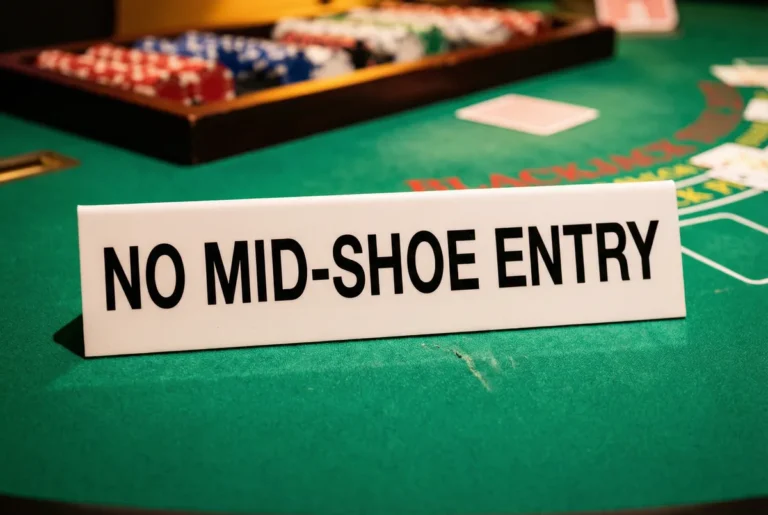
Why Some Casinos Have a No Mid Shoe Entry Rule
No mid-shoe entry rules seem random until you understand exactly what casinos are protecting against. Here is the full story.

Complete Blackjack Payout Chart for 3 to 2 and Even Money
The payout rate on a natural blackjack is the single most important number on the table. A 3:2 table and…
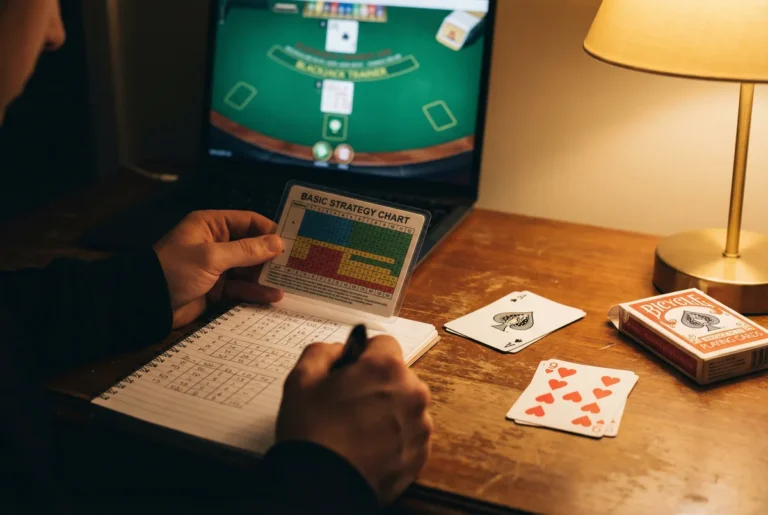
How to Build a Blackjack Practice Routine Using Free Online Tools
Build a structured blackjack practice routine using free online tools. Covers weekly study plans, focus areas by phase, progress tracking,…