
Why Automated Shuffling Machines Secretly Destroy Your Card Counting Edge
The first time I sat down at a blackjack table with a continuous shuffling machine and didn’t realize what it was, I lost 20 minutes trying to track a count that was being reset after every single hand. The machine fed discards back into the shoe immediately, which meant there was no shoe state to track, every hand was effectively a fresh deck. I got up and found a manually dealt shoe three tables away. The machines are not subtle once you know what to look for, but most players never ask. They sit, they play, and they give up an edge they did not know they had.

Two Types of Shuffling Technology
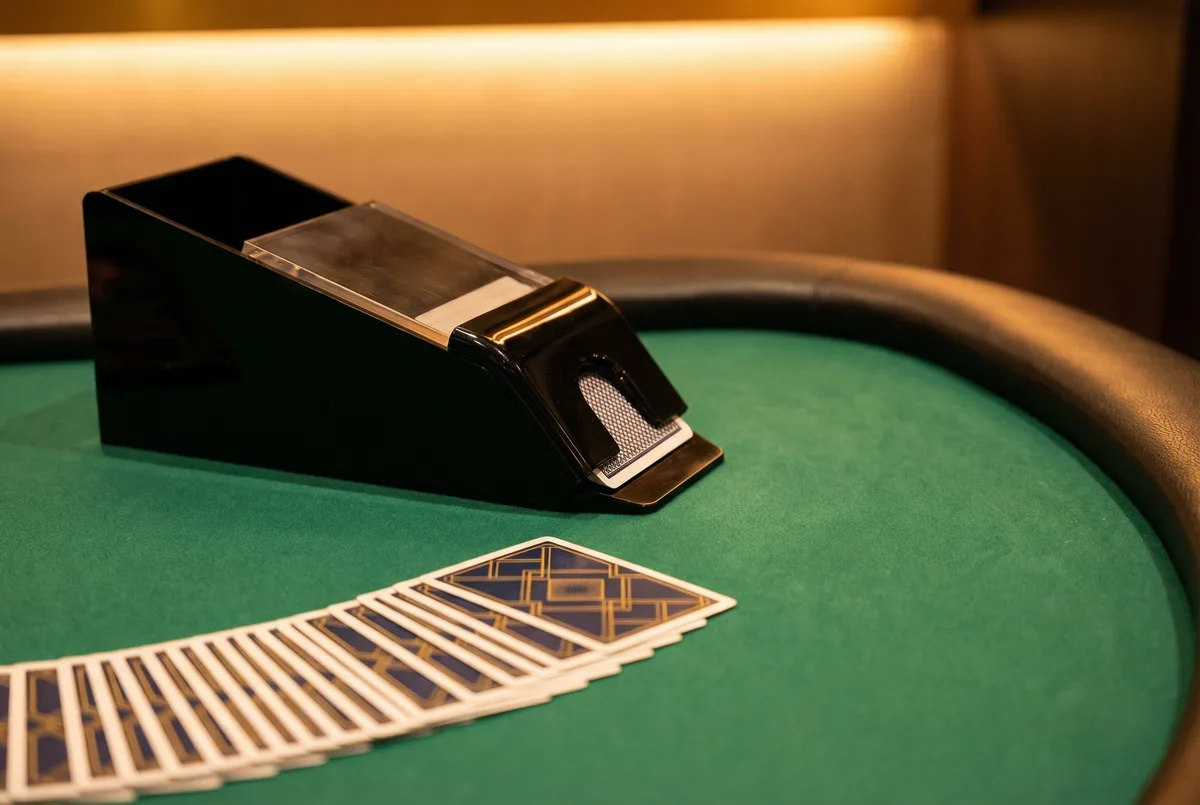
Casinos use two fundamentally different shuffling approaches. The first is a batch shuffler, also called a pre-shuffler or automatic shuffler. This machine shuffles the cards between shoes, the dealer loads the used cards in, the machine shuffles them, and the next shoe is then dealt from the shuffled pack. This is functionally equivalent to a manual shuffle. The shoe still has a defined start and end point, and a skilled counter can still track the count through the shoe.
The second type is the continuous shuffling machine, or CSM. A CSM is positioned at the table and cards are fed back into it after every hand or every few hands. The machine randomly inserts the returned cards somewhere in the remaining stack. The result is a shoe with no meaningful depth, the composition never becomes rich in high cards or low cards because cards are constantly being reintroduced in random positions. Every hand you play is drawn from a shoe whose composition approximates an infinite fresh deck.
Shuffling Technology in Casinos
1960s
Hand-shuffling standard: Every casino dealt from hand-shuffled decks. Dealers took 1-2 minutes per shuffle, creating natural breaks and the deck penetration card counters depended on.
1982
First batch shufflers in Atlantic City: Automatic batch shufflers pre-shuffle decks between shoes. Penetration still adequate for counting at most tables.
1993
CSM patent granted: Shuffle Master patents the continuous shuffling machine. It returns discards directly to the shoe, permanently eliminating deck penetration for card counting.
2001
CSM adoption accelerates: Casinos observe reduced card-counting activity at CSM tables and begin installing them on low-limit floors across Las Vegas and Atlantic City.
2020s
Shoe games reserved for serious players: High-limit rooms maintain hand-dealt shoe games. Low-stakes floors are dominated by CSMs that make counting impossible.
The distinction between these two types is not visible from the outside. Both look like machines sitting next to the dealer. The tell is behavior: ask the dealer if discards go back into the machine during the shoe or only between shoes. If during the shoe, it is a CSM. If between shoes, it is a batch shuffler. Most dealers will answer honestly if you ask directly. Some casinos display the machine type on the table placard.
How a CSM Affects Your Card Counting Edge?
Card counting requires shoe penetration, the percentage of cards dealt before reshuffling, and a CSM eliminates this entirely by continuously reinserting discards into a random position in the live shoe. In a standard 6-deck game dealt to 75% penetration, you observe 234 cards before the cut card appears. A skilled counter can develop a significant advantage in the final 25% of the shoe when the count is highly positive. The CSM makes this impossible by resetting the shoe composition after every hand.
With a CSM, the true count is always approximately zero because the deck never becomes disproportionately rich in any card value. A counter sitting at a CSM table is tracking a running count that has no practical value, the next hand is always drawn from a near-infinite, near-fresh deck. The expected value of every hand at a CSM table is identical to the expected value of the first hand of a fresh shoe. There is no opportunity for a positive expected value to develop, and no reason to vary your bet based on the count.
CSM Hands Per Hour
Faster dealing without reshuffle breaks
CSM Counting Edge
No shoe penetration, no count value
Batch Shuffler Counting Value
Treated same as manual shuffle
The speed effect is equally important. A CSM eliminates the reshuffle break between shoes, which accounts for roughly 3 to 5 minutes per shoe in a manually dealt 6-deck game. A CSM table deals approximately 15% to 20% more hands per hour than an equivalent shoe game. At a $25 table with a 0.5% blackjack house edge, 20% more hands per hour means 20% more expected losses per hour. For recreational players who are not counting, the CSM simply generates more hands and therefore more exposure to the blackjack house edge over the same clock time.
How Does Hand-Dealt Games Differ from CSM Tables in Penetration and Rules?
Manual shuffles and batch shufflers produce shoes with defined penetration, meaning the dealer deals to a specific depth before reshuffling and a counter accumulates real information as cards are revealed. After the cut card is inserted, typically 1 to 1.5 decks from the back in a 6-deck shoe, the shoe runs to the cut card and is then reshuffled. The deeper the penetration, the longer the shoe runs and the more information a counter accumulates before the reshuffle. High-value information comes late in a shoe when the count has had time to diverge meaningfully from zero.
Hand-dealt games at single and double-deck tables are the most penetration-favorable environments because the dealer holds and shuffles a small number of cards with visible depth. An experienced counter watching a single-deck game with 65% penetration is seeing 33 to 34 cards before the shuffle. The remaining 18 to 19 cards represent the high-information end of the deck where variance is highest and count accuracy matters most.
Beyond counting, hand-dealt games also tend to use better rules at the player-favorable end of the spectrum. Single-deck games in downtown Las Vegas that maintain 3:2 payouts and S17 represent some of the lowest blackjack house edges available to non-counting players. Casinos that deal by hand tend to be either protecting a premium player experience (high-limit rooms) or operating in competitive markets where rule quality is a differentiator. CSM tables cluster at low-limit floors where speed and volume are prioritized over rule quality.
How to Identify Whether a Table Uses a CSM or a Standard Shoe?
The visual identification is straightforward: a batch shuffler is only used between shoes, while a CSM receives discards continuously during play, you can observe this directly or simply ask the dealer. A batch shuffler sits beside the dealer but is only used between shoes, you will see the dealer collect all the cards, load them into the machine, wait briefly, then load the shuffled pack back into the shoe. The gap between shoes is shorter than a manual shuffle but still present. A CSM sits at the dealer’s immediate left and cards are fed directly into its input slot during play, you will see the dealer or a separate dealer helper feed used hands into the machine continuously.
The most reliable method is to ask the dealer: “Is this a continuous shuffler?” Dealers are not prohibited from answering. Many players never ask, which is why casinos do not advertise the distinction. Table signage occasionally identifies the machine type, but most signs describe payout and rule information only. If you are unsure, observe for two or three shoes, if the game never pauses for a reshuffle and discards disappear into the machine mid-shoe, you are at a CSM.
Continuous Shuffler (CSM)
Shoe / Hand-Dealt
- Card counting viability:Impossible constant reshuffle:Viable at 75%+ penetration
- Hands per hour:15-20% more hands dealt:Standard 60-80 hands/hour
Which Table to Choose and Why
The answer depends on why you are playing. If you count cards or intend to learn, a CSM table is worthless as a practice environment. Every hand you play is stripped of the shoe-state information that makes counting profitable. Sit at any shoe game with at least 70% penetration and a batch or manual shuffle.
If you play blackjack basic strategy without counting, the CSM is a technical disadvantage in terms of total hands dealt per session, but the rule quality of the table matters more than the shuffling method. A CSM table with 3:2 payouts, S17, and DAS has a lower effective blackjack house edge than a manually shuffled table with 6:5 payouts or H17. Evaluate the rules first. If two tables have equivalent rules, choose the shoe game for the lower hands-per-hour exposure.
Serious players generally avoid CSMs entirely. The speed, the lack of counting opportunity, and the tendency of CSM tables to carry inferior rules all push the edge toward the casino. At a live table, confirm the shuffle method before buying in, one question to the dealer is all it takes. Once you know whether you are sitting at a CSM or a shoe game, you can evaluate the rules accurately. Bring only what you planned for the session, and walk when you hit that number regardless of shoe conditions.
Frequently Asked Questions
A continuous shuffling machine feeds discarded cards back into the shoe during the shoe, not just between shoes. This creates a constantly reshuffled deck with no meaningful penetration, making card counting impossible and increasing the number of hands dealt per hour by approximately 15-20%.
For card counters, hand-dealt or batch-shuffled shoes are strictly better because they allow penetration and meaningful count development. For basic strategy players, the rule quality matters more than the shuffle method, but shoe games typically offer better rules and fewer hands per hour, which reduces total expected losses.
Watch whether cards are fed back into the machine during the shoe or only between shoes. If the machine receives discards continuously during play and there is no reshuffle break, it is a CSM. You can also simply ask the dealer if the table uses a continuous shuffler, they are permitted to answer.
Before you test these plays at a real table, run them through our free blackjack simulator practice unlimited hands at zero cost until every move becomes automatic.
Know What Kind of Game You Are Sitting Down To
The calculator models expected value for shoe games, CSM approximations, and any rule combination.
Blackjack Academy is an educational resource. All strategy is based on mathematical expectation. Always play within your means.

Written by
Mark AnurakProfessional card counter since 2009 · 500,000+ hands logged · Former Macau advantage player. Studied under Thorp, Griffin & Wong methodology. Full bio →
Learn More
Continue your education with these related lessons.
How Casino Shuffles Work and Their Effect on Blackjack Play
Hand shuffles, shuffle machines, cut card placement, and penetration every shuffle decision a casino makes has a direct effect on…
What Really Happens When You Bust in Blackjack and How to Avoid It
Busting in blackjack means going over 21 and the fact that the dealer acts last is the entire source of…
Why Free Blackjack Games Online Are the Best Strategy Training
Free blackjack games online remove the financial pressure that blocks learning. Discover what they teach, what they cannot, and the…